Advancing healthier ageing with new Future Health Technologies programme
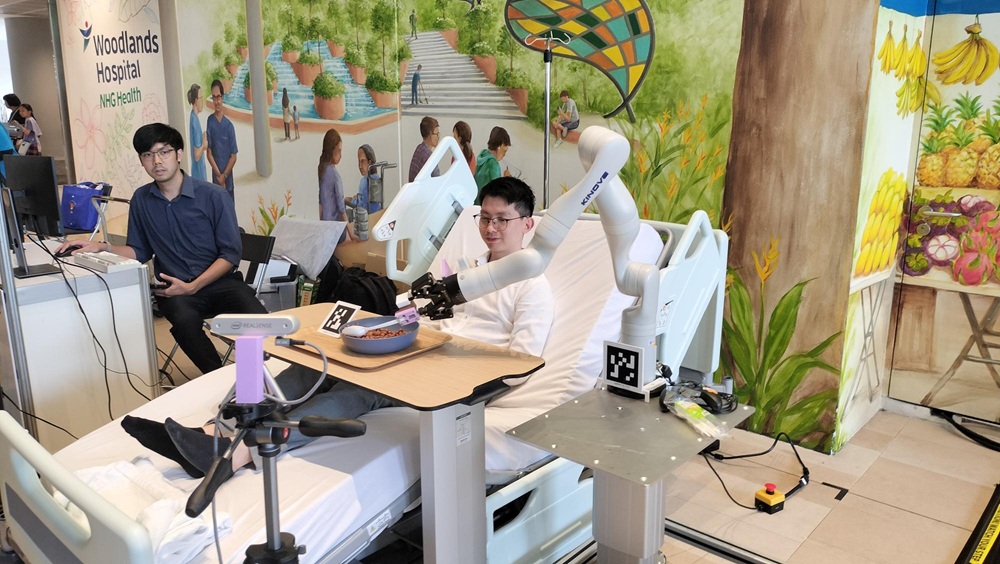
Photo: A prototype of NTU's MakanBot, an assistive robot designed to allow people with limited hand mobility to feed themselves using only head movements or voice commands, at the NHG Health Musculoskeletal Day 2026.
NTU Singapore is helping to drive the next phase of innovation in healthy ageing through the launch of the Future Health Technologies (FHT2) programme.
Led by the Singapore-ETH Centre, in collaboration with the National Research Foundation (NRF), NHG Health and NTU, the FHT2 programme brings together global research and clinical expertise to translate AI and robotics into real-world healthcare solutions.
Backed by a S$37.9 million investment, FHT2 focuses on helping people stay mobile, mentally well and independent for longer - addressing the gap between Singapore’s lifespan and health span.
From research to real-world impact
FHT2 marks a shift towards clinical translation, moving innovations from lab to practice by 2030. It targets three key areas:
- Musculoskeletal health and mobility: AI-powered digital twins, wearable sensors and fall prevention programmes to reduce fractures and disability
- Mental well-being and cognitive health: Precision digital therapeutics using AI and behavioural science for personalised care
- Rehabilitation and recovery: Home-based rehabilitation using soft robotics and AI to improve access and continuity of care
Prof Christian Wolfrum, Deputy President and Provost, NTU Singapore, said, “NTU is uniquely positioned, with research strengths at the intersection of technology, medicine and real-world application. Through FHT2, we are advancing AI and robotics innovations that will not only extend how long people live, but also transform how well they live, supporting healthier and more independent ageing in Singapore and beyond.”
Building on strong foundations
FHT2 builds on strong foundations from its first phase, which delivered innovations such as fall-risk sensors, digital twin fracture models, cognitive assessment tools and robotic rehabilitation systems.
Through close collaboration with international and healthcare partners, NTU is helping to accelerate the deployment of these technologies across hospitals, communities and homes, supporting Singapore’s shift towards preventive, personalised care.
The programme was launched at the Scientific Congress on 28 March, held as part of the NHG Health Musculoskeletal Day 2026, officiated by Mr John Lim, Chief Executive Officer, NRF and Chief, Public Sector Science & Technology Policy and Plans Office.
Separately, the NTU Rehabilitation Research Institute of Singapore organised the Pre-Congress Symposium of Musculoskeletal Day 2026 on 26 March 2026 at the Heritage Centre, Headquarters Building, LKCMedicine. The symposium brought together over 100 participants and featured three thematic sessions covering biological mechanisms, biomechanics (structure and function), and clinical and population health - highlighting the translation of musculoskeletal science into real-world care.