
How we built Singapore's flying machine
For years, Dr Shawn Lim worked in secret on a cutting-edge aircraft as an NTU PhD student. He shares the highs and lows of building the future of urban mobility
by Kenny Chee / Photos and video by Hillary Tan
When I started working on Singapore’s first locally designed and built full-sized electric aircraft in 2020, it felt like something from the Mission: Impossible movies.
The odds were stacked against us. Singapore had never designed or built an electric vertical take-off and landing (eVTOL) aircraft of this scale before. We weren’t sure if we had the right ideas or talent. We didn’t even have our own laboratory.
But we had a dream and a whole lot of determination. Knowing I had the rare opportunity to help develop a new type of aircraft in Singapore motivated me to stay on.
Designing an eVTOL aircraft required a complete rethink.
 Photo: Shawn Lim
Unlike conventional airplanes and helicopters, it uses electricity, not fuel, to power its motors and rotors. Navigating this challenge wasn’t easy. But it was fascinating as it gave us more room to innovate.
It was common for me to pull 60-hour work weeks and miss out on my social life, especially before flight demonstrations. Friends and family kept asking what I was working on. But strict non-disclosure agreements meant I couldn’t tell them. My answers ranged from “just schoolwork” to the suspiciously boring “research stuff”.
Occasionally, I’d say: “Maybe a flying car… but I can’t say more.” Anything else and I could’ve been served a lawyer’s letter.
 The project was the brainchild of my NTU professor, Prof James Wang, a global pioneer in electric vertical flight, who often reminded us to dream big and act on our dreams.
Getting regulatory approval for the eVTOL aircraft’s flight test was also tough, as there was no precedent in Singapore. We worked closely with regulators to develop a flight test plan, submitting technical documents hundreds of pages long.
There were other times when the project felt overwhelming, with failures at critical stages and crashes during development. In hindsight, these challenges were part of the learning process. For instance, securing flight test approval from the authorities helped us understand how engineering, safety and regulation must work together in aircraft development.
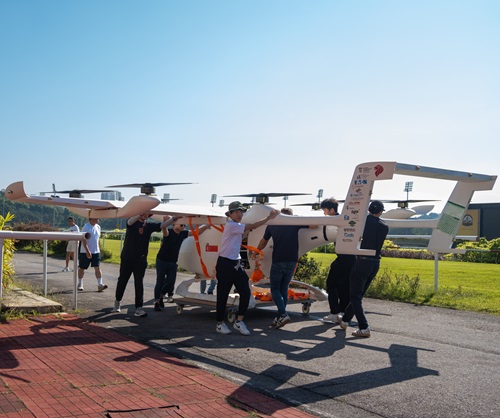
What kept our team moving forward was our resolve. We believed we could overcome the difficulties and make the aircraft work. If it can be dreamt, it can be built. The motto of our project leader, Prof James Wang, guided us through tough times.
The moment it all clicked for me was when the aircraft executed a technically difficult transition manoeuvre: switching from hovering like a drone to flying forward like an aeroplane. Years of modelling, design and dedicated teamwork had finally come together in that successful test.

Photo: Shawn Lim
Prof Wang (left) inspired us to build what others only imagine. After graduating last year, I decided to continue that journey as a Research Fellow at NTU’s School of Mechanical & Aerospace Engineering.
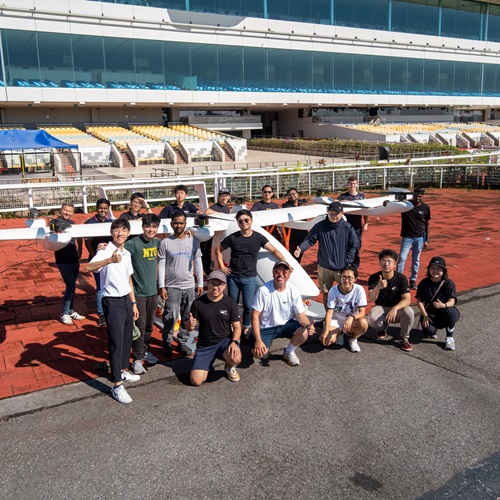
Testing the aircraft at the former Singapore Turf Club in 2025. Early in the project, several final-year project students from NTU’s School of Mechanical & Aerospace Engineering helped us out each year. They have since graduated but a few stayed on with the team.
Mission possible for NTU It’s not a bird, and it’s not a plane. Built by NTU engineers and researchers, this eVTOL aircraft prototype offers a new way to move goods or people quickly and efficiently through congested cities. With an 8m wingspan and eight lift rotors, it can hover like a helicopter, fly forward like an aeroplane and land vertically in small spaces. See how NTU's eVTOL aircraft could give future air travel a lift |
This story was published in the Mar-Apr 2026 issue of HEY!. To read it and other stories from this issue in print, click here.




/singlit-thumbnail.tmb-listing.jpg?sfvrsn=b9e3d209_1)