
He knows 20 languages and wants to save others from disappearing
One curious click on a YouTube video opened up a world of languages for Nigel Koh. At NTU, he found a purpose for his passion: helping to keep endangered tongues alive.
by Tan Zi Jie / Photos by Nigel Koh
Some students prep for overseas exchange by packing warm clothes. Nigel Koh is teaching himself three languages.
There is Finnish for daily life at his exchange university in Finland next year. And Estonian, which he picked up a few years ago and which nudged him towards studying in the Nordics.
Then there’s Northern Sámi, an endangered language with an estimated 20,000 speakers near the Arctic Circle, where he hopes to catch the Northern Lights and try dog-sledding.
“If I’m visiting the region, it’s only respectful to learn their local language,” says the NTU linguistics and multilingual studies student.
“And it’s just fun to challenge myself.”
Learning three languages at once may sound like plenty. But for this polyglot, it’s the latest chapter in a decade-long fascination.

Down the YouTube rabbit hole
When pressed for a number, Nigel says he knows about 20 languages.
He considers himself fluent in five languages, saying he can speak and write English, Mandarin, Spanish, Portuguese and Esperanto well. Esperanto was created to help people from different language backgrounds communicate.
When he was 14, he stumbled across a YouTube video explaining the grammar of a foreign language. “It really blew my mind. I didn’t know that languages could work in such different ways,” he recalls.
For example, Turkish speakers use different word endings when describing a past event, depending on whether they witnessed it or heard about it from someone else.
“It felt like I’d discovered this whole new world of complexity.”
Over the next decade, he followed his curiosity from one language to another, learning through Duolingo and library books. Flashcards help him pick up new vocabulary, and reading material such as Japanese manga keeps things lively.
Music often points him towards a new language. The global hit Despacito inspired him to learn Spanish while other songs sparked his interest in Finnish, Romanian and Dutch.
Nigel does not expect to master every language he explores. “Fluency is a spectrum,” he says. “I try to reach a level where I can understand 90 per cent of a song’s lyrics or a news article.”

Nigel’s notes in Finnish on Northern Sámi, an endangered language native to Norway, Sweden and Finland. With few English resources available, he is teaching himself using a Finnish textbook.
Into a wonderland of words
Nigel chose to pursue linguistics and multilingual studies at NTU for its focus on multilingual societies, including Singapore and countries across Southeast Asia.
In university, he picked up Russian and German. Campus life gives him plenty of people to practise Spanish, Italian, Finnish and even Romanian with.
“Sometimes I get my Romance languages mixed up. Once, I was speaking to an Italian student and accidentally used some Spanish words. But he happened to be learning Spanish as well, so we just laughed about it.”
But more than adding languages to his list, NTU’s programme opened his eyes to the less widely-spoken languages that may soon disappear – and led him to his calling.
"Every language carries unique stories, history and knowledge of the culture it comes from. To lose all that to language extinction would be such a shame for humanity."
– Nigel
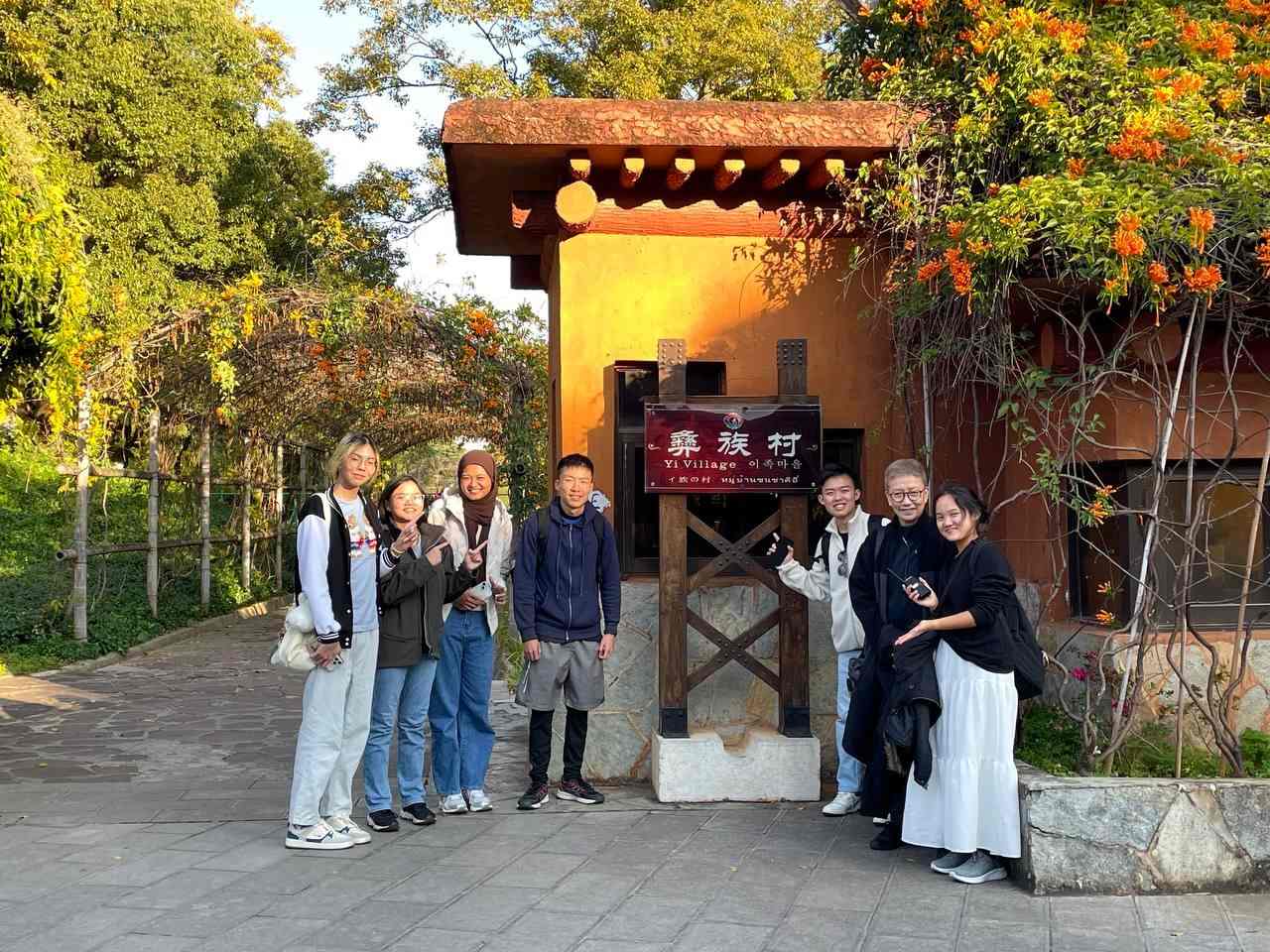
On a field trip to Kunming, Nigel suggested his group learn about the endangered language of the minority Yi tribe, as part of their sustainability course in the NTU-University Scholars Programme. Find out how their visit inspired another student to view her heritage differently.
Investigating languages before they’re lost
Of the estimated 7,000 languages spoken around the world, about 40 per cent may disappear over the next few generations.
“Every language carries unique stories, history and knowledge of the culture it comes from,” Nigel says. “To lose all that to language extinction would be such a shame for humanity.”
“That’s why I really admire my NTU professors who travel to remote corners of the world to collect data on endangered languages.”
One of his heroes is veteran linguist Geoffrey Benjamin, who has documented the languages and cultures of indigenous Orang Asli tribes in Malaysia since the 1960s. The retired NTU associate professor still lectures part-time and teaches Nigel about Malay and Southeast Asian linguistics and cultures.
Nigel is getting a taste of field linguistics through his Undergraduate Research Experience on CAmpus (URECA) project. He acts like a grammar detective to uncover the rules of Helong, a language spoken by around 14,000 people in West Timor, Indonesia.
“Helong has this cool grammar feature where a word’s sounds and letters can switch places. For example, ‘blaho’, meaning ‘mouse’, can become ‘blaoh’. I am figuring out when and how this happens by analysing data gathered from native speakers by Asst Prof Tamisha Tan,” Nigel explains.
He hopes to follow in his NTU professors’ footsteps and become a field linguist, working alongside communities to create lasting records of their languages, and the customs and traditions woven into them.
“Language diversity is like biodiversity,” he says. “Imagine if 99 per cent of the trees, plants and wildlife died out. Wouldn’t the world become less colourful?”

Speaking a language can be the trickiest part of learning one. Last June, Nigel put his Japanese to the test during a month of classes and daily conversations with his host family in Japan.
This story is part of the Sep-Oct 2026 issue of HEY!. Read other stories from the issue here.