When curiosity won’t cost you your GPA
With the Flexible Grading Option (FGO) expanded to core and ICC courses, NTU students tell HEY! student writer Gwenneth Teo what they’re eager to explore – and why less-than-stellar grades need not define their learning journey.
by Gwenneth Teo
The Flexible Grading Option, or FGO in short, lets NTU undergrads convert eligible course grades to Pass or No Record after viewing their results. These grades do not count towards their cumulative GPA. Expanded in June 2026, FGO now covers more academic units and courses, including certain major core and Interdisciplinary Collaborative Core (ICC) courses. This gives students more freedom to follow their curiosity and step beyond their comfort zones. |
Now that FGO gives students more freedom to dive into unfamiliar or challenging topics, four NTU undergrads talk about the classes they’re raring to take on and the lessons they’ve learnt from tough ones they plan to use FGO for.

Learning to code to get a better handle on AI
“Take a coding class without any experience? You can count me in. I’ve been taking humanities-focused courses so far, and I’m now thinking of doing ‘Programming in Python’, which is a core course.
This would be a major step outside what I’m used to, but understanding programming will help me make informed decisions about the use of technology and artificial intelligence (AI). I can help shape policy and regulations related to AI.
I love picking up new skills and knowledge for fun. You never know what doors might open. Before FGO was expanded, I wouldn’t have considered taking this course, even though it interested me. I’d have worried about falling behind my classmates and bringing down my GPA.
Ultimately, I dream of becoming a modern-day Renaissance man: a well-rounded person with skills across different fields. Programming, to me, is what physics was to Leonardo Da Vinci.”
Xie Long Quan Year 3, Communication Studies
Psyched to learn more despite a bad grade
“I plan to use FGO for ‘Psychosocial Aspects of Sport and Exercise’, a core module I took in Year 1. Although I got a low grade, it sparked such a strong interest in psychology that I later took an advanced course in the subject.
The class was my first introduction to psychology and included my very first quiz at NTU. After a gap year, I was still getting used to studying again. Preparing for the heavily weighted quiz was nerve-racking, and my poor score pulled down my final grade.
Despite my grade, I realised that I was genuinely fascinated by how psychology affects people in sport. I enjoyed researching for our group projects, and the lively class discussions made me want to learn more.
Before taking the course, I thought athletes were ready to compete once they had recovered physically from an injury. I learnt that the fear of re-injury can affect their confidence and performance even after they are medically cleared.
As an aspiring sports physiotherapist, I hope to help athletes rebuild their confidence alongside their physical strength. Their mental wellbeing matters as much as their physical recovery.
I’m grateful I can use FGO for this course. My grade doesn’t reflect how much I learnt!”
Nadra Nadzi Year 3, Sports Science & Management

Complex politics? Challenge accepted
“I intend to enrol in ‘Politics and Government in Southeast Asia’ and may use FGO for it.
It seems like a more complex version of 'Politics of Singapore', a challenging class I took in my first year. This time, I’ll study several Southeast Asian countries, each with its own political system, history and governance structure.
I’ll need to understand each country and compare patterns across the region, which adds another layer of difficulty.
As a double major in Environmental Earth Systems Science and Public Policy & Global Affairs, I’m particularly interested in environmental politics. I want to understand how governments operating in different political contexts prioritise and implement sustainability policies.
The course feels intimidating, but I believe it will sharpen my critical thinking and help me analyse how political differences shape real-world policy decisions.
That would be valuable for my career, as I’m keen on roles in policy or governance, especially in environmental policy.”
Ahmad Muhajir Year 3, Environmental Earth Systems Science and Public Policy & Global Affairs
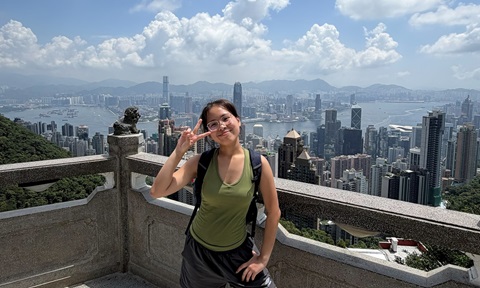
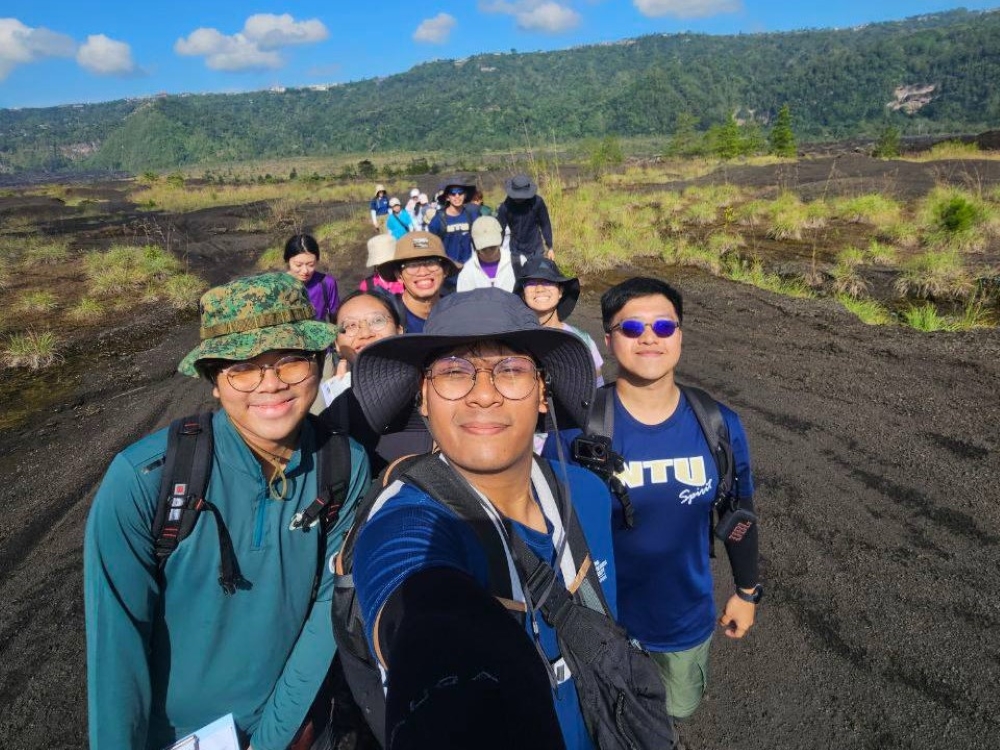 During a school trip to Bali, I explored the topic of land use change by asking farmers how they felt about their farmland being used to build tourism facilities. I learnt why it’s important to consult the people affected before deciding on environmental policies.
Tough course pointed her in a new direction
“I may use FGO for ‘Structure of Modern English’, a core linguistics course I completed in Year 2.
Even though I took notes during every lecture, the content became increasingly hard to follow.
Seniors had warned me that the course could be demanding if I did not grasp its abstract concepts from the start. We had to analyse complex sentence structures through an almost mathematical lens, using ‘formulas’ involving different types of clauses.
Seeing my poor grades for the quizzes and assignment was distressing, though I managed to pass the course.
Looking back, the experience helped me understand my strengths and weaknesses in linguistics. Sentence structure may not be my forte, but I discovered an interest in multilingualism. That guided my choice of linguistics courses in the semesters that followed.
Since then, I’ve taken a class related to multilingualism in Singapore that I really connected with. It showed me how I could help preserve our country’s endangered languages. I’ve also explored how learning environments can be designed for children with special needs.
That one difficult course did not define my learning experience. Instead, it led me towards areas I care about and, I hope, a career where I can make a difference.”
Felise Lee Year 4, Psychology and Linguistics & Multilingual Studies

HEY! STUDENT WRITER
With FGO, communication studies student Gwenneth is getting creative in batik classes and crafting stories for a Chinese multimedia writing course. She’s navigating unfamiliar territory, but hey, it’s all part of the process!
This story is part of the Sep-Oct 2026 issue of HEY!. Read other stories from the issue here.