The fresh grad making paper batteries for global giants
The brainchild of an NTU mechanical engineering graduate, Flint makes rechargeable batteries from cellulose – the stuff in paper – and other materials that break down in soil after use
by Tan Zi Jie / Photos: Flint
Carlo Charles’s green venture, Flint, is powering up fast.
The deep-tech battery startup has raised over US$4 million in funding from international investors so far. Not bad for a fresh NTU graduate.
This year, Flint began producing its first batteries for Logitech and Amazon devices. An AirTag product featuring its paper-thin battery is also set to be in Apple stores in a few months.
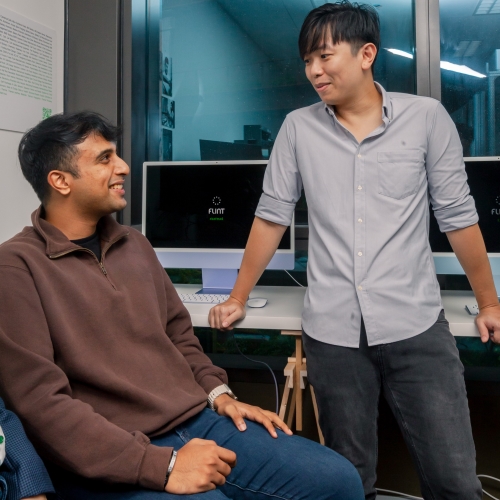
Flint’s co-founders are NTU graduates Carlo (Class of 2025) and Jeremy Wee (Class of 2014).
“As we move towards a renewable future, it’s ironic that our batteries – in our phones, laptops, watches and more – still rely on mined metals like lithium, nickel and cobalt,” Carlo says. The extraction of these metals strips land and damages ecosystems.
That’s what Flint is trying to change. Its batteries use more easily sourced materials like cellulose, zinc and manganese – with the first units coming out of its lab in CleanTech Park, the innovation district just a stone’s throw from NTU.
“We want to show the world that even a small country like Singapore can do this,” adds Carlo, who made the Forbes 30 Under 30 Asia list last year. Flint is building a larger manufacturing plant in Europe too, with more brand tie-ups in the works.
The NTU spark that set it off
For all its momentum now, Flint’s first spark came from a specific NTU discovery.
Growing up in a climate-vulnerable part of the Philippines, Carlo wanted to tackle climate change through technology. At 13, the serial tinkerer built an air purifier from recycled materials.
By 2021, he was an NTU mechanical engineering freshman who had started Flint for a different battery idea.
Then he came across an NTU paper on biodegradable zinc batteries printed on cellulose paper coated with hydrogel.
“It was so unique,” he recalls. “I wondered: ‘How can I turn this into something real?’”
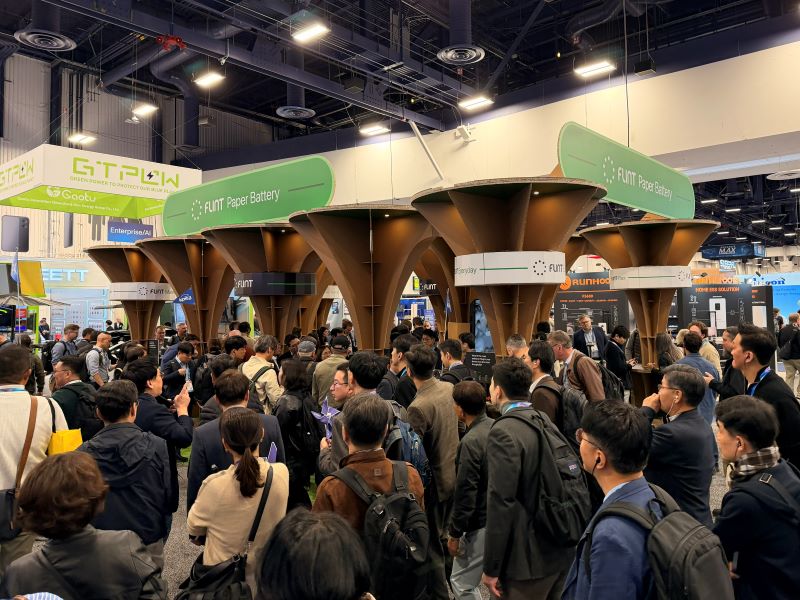
Flint’s paper batteries won awards at the last two editions of the Consumer Electronics Show, a major annual tech showcase in the US.
"We want to show the world that even a small country like Singapore can do this."
– Carlo
From spark to surge
Fired up after learning more from the study’s co-lead author, Prof Fan Hongjin, Carlo began testing new ways to build greener batteries.
Much of that work happened late at night in NTU’s makerspaces. “I could design something, go to the lab, 3D print it, build my prototype and test it quickly,” he says.
“That freedom of creativity and expression helped me come up with many new ideas.”
NTU courses also sharpened his entrepreneurial instincts. In a venture capital class, he learnt firsthand from founders invited by his lecturer.
While juggling his studies, Carlo kept building Flint, winning international competitions and growing his team.
But the ride came with trade-offs. “Sometimes I felt bad about missing out on university life, like time with friends, hall life and student club activities,” he says.
In those moments, his NTU mentors, Prof Ooi Kim Tiow and Assoc Prof David Fan, kept him grounded. “They helped me see the bigger picture – to be grateful for my experiences and not compare myself with others.”
Now, the fresh graduate is paying it forward, bringing former NTU classmates and interns into Flint’s 12-strong team.
For anyone hesitating over an idea, he says: “Take action. Don’t get stuck just thinking. Sometimes, the smallest start can make the biggest difference.”
Read more stories of students innovating for a better world here.
This story was published in the Mar-Apr 2026 issue of HEY!. To read it and other stories from this issue in print, click here.