Tech x Life
How NTU researchers are harnessing science and technology to unlock new possibilities and transform everyday life
by Lester Kok / Illustrations by Vivian Lim
Sunscreen that’s kind to corals
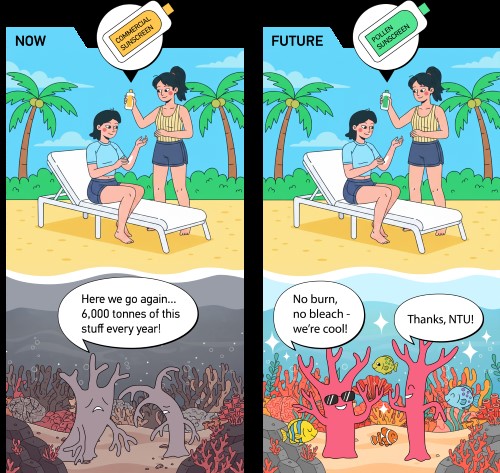
Good news for beach lovers – and coral reefs. NTU scientists have created the world’s first pollen-based sunscreen that protects skin without harming marine life.
Made from the pollen of camellia flowers, this eco-friendly formula provides the same UV protection as commercial sunscreens, but without the harmful chemicals and minerals that damage marine life.
In lab tests, the pollen gel effectively blocked UV rays while keeping corals safe. In contrast, regular sunscreens caused coral bleaching within just two days.
It’s cool, too. Under simulated sunlight, the new sunscreen lowered skin surface temperature by up to 5°C, making it the perfect companion for sunny days and ocean getaways. Now that’s real flower power.
The robot that’s got your back

Meet DR BA, a robot chaperone that’s got your back – literally. Designed to support seniors and patients in rehabilitation, this friendly robot can help users walk, stand and even dance without fear of falling.
Developed by NTU scientists in partnership with Tan Tock Seng Hospital, the Data-driven Robotic Balance Assistant (DR BA) is now being trialled in a few active ageing centres in Singapore.
At these centres in Tampines, the robot joins seniors in Zumba and group exercise classes as their trusty workout buddy.
Using smart sensors and motion data, DR BA detects even the slightest loss of balance and immediately springs into action, “catching” the senior it is attached to with a safety harness to prevent injuries. It’s like having a personal physiotherapist on alert.
Meal time gets productive

NTU scientists have reimagined fish farming with a spawning method that’s less stressful and more successful. By coating fish feed with hormone-filled microcapsules, they’ve turned mealtime into breeding time.
Trials on Asian seabass showed fertilisation success of over 80%, outperforming traditional hormone injections while producing healthier baby fish. The method also doubled the number of viable eggs, showing that a gentler approach can be far more productive.
Traditional methods also require trained personnel to inject each “mother fish” individually, a labour-intensive process that stresses the fish.
This is the world’s first documented success of oral hormone-induced spawning, a big step towards a more sustainable seafood future.
This story was published in the Jan-Feb 2026 issue of HEY!. To read it and other stories from this issue in print, click here.