AI built on campus
NTU students aren’t just learning AI, they are directing it to fix what frustrates them and others. The result? A glimpse of the future
by Derek Rodriguez
What if your CV could prove itself?
 Visual: Freepik + Skillmetrics
"I was inspired by my parents, who are in their mid-50s."
– Runlin
Imagine a world where you don’t have to dress up your resume. Instead, your university connects employers directly to graduating students, recommending them based on their aptitudes, interests and skills.
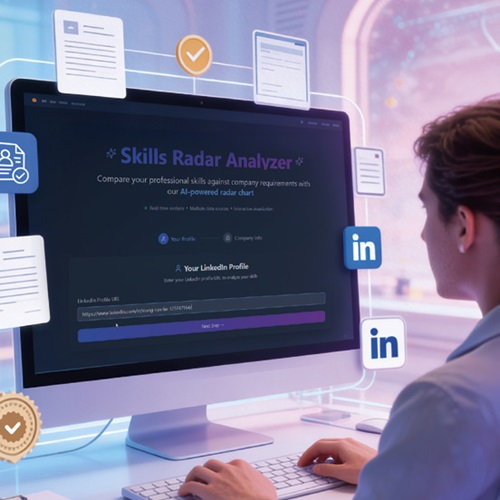
This automated hiring pipeline is what Skillmetrics is working towards. And behind this potentially game-changing platform is second-year computer engineering student Xiong Runlin.
One hurdle in modern hiring is verifying claims on resumes or on LinkedIn. Recruiters often have no reliable way to validate these, leading to multi-round interview processes.
Skillmetrics aims to change that by validating a student’s achievements through their transcripts, internship records and co-curricular activities. This not only builds trust but shortens the hiring cycle too.
At the same time, the platform analyses both technical skills and extracurricular growth, helping users benchmark themselves against industry standards. And by studying interview processes from its corporate partners, it also prepares students for the latest interview techniques.
Interestingly, the idea didn’t start with students.
“I was inspired by my parents, who are in their mid-50s. They felt they didn’t have a way to pivot away from their labour-intensive jobs,” says Runlin. “I later realised that students face a similar crisis, such as those in computing, like me. The outlook for new graduates is increasingly challenging.”
Runlin ran the idea past friends and mentors from the NTU Entrepreneurship Academy, where he is pursuing a minor in entrepreneurship. With their support, he secured two grants – one from the Academy and another from the College of Computing & Data Science.
“NTU’s entrepreneurship classes also allowed me to meet mentors and like-minded individuals. Having this community has catalysed the growth of Skillmetrics,” he says.
Now in its final stage of development, the platform is preparing for a pilot launch in June, just in time for the hiring season.
Smart microscopes without the price tag
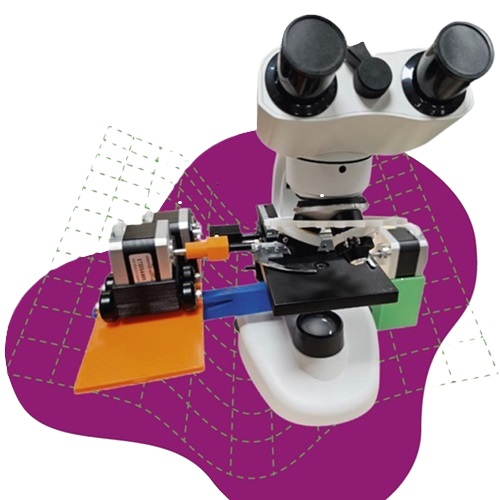 The Autoscope team is souping up traditional microscopes with upgrades, including a camera, mini computer and software kit, enabling the system to automatically focus on high cell density areas to capture and identify cells.
"We didn't expect to be running a business, so it's thrilling for all of us."
– Xiao Yang
Ever tried taking photos of cells through the eyepiece of a microscope using your phone?
If you’ve worked in a lab, you might relate to the frustration biological sciences students Chong Zi Hui and Oh Jun Rong felt during a lab session.
They brought the problem to a Making and Tinkering class, where they linked up with fellow CN Yang scholars Ray Wang, Tan Xiao Yang and Teo Zheng Da. Together, they designed and constructed an attachment that made capturing images far easier. But they didn’t just stop there.
The project evolved into Autoscope, an upgrade kit, complete with software, that converts a traditional microscope into an automated system. With features like autofocus, and AI-powered cell counting and identification, it offers capabilities typically found only in automated microscopes that cost thousands of dollars – often out of reach for smaller labs.
Autoscope changes that as a low-cost solution accessible to schools and biotech startups.
“It’s been exciting to continue our project beyond the course, with the potential for real-world adoption,” says Jun Rong.
For these accidental entrepreneurs, navigating the business aspects has been a learning curve, especially coming from backgrounds in aerospace engineering, computer engineering, chemistry and biological sciences. Finding funding and opportunities to showcase their work hasn’t been easy either.
But with support from professors and guidance from NTU’s entrepreneurship academy, they’ve taken steps towards commercialisation, including filing a patent for their mechanical design, applying for grants, and taking part in business pitches
“We didn’t expect to be running a business, so it’s thrilling for all of us,” says Xiao Yang.
“We look forward to being on Shark Tank,” adds Zi Hui with a laugh.
The missing clue to understanding notes
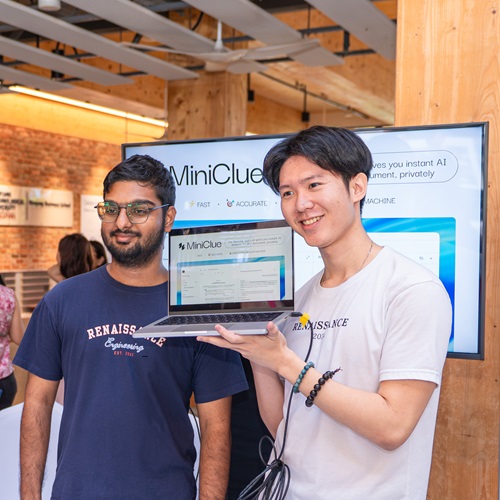
"Every time I got stuck, the process of getting help was so disruptive."
– Sheng Rui (right), on how the idea for MiniClue grew out of his own study habits
Do you switch between lecture slides and ChatGPT to understand concepts? MiniClue might be for you.
Invented by Renaissance Engineering Programme students Leom Sheng Rui and Bharagth Ravindhran, MiniClue is a desktop app that lets users read and chat with their documents side by side, without leaving the page.
The idea grew out of Sheng Rui’s own study habits. A visual and kinesthetic learner, he would go through lecture slides at his own pace and wrestle with the content, turning to ChatGPT when he hit a roadblock.
“Every time I got stuck, the process of getting help was so disruptive. Screenshot, switch app, paste, type, read, switch back, find your place again. It sounds minor, but it breaks concentration and makes studying feel more exhausting than it needs to be,” says Sheng Rui.
MiniClue went through several iterations. The first version autogenerated explanations for each slide, but they fell short. This led to a second version that let students chat with their lecture slides and ask specific queries.
The next leap came from a conversation Sheng Rui had with a lawyer friend.
“I showed her MiniClue and she said: ‘This is exactly what I need, but I can’t use this. My files are confidential’,” says Sheng Rui.
That’s when it clicked. The problem extended beyond students to lawyers, doctors, researchers and other professionals. But using tools like ChatGPT often means risking sensitive data. The current version of MiniClue allows users to learn with AI while keeping their data secure.
year-end.
Its long-term goal is to become the default tool for anyone whose work involves reading and understanding documents.
Where AI systems learn to play

"The idea came from seeing a common problem across AI, robotics and visual computing: good data is hard to get."
– Howell (right)
AI learns by “watching the world” – millions of images and videos scraped from the internet. But this comes with a catch: the data is often messy, inconsistent and expensive to clean, and it doesn’t always teach machines how the real world works, like how objects relate to one another.
This is where Graphyti comes in.
Programme, Graphyti lets users create 3D environments that they can fully control. These are custom worlds where you decide everything – layout, objects, labels, camera angles, even lighting – and export clean, ready-to-use training data straight from them.
This gives AI systems cleaner, more useful data – faster and without the hefty price tag.
Howell.
The duo sees Graphyti supporting a wide range of industries, including robotics, healthcare, entertainment and marketing in the future. For now, they’re focused on building environments for robotics, AI research and other fields that rely on high-quality spatial data.
Adds Eunice: “Creating this at NTU has given us credibility when speaking to researchers, partners and stakeholders, and has helped us grow Graphyti from an experimental idea into something with real commercial potential.”
The beauty of AI
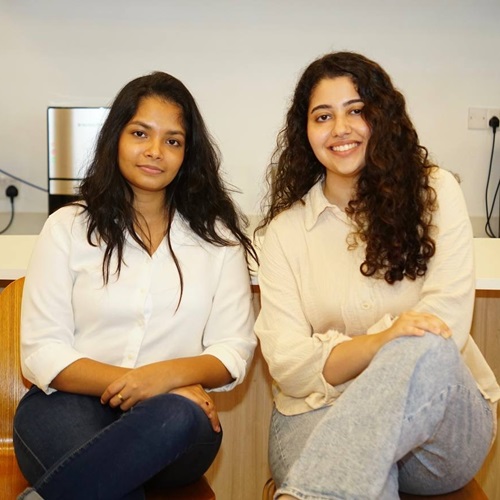
"It taught us that AI should be a servant, not the boss."
– Alisha (left)
Many startups start with a problem. Idle started with the wrong one.
NTU students Alisha Wadkar (left) and Kritika Seth (right) first set out to fix a shared frustration – booking nail and haircut services on campus. Their idea was a “Grab for grooming”, connecting users to stylists who make house calls.
Then they went out and spoke to more than 500 shop owners and realised they had missed the point.
The real problem wasn’t bookings. It was everything else.
Most neighbourhood salons and barbershops were running on a messy mix of WhatsApp, paper notebooks and mental math. So the pair pivoted to an AI-powered platform that handles the backend to let business owners focus on their craft.
“Idle is basically the plumbing that fixes all the admin issues,” says Alisha, a final-year electrical and electronic engineering student.
Kritika, an NTU mathematical sciences graduate, now runs Idle full-time as CEO. Alisha, the CTO, is finishing her degree while building the startup, even if it means extending her time at NTU.
The University has also shaped their journey. Through her minor in entrepreneurship, Alisha picked up “the essentials like basic accounting, what kind of company to incorporate, and the importance of things like patenting”. NTU’s entrepreneurship workshops also helped her refine Idle’s concept in its early days.
Along the way, the team’s understanding of AI evolved. In one early version, the system flagged a staff member for declining revenue. But a closer look revealed a different story.
“The staff member was spending extra time supporting a client going through a rough time. That was a massive wake-up call. It taught us that AI should be a servant, not a boss,” says Alisha.
Today, Idle surfaces insights, not decisions, leaving owners in control.
Since launching in late 2024, Idle has gained backing from Microsoft, NVIDIA and BLOCK71, accelerating its technical development. Now, the focus is on making it work seamlessly.
“I want Idle to be the default infrastructure for the service industry,” says Alisha. “So shop owners can finally get their evenings back while our engine handles the chaos in the background.”
This story was published in the Mar-Apr 2026 issue of HEY!. To read it and other stories from this issue in print, click here.