Helping stroke survivors feel more like themselves
Started by an NTU medical student who spotted a care gap, SemperStroke is a virtual reality (VR) app with simple games that help stroke patients rebuild physical and cognitive abilities
by Tan Zi Jie / Photo by Hillary Tan
During his clinical attachment at a hospital in 2023, a stroke patient said something that stuck with James Wang, then a third-year NTU medical student.
“He had been a banker and was moving well again after rehabilitation. But he could no longer interpret financial reports or make rapid decisions with the same ease and confidence as before,” recalls James.
Most people think stroke rehab is about getting patients back on their feet. But cognitive recovery matters too. Stroke survivors face about an 80% higher risk of cognitive decline, including dementia. One in four recovered patients under 50 also do not return to work.
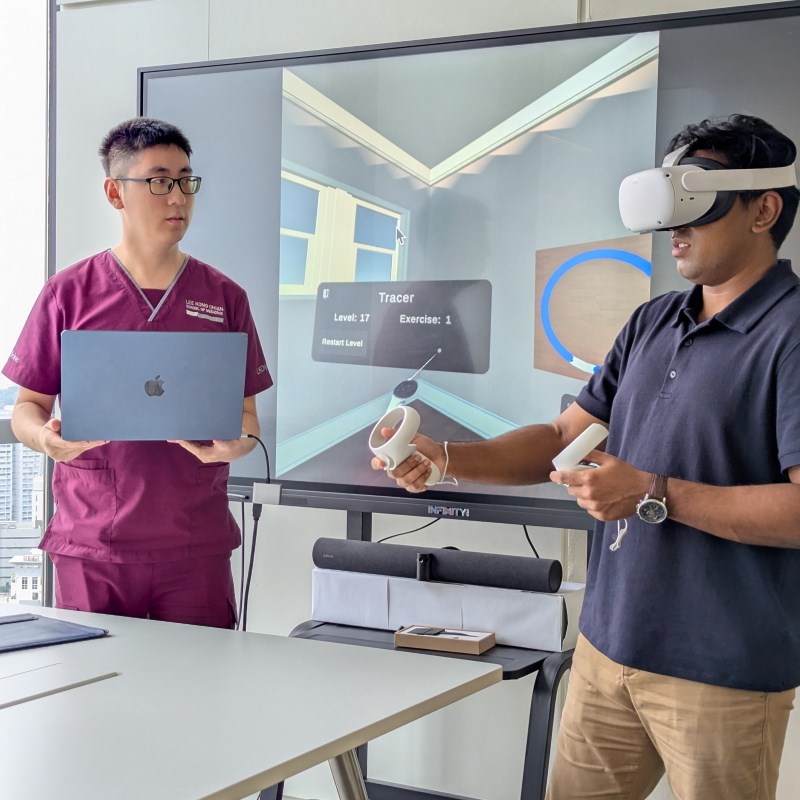
NTU medical student James and psychology graduate Ganeash have created a VR stroke rehab tool, which includes a shape-tracing game (shown on screen) that helps stroke survivors train their motor movements and rebuild hand-eye coordination.
“When you spot a gap like this, you can either dwell on it or try to find a solution,” says James, who is now in his final year at NTU’s Lee Kong Chian School of Medicine (LKCMedicine).
Encouraged by his supervisors, James joined a medical innovation competition, where he met co-founder Ganeash Selvarajan, then a psychology undergraduate at the National University of Singapore.
Together with other students, they developed SemperStroke – a low-cost, game-like VR tool that helps stroke patients train their physical and cognitive skills at home through simple exercises such as block building and item recognition.
The idea is to make rehab easier to keep up with, cut down on hospital visits that often depend on caregivers, and lighten the load on healthcare workers too. The concept won the team a $10,000 grant to build their first prototype.
Turning ambition into action
To move SemperStroke forward with a clearer roadmap, James and Ganeash joined NTU’s social innovation and entrepreneurship programme in 2024.
“NTU’s social entrepreneurship workshops taught us to define our scope clearly, set realistic timelines, and be strategic in our use of funds,” Ganeash says.
“Advice from innovators and experts also helped sharpen SemperStroke’s focus. We narrowed our target audience to stroke patients under 50, who may be more open to VR therapy, and shortened the exercises to no more than 15 minutes to reduce discomfort.”
With another $10,000 in NTU grants, the team bought VR headsets and tapped NTU computing expert Prof Guan Cuntai’s network to hire programmers to improve the software.
To ground the tool in patients’ practical needs, they also sought advice from stroke rehabilitation expert Assoc Prof Loh Yong Joo, an adjunct lecturer at LKCMedicine.
The duo also delved into neurology and cognitive science research. James has co-authored over 35 papers, including one accepted by a top journal, Brain, while Ganeash has co-published three journal articles.
Balancing SemperStroke with medical school is not easy, but James says it’s worth it. “The biggest sacrifice is time with family and friends, but I’m driven by my passion to make a difference in patients’ lives.”
He adds that they have built a strong rhythm, taking turns to shoulder more when the other is stretched.
"We started this as students, and we still have a lot to learn. We're thankful to NTU's entrepreneurship experts and clinicians who took us seriously and guided us in bringing this idea to life."
– James
The long road to real impact
After three years of development, SemperStroke has received good feedback from its first few users.
The next step is a clinical validation study and trial with stroke survivors at a local hospital, being set up with support from LKCMedicine.
They hope the trial will show whether using the tool every day can improve patients’ cognitive abilities, such as attention and memory, and quality of life – and help them get back what many take for granted, from clearer thinking to working full-time.
The project is now at a crossroads. James will soon graduate from medical school and begin his housemanship in May, while Ganeash will start his PhD in cognitive psychology this August.
Clinical trials can take years. Even so, they remain committed to SemperStroke.
“We started this as students, and we still have a lot to learn,” says James. “We’re thankful to NTU’s entrepreneurship experts and clinicians who took us seriously and guided us in bringing this idea to life.”
Ganeash, whose loved ones have suffered strokes, adds: “If we can help young stroke survivors feel independent and confident enough to provide for themselves again, that would bring us so much joy.”
Read more stories of students innovating for a better world here.
This story was published in the Mar-Apr 2026 issue of HEY!. To read it and other stories from this issue in print, click here.