NTU and Max Planck Society deepen research collaboration, expand pathways for education
 NTU Singapore and German research organisation Max Planck Society (MPG) are deepening their partnership by strengthening scientific collaboration and exploring new pathways for research and education.
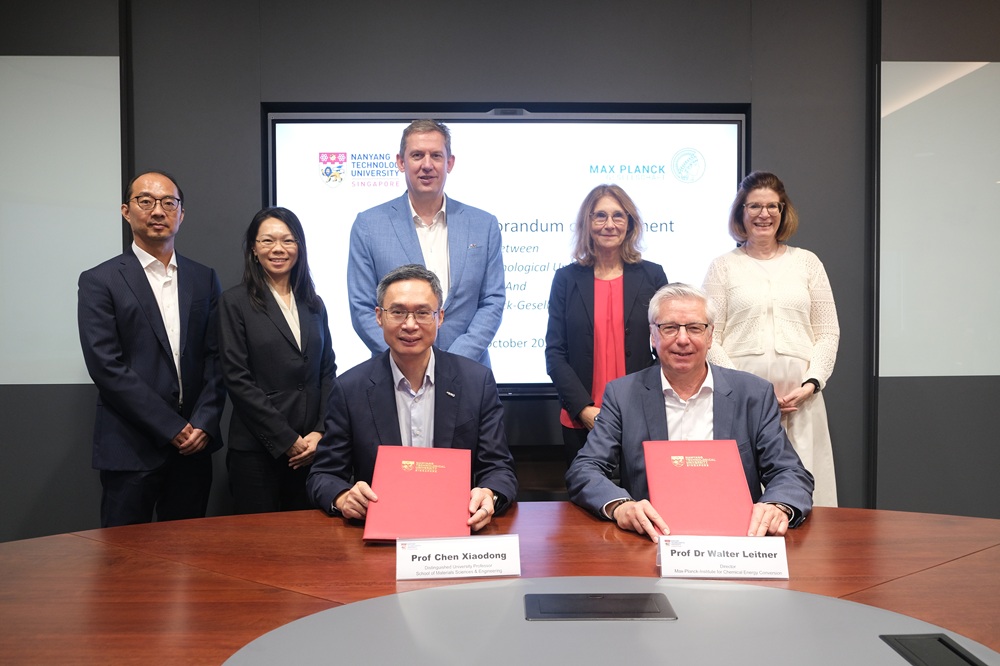
NTU and MPG signed a Memorandum of Agreement to establish a joint PhD supervision programme between NTU and the Max Planck Institute for Chemical Energy Conversion. PhD candidates under this programme will work with supervisors from both NTU and Max Planck Institute for Chemical Energy Conversion in the fields of sustainable energy and materials science.
Both institutions will also promote collaboration in the natural sciences and interdisciplinary frontier research involving the Max Planck Schools and other programmes across the MPG. This partnership will provide undergraduate and postgraduate students to gain research experience at NTU and Max Planck Institutes in Germany, as well as participate in research training and academic programmes. A key focus will be on structured doctoral training and opportunities for PhD candidates and Fellows.
The partnerships were formalised at a ceremony on 8 Oct on the NTU Singapore campus, attended by NTU Deputy President and Provost Professor Christian Wolfrum and MPG Secretary General Dr Simone Schwanitz.
NTU and MPG to provide joint PhD Supervision
The joint PhD supervision programme is overseen by NTU’s Graduate College, NTU’s School of Materials Science and Engineering, and the Max Planck Institute for Chemical Energy Conversion.
It will support NTU PhD students conducting research in areas including sustainable energy, advanced functional materials, electrochemistry and catalysis, energy storage and conversion, clean energy materials, and green chemical processes.
The programme will place strong emphasis on interdisciplinary research that integrates materials science, chemistry and energy technologies.
Creating pathways for research talent
The Max Planck Schools are a joint graduate programme of German universities and research organisations. They bring together leading researchers across institutions to provide promising doctoral candidates with structured training, international research experience and access to research networks.
At the undergraduate level, NTU and MPG plan to explore a pathway to identify NTU students with strong research potential who are keen on a postgraduate research and further studies. This includes a competitive nomination process, short-term research internships at Max Planck Institutes and early exposure to structured PhD environments, including the Max Planck Schools.
At the Master’s level, potential areas of cooperation include research-oriented Master’s theses co-supervised by NTU and MPG scientists, research rotations at both institutions, and joint summer schools and advanced methodological courses.
For doctoral training, the partnership provides a framework to explore joint training and supervision arrangements. These might include dual mentorship, joint thesis advisory committees, mobility periods at both institutions, and participation in joint summer schools, symposia and conferences.
The joint training aims to cover advanced research methodologies, research integrity, innovation and entrepreneurship, leadership development and interdisciplinary research.