S$25 million Healthy Longevity Institute and global brain health collaboration to advance healthy ageing
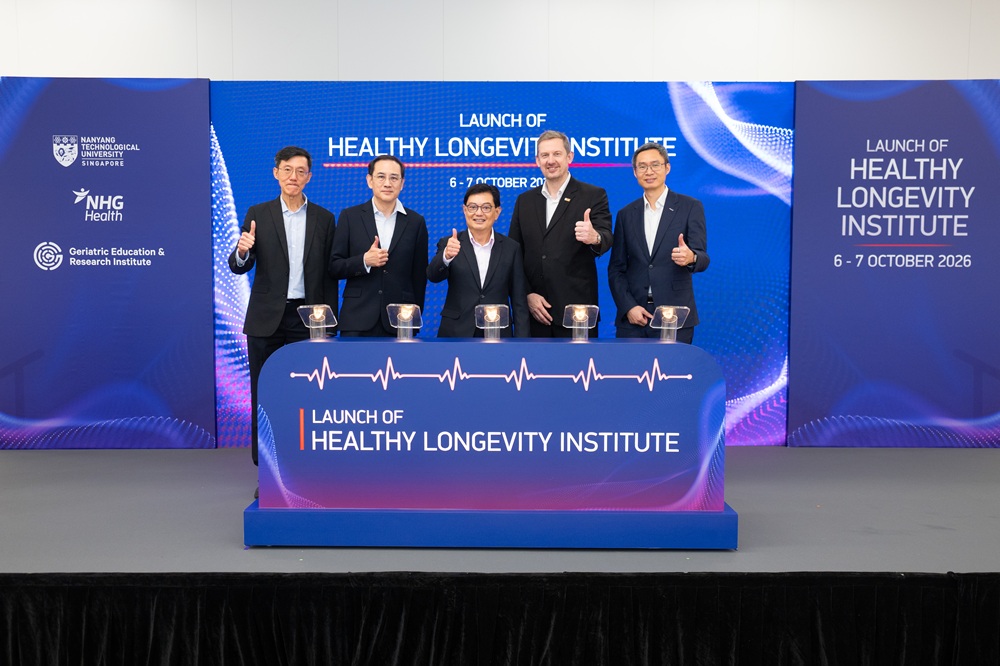
Image: The launch of the Healthy Longevity Institute (HELI) was officiated by Mr Heng Swee Keat, Chairman of the National Research Foundation (centre). From left: Assoc Prof Ding Yew, GERI; Prof Benjamin Seet, NHG Health; Prof Christian Wolfrum, NTU; Prof Chen Xiaodong, NTU.
Nanyang Technological University, Singapore (NTU Singapore), NHG Health and the Geriatric Education and Research Institute (GERI) launched the Healthy Longevity Institute (HELI) today at a ceremony officiated by Mr Heng Swee Keat, Chairman of the National Research Foundation (NRF).
Set up with an initial S$25 million investment, HELI will be an integrated platform bringing together clinical medicine, translational science, engineering and computational systems development, and the social sciences to extend the healthy, active years of Singapore’s ageing population.
It is set up to contribute to Singapore’s broader efforts in healthy longevity, alongside the Grand Challenge on Maximising Healthy and Successful Longevity, one of the national priorities under the Research, Innovation and Enterprise (RIE) 2030 plan coordinated by NRF.
HELI will focus on three interconnected pillars: cognitive and mental health; physical health; and clinical and policy research. HELI will combine NTU’s research and technology strengths; NHG Health’s clinical expertise, population cohorts, and care network; and GERI’s national role in clinical and translational research on ageing. Together, they will work to translate scientific discoveries into improvements in our healthcare system, in support of RIE 2030 (See Annex A for more details).
Professor Christian Wolfrum, NTU Deputy President and Provost, said: “Ageing is not a collection of independent diseases. It is a systemic loss of resilience shaped by biology, behaviour, and the environment interacting over decades. HELI was founded on the recognition that no single discipline can unravel that complexity by itself. By combining NTU’s engineering and data science capabilities with NHG Health’s clinical networks and GERI’s expertise in translating research into practice and policy, we can move from targeting individual conditions to intervening in the ageing process itself.”
Professor Benjamin Seet, Group Chairman Medical Board (Research), NHG Health, said: “Healthy longevity requires both physical and mental health to be maintained as we age. This cannot be achieved in a clinic alone. Through HELI, our clinicians will be working alongside scientists, engineers and community partners to develop real-world solutions to help people in Singapore age healthier and better. With a super-ageing population, we have our tasks and priorities cut out for us.”
Associate Professor Ding Yew Yoong, Executive Director and Lead Scientist, GERI, said: “HELI reflects a shared commitment to ensuring that research makes a meaningful difference to the health of older adults. We need stronger integration between research and practice to ensure evidence can inform the design and implementation of interventions that are relevant, effective and responsive to the evolving needs of an ageing population. By addressing what enables or hinders implementation, we can turn promising science into scalable solutions that are ready for real-world adoption, helping people live healthier lives longer.”
Complementing HELI’s work on cognitive and mental health, NTU Singapore also announced a new strategic global partnership with the International Alliance on Brain Health (IABH).
Through NTU’s new partnership with IABH, the University will establish a Singapore Brain Health Programme, connecting local researchers with IABH members for joint international projects and access to global datasets. IABH, which is led by renowned neurologist Professor Claudio Bassetti, links over 20 national brain health initiatives across five continents (See Annex B for more details).
Professor Claudio Bassetti, President of the International Alliance on Brain Health (IABH), Rector of Università della Svizzera italiana (USI), member of the Board of Ente Ospedaliero Cantonale (EOC), and Vice-President of the European Brain Council (EBC) said: “This partnership represents a major opportunity to strengthen international collaboration in brain, mental health and longevity. I see particular potential in building a strong Swiss–Singaporean partnership, bringing together two highly innovative ecosystems with complementary strengths in neuroscience, medicine, technology, artificial intelligence, data science and healthcare implementation. There is also a unique opportunity to develop a strategic collaboration between NTU, the Swiss Brain Health Initiative and the USI–EOC ecosystem. Joint research based on dedicated cohorts, together with innovative work in Brain Economics, Brain Care at the Workplace, and the development of new AI-assisted brain health metrics, offers particularly promising opportunities for collaborative research, innovation, validation, and real-world implementation.”