
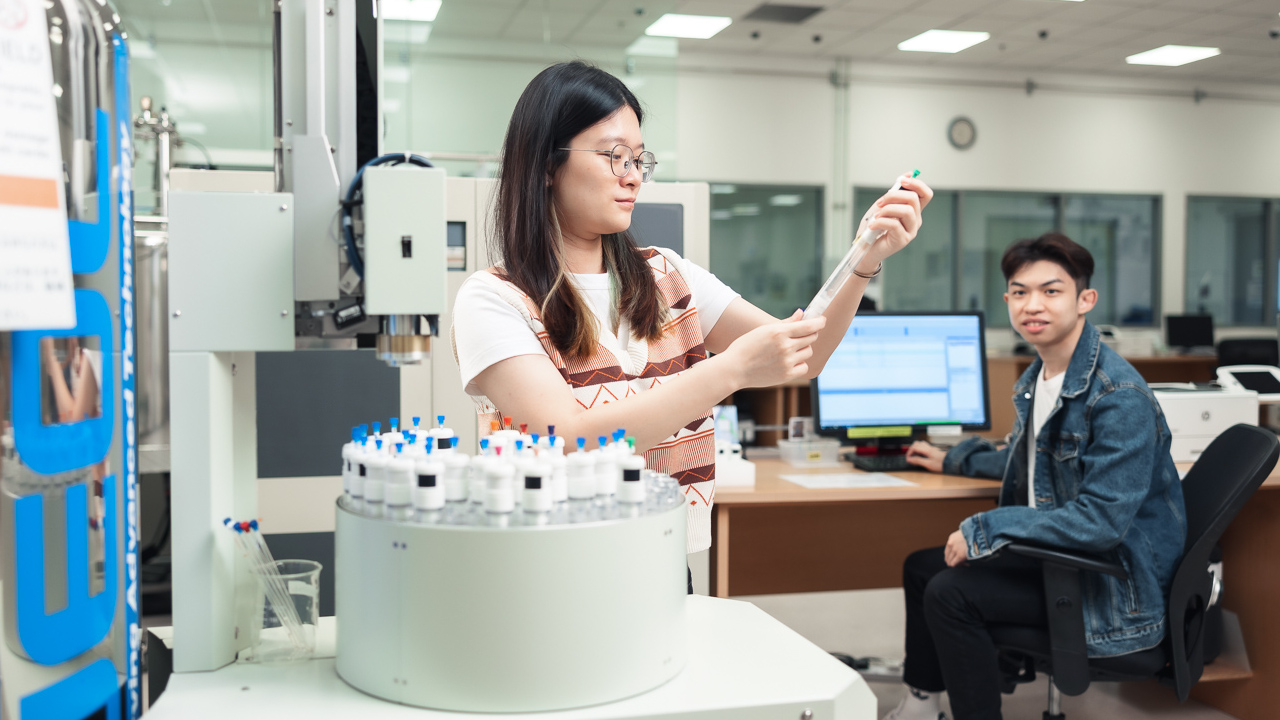
A postgraduate coursework-based programme focusing on practical skills for chemistry-based industry work and chemistry-based research and development.
This programme provides rigorous training in the use of state-of-the-art
instrumentation, artificial intelligence, and nanotechnology in
chemistry, as well as soft skills such as scientific communication and
teamwork. It is suitable for recent graduates from chemistry-oriented
Bachelors’
degree programmes, as well as working professionals in the energy,
chemicals,
and related industries.
For admission matters and enquires, please email:
MSc in Chemical Sciences and Instrumentation: MSCSI@ntu.edu.sg
An Elite Program from a Global Leader in Chemistry
This program is offered by a world-leading institution for chemical education and research. NTU is ranked 8th globally for Chemistry in the QS World University Rankings by Subject 2026, ensuring you receive a premier education that is recognized worldwide.
A Unique Core Curriculum Blending Science and Enterprise
The program’s foundation is designed not just for scientific excellence but for real-world impact.
- Hands-On Technical Mastery: The core module in Advanced Chemical Instrumentation provides in-depth, practical experience with the state-of-the-art instruments used in modern chemistry.
- From Lab to Market: A distinctive core course in Technology Commercialisation equips students with the skills to manage innovation, understand intellectual property, and translate technological research into sustainable products and services for the global market.
- Critical Scientific Thinking: The curriculum emphasizes high-level scientific communication and the Critical Evaluation of Chemistry Research, preparing students for leadership in academic and industrial R&D.
Dual Specializations to Align with Your Career Goals
Students must choose one of two specialized tracks, allowing for deep expertise in high-demand fields:
- Synthesis and Life Sciences: This specialization focuses on the molecular foundations of medicine and biology. It covers crucial topics such as Drug Discovery and Development, Graduate Chemical Biology, and advanced organic and inorganic chemistry, preparing graduates for careers in the pharmaceutical and life sciences sectors.
- Analytical and Nanotechnology: This forward-looking track focuses on the technologies driving Industry 4.0. It includes cutting-edge courses in Advanced Nanoscience and Nanotechnology and the Application of Artificial Intelligence in the Chemical Sciences, alongside advanced materials chemistry and industrial analytical chemistry.
Pathways to a High-Impact Career
The program is structured to provide extensive practical experience and clear career pathways:
- Industry and Research Immersion: Students can choose a Graduate Internship to gain on-the-job training at a leading chemical company or institution, or undertake a multi-trimester Research for MSc project to prepare for a research-intensive career.
- Interdisciplinary and Future-Focused Electives: A wide array of electives allows students to explore topics like Computational Chemistry, Scientific Computing with Python, Environmental and Sustainable Development, and Advanced Techniques in the Pharmaceutical Industry.
- Bachelor’s degree with a minimum of honours (distinction) or equivalent from a reputable university.
- Minimum TOEFL score of 85 or IELTS score of 6.0 (only if your first degree was not taught in English).
- Special consideration may be given, on a case-by-case basis to applicants with relevant work experience and letters of recommendation.
APPLICATION INFORMATION
Application
- Applicants are to submit their applications via the online application portal (Graduate Admission System).
- A S$50 non-refundable application fee (per online application and inclusive of prevailing GST) is payable.
- Starting from AY2026 intake, the application period are as follows:
Application period | September 2026 to March 2027 |
| Offer and acceptance | September 2026 to March 2027 |
| Matriculation | July 2027 |
Course commencement | August 2027 |
Application Status
The application outcome will be released via the online Graduate Admission System by end-May / June (August Intake).
Click here to check your application status after you have made a successful online payment.
Submission of Application
All semesters' examination results up to the time of application.
Please ensure that all mandatory and supporting documents are uploaded in the online Graduate Admission System before submitting your application. Submission of hardcopy documents is not required at the application stage.
Only applications submitted by the stipulated application deadline will be processed.
***Applicants should consider carefully that they are able to cope with work/personal/financial commitments before applying/accepting admission as full-time/part-time candidates. Deferment of admission base on these reasons may not be considered.
| Study Type | Minimum Candidature | Maximum Candidature |
| Full-time Study | 1 years (3 Trimesters) | 2 years (6 Trimesters) |
| Part-time Study | 2 year (6 Trimesters) | 4 years (12 Trimesters) |
Total Graduation Requirement: 30 AU
- 9 AU of compulsory courses
- 21 AU of electives from a chosen specialisation track and other electives
- A minimum CGPA of 2.50/5.00
View the Course: MSCSI AY26/27 Curriculum
*Note: the curriculum is subject to change.
*More course content details will be provided soon| Public Sector | Private Sector |
|---|---|
NEA, PUB, EMA – Environmental monitoring, water quality, emission control | Analytical & Pharma (Agilent, Bruker, GSK, Pfizer) - Instrumentation, QA/QC, drug analysis |
A*STAR, Research Institutes - Advanced materials, nanotechnology, sustainability R&D | Chemicals & Materials (BASF, Evonik, Shell, Micron) - Catalysis, materials development, process optimisation |
MOE, Polytechnics & Universities – Teaching, analytical science research | Biotech & Life Sciences (Thermo Fisher, Illumnia, Roche, Novartis) - Genomics, biomedical instrumentation, diagnostics |
| MedTech & Diagnostics (Philips, Abbott, Cytiva, 3M) - Device testing, biomedical analytics, manufacturing |
| Startups & DeepTech - AI-driven instrumentation, green chemistry solutions, sustainable technologies |
The tuition fees for Academic Year 2027/28 are as follows:
| Deposit Fee | S$ 5,450 (Deposit fee will be used to offset first payment) |
| Tuition Fee | S$ 48,069 |
| Payment Schedule | Full-time students will be billed in three trimesters while part-time students will be billed in six trimesters. |
| Note | Application fee S$50.00 |
*All fees shown are inclusive of 9% prevailing GST.
The tuition fees for Academic Year 2026/27 are as follows:
| Deposit Fee | S$ 5,450 (Deposit fee will be used to offset first payment) |
| Tuition Fee | S$ 45,780 |
| Payment Schedule | Full-time students will be billed in three trimesters while part-time students will be billed in six trimesters. |
| Note | Application fee S$50.00 |
*All fees shown are inclusive of 9% prevailing GST.
Financial Assistance:
- Singaporean Citizens (SCs): Enjoy a study grant of S$10,000+ prevailing GST (S$10,900).
- Singapore Permanent Residents (SPRs): Enjoy a study grant of S$5,000 prevailing GST (S$5,450).
- SCs and SPRs who require further assistance may apply for financial aid (up to S$10,900) in addition to the SC/SPR study grant.
- NTU Alumni: On top of the above, alumni can enjoy a 10% grant of the tuition fee. Eligible for holders of bachelor's, master's, and/or doctoral degrees obtained from NTU Singapore.
Please note the following:
- All fees listed are INCLUSIVE of 9% GST.
- A non-refundable deposit of S$5,450 is payable upon acceptance of the offer.
- A one-time miscellaneous fee will be billed every academic year.
- Tuition fees do not include the cost of recommended textbooks and other course materials. Students are responsible for their own travel, accommodation, and miscellaneous expenses.
- All incentives and subsidies will be distributed evenly across the billing period — either 3 trimesters for full-time students or 6 trimesters for part-time students.
- Fees are reviewed annually and are subject to revision.