

Master of Arts (Counselling and Guidance)

Master (Coursework)

Programme Type

Full-time, Part-time

NIE Graduate Programmes

[email protected]

The Master of Arts (Counselling and Guidance) programme preview session is on 13 November 2025, Thursday, 1pm. The preview will be held virtually via zoom. Interested applicants are welcome to register at this link!

The registration will close on 6 November 2025, Thursday, 12pm.


Counselling and guidance are evolving to meet the needs of individuals in schools and communities to improve their understanding, adjustment, and daily functioning across the lifespan. The roles of counsellors are notably complex and multifaceted. The challenges and demands in the quality of the counselling and guidance services offered in educational and community settings are also increasing. Hence, counsellors need to be reflective about their own practices and ways to enhance their competencies in these areas.

The Master of Arts (Counselling and Guidance) is a rigorous, informative and structured training programme. It is a course-work oriented professional degree that is designed to prepare new entrants into the fields of counselling and guidance as highly competent and caring counsellors. The Master of Arts (Counselling and Guidance) is also designed to enhance and upgrade the knowledge and skills of counsellors at a master's level and to prepare those who may wish to pursue a doctoral education later.

Curious to know what our faculty and students think about our programmes? Click here to find out from our "Getting to Know Series"!

The programme emphasises a developmental perspective, focusing on issues pertinent to providing counselling and guidance services and programme development. The counsellors' personal and professional growth and development; appreciation of diversity and demonstration of understanding ethical and legal issues are also emphasised. The practicum allows application of theories and techniques leading to effective individual and group counselling.

  • You must have a Bachelor's degree from a recognized university preferably with Honours or equivalent in a relevant discipline such as education, psychology, social work, or social science.
  • Only applicants who have the suitable personal attributes and aptitude for the counselling profession with potential to contribute to the community will be considered. Preference will be given to applicants with a clear career path for becoming a Professional Counsellor after obtaining the MACG qualification.
  • Preference will be given to those who have relevant experience in direct counselling work, social/mental health care service sectors, and/or majored in related fields such as education, psychology, social work, or social science.

See detailed requirements for competency in English Language here.

Completed application forms will be reviewed and shortlisted applicants will be required to attend an admission interview with the faculty panel.

There is generally only one intake for this programme, in August. You are advised to visit the website and look out for NIE’s announcements in November/December to confirm if the programme will be open for application at any particular intake.

Applicants who are currently working with sponsors, donors or financial institutions to fund their studies, are encouraged to submit their applications early to NIE so as not to miss out on our application period.

Applications are to be made online. Click here to sign up for an ISAAC (Integrated Student and Academic Administration System) account to apply with us. For those with an existing account, login to apply.

More information on required documents for application can be found here.

The Master of Arts (Counselling and Guidance) is offered on both full-time and part-time basis.

The candidature periods are as follows:

Full-time

Minimum

1.5 years

Maximum

2 years

Part-time

Minimum

3 years

Maximum

4 years


The MACG programme is a professional degree that comprises 42 Academic Units (AUs). Students may opt to complete the programme under the Practice Track or Practice-Research Track. The Practice Track consists of 12 courses of 3 AUs each (including 10 core courses and 2 elective courses) and clinical placements (2 blocks of practicum of 3 AUs each). Students who wish to strengthen their skills and knowledge in research may opt to do a Research Project elective (3 AUs) in place of a general elective, subject to approval.

The core areas have been identified as the essential competency areas for counsellors by the Council for the Accreditation of Counselling and other Related Educational Programmes (CACREP) in USA, and the Singapore Association for Counselling. For clinical instruction, a total of 400 hours (100 hours of face to face counselling and 100 hours of associated activities for each practicum) is required.
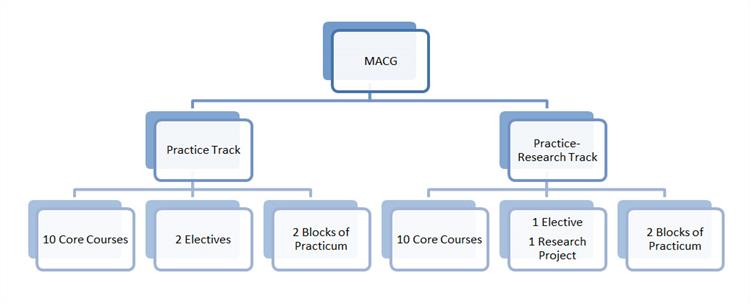

macg-flowchart
Important note for matriculated students:
Please refer to the ISAAC system for the programme structure relevant to your intake during Course Registration or consult Dr Lee Boon Ooi, your programme leader if you need clarifications.

Courses and Study Plan
Click here for more information.

Course Descriptors

MAC810 Ethical, Legal and Professional Issues in Counselling (3 AUs)
The topics covered include professional roles and function, codes of ethics and standards of practice, legal matters and potential liabilities, safeguarding confidentiality, duty to warn, boundaries in therapeutic relationships, client rights, and value differences with clients in the Singapore context.

MAC811 Multicultural Counselling (3 AUs)
When contemporary societies become more culturally diverse due to globalization, counsellors and their clients may not share the same sociocultural values. Counsellors can no longer assume that their counselling approaches are applicable to everyone. Counselling is not value-free but is embedded in worldviews mainly derived from Western and dominant cultures. As such, counsellors must be able to adapt their counselling processes when working with clients across cultural groups and social classes.

The aim of this course is to help counsellors become more culturally competent in three main areas:

1) becoming more aware of their own assumptions about human behaviours, values, normality, and wellbeing;

2) becoming more aware of the worldviews of culturally diverse clients; and

3) being able to develop intervention strategies consistent with the worldviews of their clients in Asian contexts.

MAC812 Life-Span Developmental Psychology (3 AUs)
This course gives an overview of the development and disorders of child and adolescent. It discusses the main features of physical and psychosocial development of children and adolescents. Topics which will be covered include the role of self-concept and self-esteem, parent-child relationships, asperger, autism, ADHD, anger management and prevention of violence, creativity and emotional intelligence.

MAC813 Career Development and Counselling (3 AUs)
This course provides an understanding of the theories of career development and career counselling / guidance; acquire knowledge and skills in career guidance, assessment  counselling; know the development of career guidance  counselling in Singapore schools  community; know the trends and issues in workforce development in Singapore and beyond; mobilise / organise resources in and out of the school to facilitate the implementation of the programme; and design research to review / evaluate the programme for improvement.

MAC814 Theories of Counselling and Psychotherapy (3 AUs)
This course aims to help students develop an in-depth understanding of major current affective, cognitive, and behavioural models and skills in using these approaches in counselling. Specific orientations discussed include psychoanalytic therapy, Person-centered therapy, Reality therapy, Gestalt therapy, Rational-emotive-behavioural therapy and Cognitive-behavioural therapy.

MAC815 Advanced Counselling and Interviewing Skills (3 AUs)
This course examines the development of counselling skills through the counselling process involving phases of relationship building, problem exploration and identification, goal-setting, designing intervention strategies, evaluation outcomes and termination. This class is predominantly experiential. An emphasis is placed on the practice and demonstration of skills, development of counselling plans, and strategies for assistance.

MAC816 Group Process and Counselling (3 AUs)
Theory and practice of group counselling will be presented, discussed, and practiced in this course. Students will learn about the principles of group dynamics, process and counselling techniques. Application of groups in community and educational settings for remedial and preventive purposes will be explored.

MAC817 Psychopathology and Appraisal (3 AUs)
Psychopathology and Appraisal provides an overview of the Diagnostic and Statistical Manual of Mental Disorders  5th Edition (DSM-5) and equips students with the foundational knowledge relating to the etiology, identification, developmental course and treatments of various psychological disorders observed across the life-span (i.e., children and adults). The psychological disorders covered include, anxiety disorders, obsessive compulsive and related disorders, bipolar and related disorders, depressive disorders, personality disorders, somatic symptom and related disorders, dissociative disorders, schizophrenia spectrum and other psychotic disorders, feeding and eating disorders, and neurodevelopmental disorders.

MAC818 Research Methodology and Statistical Analysis in Counselling (3 AUs)
This course covers the research designs and basic statistics. For research designs, topics covered include research problems and hypothesis formulation, the sampling and instrumentation, writing research reports, and evaluating research. For research statistics, students are exposed to the understanding of basic statistics and using statistical software (SPSS) in data analysis. Topics included are preliminary data analysis, descriptive and inferential analysis, parametric and non-parametric tests, univariate and multivariate tests.

MAC819 Programme Evaluation in Counselling and Guidance (3 AUs)
This course provides the students with the basic understanding of procedures for counselling programme development and accountability/evaluation. It focuses on the needs assessment, planning, development, design, implementation and evaluation of a comprehensive counselling and guidance programme. The community and school-related issues and management competency of the counsellor will be emphasised.

MAC820 Introduction to Family Counselling (3 AUs)
This course gives an introduction to family systems theories and investigates family issues that surface in counselling. Critical examination of systemic change, dysfunction, stages of family development, the dynamics of family interaction, problems associated with individual adjustments, adaptations and other reactions within family is included.

MAC821 Mental Health and Community Counselling (3 AUs)
This course introduces the students to the field of community mental health counselling. Topics covered include the roles of the community mental health counsellor, professional ethics, managed care, various contexts of practice and organisational structures, outreach, advocacy, mandated clients, crisis intervention services, prevention, consultation, and an understanding of how diversity influences the practice of mental health/community counselling.

MAC822 Addiction and Suicide Counselling (3 AUs)
This course provides an overview of two areas of concern: addictive behaviours and suicidal tendencies. For addiction counselling, the psychological concept of addiction, development of addictive behaviours as well as the assessment and treatment involve individual, group and family dynamics are addressed, with focus on substance abuse among youth, pathological use of the internet and digital games, gambling and co-dependency. For suicide counselling, the course covers risk assessment and suicide clues, intervention strategies in suicide prevention as well as suicide grief and bereavement. Students are also exposed to professional and community resources available, when and how to refer clients to the resources.

MAC823 Counselling Supervision (3 AUs)
This course is an introduction to the theory, research and practice of counselling supervision. The course is designed to help students understand the supervisory relationship, various models of supervision and how the models relate to the process of supervision.

The differences between supervision and counselling/psychotherapy and consultation will be explored along with other topics including:

(a) the role of the supervisor

(b) relevant ethical and legal issues related to supervision,

(c) styles of supervision

(d) methods in supervision.

MAC824 Introduction to Play Therapy (3 AUs)
Introduction to Play Therapy is an experiential and interactive clinical course designed to provide trainee counselors and psychologists with the knowledge and skills to work effectively with children in various clinical and school settings. Working with children requires a specific skill set and expertise that is different than working with adolescents and adults. Play therapy is an evidence-based intervention and research has demonstrated its efficacy for addressing various issues children present with such as low self-esteem and disruptive behaviour.

Through the course, participants will be familiar with child-centred play therapy and acquire basic play therapy skills including the logistical set up of a play room and basic play therapy skills. Participants will also be prepared to handle typical issues in play therapy. Participants will get hands-on experience that will prepare them to work competently with children.

MAC841 Research Project (3 AUs)


The Master of Arts (Counselling and Guidance) programme is fully certified by the Singapore Association for Counselling as a training programme for Registered Counsellors. Upon completing the programme, students are expected to be competent in various areas including major counselling theories, evidence-based practices, case conceptualisation, treatment plan, case documentation, ethical and legal issues, and research and programme evaluation skills in counselling. Students are trained to adopt an integrated approach to counselling, which draws on knowledge from various counselling theories, developmental psychology, abnormal psychology, and multicultural therapeutic perspectives.

For tuition fees, please click here..

For more information about scholarships, please click here

For programme-related matters, please consult the programme leader, Dr Lee Boon Ooi, for more information.

Related Programmes