
Courses
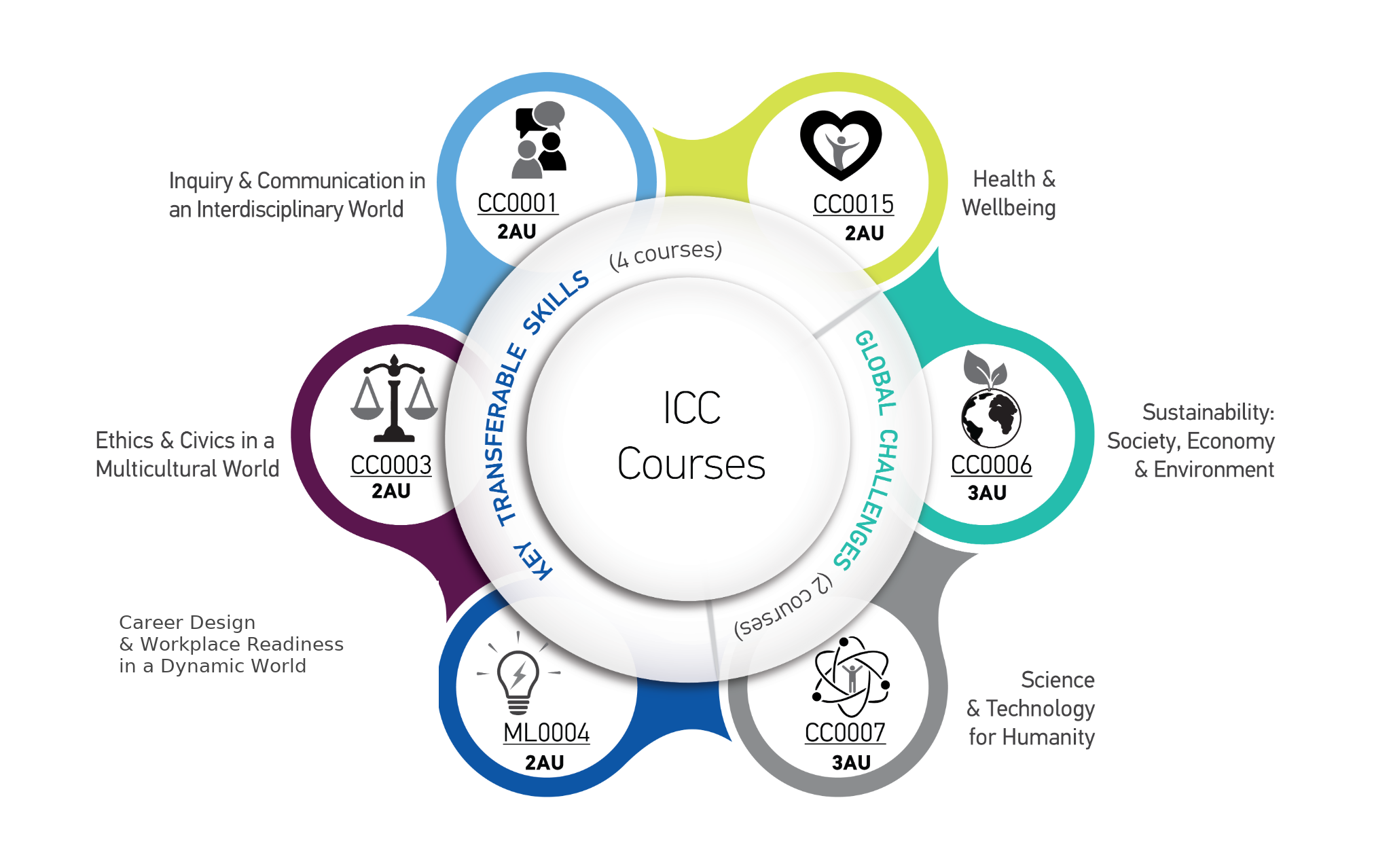
The following 6 ICC courses for undergraduate programmes were developed by NTU faculty of diverse disciplinary backgrounds to address real-world subject matters from various perspectives:
Course Information
| Course Code | CC0001 |
| Course Title | Inquiry and Communication in an Interdisciplinary World |
| Academic Units | 2 AUs |
| Start of Instruction | Week 2 |
Course Aims
Researchers agree that writing is a tool for thinking (Menary, 2007; Klein & Boscolo, 2016; Miller and Jurecic, 2016; Reis, n.d.). As Reis explains, “The bodily act of writing externalizes our thoughts, and the imposed structure (the written word) provides a vehicle by which those thoughts may be reorganized into new thinking, a new way of seeing the thoughts or a new way of organizing thoughts.” Miller and Jurecic similarly argue that “writers discover what they think not before they write but in the act of writing” (2016, p. 60). One of the main aims of this course is to allow you to experience writing as a tool for thinking and to practice expressing ideas in formal writing and oral communication.
While you will have the opportunity to understand and practice the genre conventions that are specific to your discipline later in your studies, this first common communication course is designed to help you form habits of mind that will serve you across the university and even in the world outside of the university.
Taken by all first-year undergraduates, this foundational course will develop your written and oral communication skills, as well as your ability to read and analyze texts. It will help you to understand revision as integral to the process of composition, to convey your interpretations and ideas with confidence and clarity, and to consider audience and purpose when you communicate.
Intended Learning Outcomes
By the end of this course, you should be able to:
- Closely observe and analyse texts and phenomena.
- Design questions or puzzles that can motivate further exploration.
- Summarise, paraphrase, and quote from sources accurately and ethically.
- Compose complex arguments that build on the ideas of published authors as well as your own analysis and thinking.
- Express your ideas orally through presentations.
- Discover writing as a tool for thinking.
- Use peer and teacher feedback to revise your thinking and communication.
- Recognise audience and rhetorical situation as significant factors in communication.
- Reflect and set your own learning goals in the course (pre-course self-reflection).
- Reflect on your learning achievement in the course and the achievement contributors (post-course self-reflection).
Course Content
For this course, you will be asked to explore a topic for your own research. Your choices are:
- A place in Singapore;
- A community within Singapore; or
- Your own writing practices.
You will begin by closely observing your chosen topic, recording your data, and analysing interesting patterns or puzzles in what you observe. In class, we will practice how to come to a question to which you do not have an answer. This question will become the motivation for your writing in the course. Eventually, you will be asked to find two sources that can help you respond to your question. Your final goal will be to draft an op-ed (short for “opposite the editorial page”), a piece of writing usually found in a newspaper or magazine that expresses an author’s opinion on a current topic. Your op-ed will be peer workshopped and revised substantially over two to three weeks. You will also consult with your teacher and receive feedback on your draft.
At the end of the semester, you may decide to send your op-ed to a newspaper or online platform.
Course Information
| Course Code | CC0003 |
| Course Title | Ethics and Civics in a Multicultural World |
| Academic Units | 2 AUs |
| Start of Instruction | Week 1 |
Course Aims
This course aims to equip with the necessary philosophical foundations to understand theories of ethics and subsequently apply those theories to real-life scenarios and issues. It also aims to enable you to understand and critically assess the civic institutions that structure their local and global communities. To these ends, the course will examine the nature of ethics, its understanding across different cultures, and how it is manifested in concepts, social structures, and governance institutions.
Topics to be explored include human rights, democracy, freedom of speech and inequality. The rights and duties of citizenship shall be a unifying theme. You will think through assumptions they hold on all of these matters. You will be provided with the tools to understand various and even contradictory perspectives on these important issues.
Time will also be devoted toward understanding Singapore’s own institutions and ideologies, which are of course products specific to our country’s own unique historical and geo-political circumstances. You will have better appreciation of the country’s institutions after reading the module.
Intended Learning Outcomes
- Collaborate & develop a multidisciplinary understanding, which are key features of ICC curriculum.
- Identify the morally relevant features of situations, decisions, and policies.
- Explain your moral responsibilities to actively participate in activities that strengthen your local and global communities.
- Critically assess the civic structures and institutions of your communities and your role in them.
- Make well-informed arguments on some major contemporary issues.
- Apply ethics and civics concepts to the Singapore context.
- Reflect and set your own learning goals in the course (pre-course self-reflection).
- Reflect on your learning achievement in the course and the achievement contributors (post-course self-reflection).
Course Content
The course will cover the following topics:
- Introduction – What is Ethics, Civics, Multiculturalism and how is this relevant to you?
- Reasoning for ethics and civics + Logic Quiz
- Ethics of Wellbeing
- Ethics of Human Rights
- Reproduction Ethics: Abortion
- Ethics of Euthanasia
- Equality & Meritocracy
- Multicultralism
- Ethics of Political Freedom
- Ethics of Free Speech
Course Information
| Course Code | ML0004 |
| Course Title | Career Design and Workplace Readiness in a Dynamic World |
| Academic Units | 2 AUs |
| Start of Instruction | Week 1 |
Course Aims
This course empowers you to build successful careers through a combination of self-discovery and the development and application of essential workplace skills.
You will enhance your self-awareness through comprehensive self-assessment, mastering techniques for effective resume and cover letter writing, networking and interviewing. You will then apply these skills through practical exercises, including mock interviews and resume critiques, receiving valuable feedback to refine your approach.
The culmination of this process is the creation of a well-defined and actionable career plan, setting you on a path toward achieving your professional goals.
Intended Learning Outcomes
By the end of the course, you should be able to:
- Conduct a Self-Assessment and Explore Career Pathways: You will perform a comprehensive self-assessment to identify your values, interests, skills, and personality traits, culminating in the creation of three potential career pathways.
- Refine a Chosen Career Pathway Through Prototyping: You will refine one chosen career pathway through a structured prototyping conversation, incorporating feedback to inform career planning and the creation of a professional resume and cover letter.
- Develop a Targeted Job Search Strategy: You will develop a comprehensive job search strategy, incorporating online platforms, networking, and informational interviewing, resulting in a targeted resume and cover letter.
- Develop effective Resume Writing and Job Interviewing skills: You will learn, prepare, roleplay and be coached on resume writing and job interviewing skills through in-class activities and coaching clinics.
- Apply Key Workplace Skills to Workplace Examples: You will learn and apply at least two key workplace skills (e.g. effective communication, conflict resolution, ethical decision-making) using examples drawn from real workplace situations.
- Develop an Actionable Career Roadmap: You will develop a detailed career roadmap outlining short-term and long-term goals, strategies, and skill development, informed by self-assessment, prototyping, and job search activities.
- Reflect and set your own learning goals in the course (pre-course self-reflection).
- Reflect on your learning achievement in the course and the achievement contributors (post-course self-reflection).
Course Content
The topics that will be covered in this course are:
Topic 1: Welcome to the Future World
- The Future of Work
- The Fourth Industrial Revolution
- The Future of Work: What Skills will be Needed
- Digital, Green and Care Economy
- Singapore Skills Framework
- Career vs. Job
- Designing your Life
Topic 2: Designing Your Career Path
- Introduction to SODA
- Values, finding true north and build your compass
- Identifying Work View and Life View, Achieving Coherence
- Flow Theory
- Personality and Skills
- Prototyping, Odyssey Plan, Dashboard
- Career Mobility
Topic 3: Developing Job Search Skills
- Ways to Get a Job
- Resume – Component, Format, KSA, CAR
- Cover Letters
- Job Interview – Preparation, Interview Tips, Typical Interview Questions and How to Answer Them, Post Interview Follow-up
Topic 4: Taking Action in Your Career Journey
- Personal and Online Brand
- Elevator Pitch and Elevator Conversation
- Outsider Problem
- Prototyping Conversation
- Networking
- Offer Searches
- Happenstance
Topic 5: Master LinkedIn for Success
- Creating an Optimised LinkedIn Profile
- Developing your Personal Brand in LinkedIn
- Strategic Networking and Building Connections in LinkedIn
- Content Creation and Engagement
- Leveraging LinkedIn for Career Opportunities
Topic 6: Developing Critical Life Skills
- Emotional intelligence
- Self-Confidence / Growth Mindset
- Adaptability, Resilience / Grit
- Communication Skills
- Presentation Skills
- Collaboration Skills
- Conflict Management Skills
- Critical Thinking and Problem-Solving skills
- Curiosity and Continual Learning
Topic 7: Developing Critical Workplace Skills
- Importance of Internships
- Political Skills
- Working with Difficult Colleagues
- Working with a Diverse Multi-Generational Workplace
- Ethics in Workplace Challenge
Course Information
| Course Code | CC0015 |
| Course Title | Health and Wellbeing |
| Academic Units | 2 AUs |
| Start of Instruction | Week 2 |
Course Aims
This course aims to provide multi-disciplinary competence in a cross-disciplinary, collaborative learning environment, with student interaction and collaboration across schools as a key learning foundation. As the title connotes, the main objective of this compulsory undergraduate course is to examine what constitutes living a good, healthy, and flourishing life.
According to research, individuals around the world pursue this “flourishing life” in different ways, be it through improving one’s physical fitness, seeking authentic relationships with others, or making a positive change in the environment. Thus, knowing and understanding how the different components of a “good life” contribute to one’s overall functioning is critical to one’s healthy wellbeing. The latter, in turn, affords many benefi ts such as better health (physical, mental, and emotional health) and stronger relationships.
By the end of this course, you would have developed an awareness of what constitutes living a healthy and flourishing life, both of which indirectly contribute to a successful undergraduate education.
Intended Learning Outcomes
By the end of this course, you should be able to:
- Describe what healthy living and wellbeing means to you as an undergraduate student.
- Identify common health and mental issues (including knowing the sources of help) in Singapore and how this knowledge would benefit you and the people around you.
- Demonstrate coping strategies for developing resilience and self-care, playing an active role in living a healthy and meaningful life.
- Distinguish between healthy and unhealthy communication styles, and apply empathic communication and conflict resolution strategies for healthier relationships.
- Recognise the importance of self-determination and values-based actions in the pursuit of personal growth and self-actualisation.
- Explain health and mental health care issues at a global level, in relation to understanding Singapore perspectives.
- Discern between facts and myths of common health issues related to nutrition, fitness, and diseases.
- Evaluate the consequences of health-related behaviours on longevity and health-adjusted life expectancy.
- Collaborate effectively on health and wellbeing issues in cross-disciplinary teams.
- Reflect and set your own learning goals in the course (pre-course self-reflection).
- Reflect on your learning achievement in the course and the achievement contributors (post-course self-reflection).
Course Content
The following topics will be covered in this course:
- The Body-Mind-Spirit Connection for Health and Wellbeing
- Health and Wholeness
- Health and Disease
- Health and Nutrition
- Health and Fitness
- Understanding Stress and Fostering Self-Care
- Building Mental Health Awareness and Resources
- Nurturing Healthy Relationships and Social Wellness
- Aspiring Personal Growth and Self-Actualisation
Course Information
| Course Code | CC0006 |
| Course Title | Sustainability: Society, Economy & Environment |
| Academic Units | 3 AUs |
| Start of Instruction | Week 1 |
Course Aims
The course aims to inspire a long-lasting mindset of awareness, critical thinking, curiosity, and collaboration across disciplines through the lens of current sustainability challenges.
You will learn to analyse sustainability issues from different perspectives (social, economic, and environmental) and on different scales (individual, organizational, Singaporean, and global). You will then use these skills to discuss and propose solutions for sustainability challenges facing Singapore and the world.
By the end of the course, you would have developed an awareness for, and a system thinking approach to, sustainability, which you can continue to develop no matter which discipline or career path you choose to embark on.
Intended Learning Outcomes
Upon the successful completion of this course, you will be able to:
- Explain the multidimensional systemic nature of sustainability.
- Analyse sustainability challenges from social, economic, and environmental perspectives.
- Identify and present possible solutions for a sustainable world on different scales for the individual, organizations, Singapore, and globally.
- Critically discuss sustainability issues in small and large group settings.
- Collaborate effectively on sustainability issues in cross-disciplinary teams.
- Evaluate the work of peers on their projects related to sustainability.
- Reflect and set your own learning goals in the course (pre-course self-reflection).
- Reflect on your learning achievement in the course and the achievement contributors (post-course self-reflection).
Course Content
All topics covered are analysed from each of the three systems: Society, Economy, and Environment, with an emphasis on how sustainable development needs to include all three systems.
Topics to be covered in the course:
- Introduction: Why each discipline should know about sustainability, UN SDGs, Singapore Green Plan.
- Poverty and equality: How to measure it, how widespread it is, how to eradicate it.
- Food systems: Sustainability and global food security.
- Water: Availability and sustainable management of water resources.
- Energy and Climate Change: Sustainable and reliable sources, mitigation of climate change and policy instruments.
- Responsible consumption and production: Waste reduction.
- Pollution: Air, plastics, light, noise.
- Sustainable cities: The role of big cities in sustainability development. What is a sustainable city?
- Planetary boundaries, Earth system feedback and tipping points: Staying in control of our planet and its systems.
Course Information
| Course Code | CC0007 |
| Course Title | Science & Technology for Humanity |
| Academic Units | 3 AUs |
| Start of Instruction | Week 1 |
Course Aims
The course invites you to navigate the two global challenges of our time - Ageing Societies and Artificial Intelligence - by bridging the gap between scientific innovation and human-centric application. Rather than training you to be a computer scientist or a gerontologist specifically, this course empowers you to become an informed citizen and ethical innovator capable of addressing complex global challenges through various disciplinary lenses.
You will learn about a process of agentic inquiry where you will leverage advanced AI tools as thinking partners to synthesise research, resolve contradictions and prototype solutions for real-world stakeholders. Ultimately, this course is designed to foster the critical thinking and moral discernment necessary to ensure that technological progress remains firmly anchored in human values.
Intended Learning Outcomes
Upon the successful completion of this course, you (as a student) will be able to:
- Explain the foundational scientific and technical principles of ageing (e.g., cellular senescence, cognitive reserve) and artificial intelligence (predictive and generative AI), while evaluating the human challenges these innovations address and the social or technical limitations of their application.
- Describe and analyse connections between, three general classes of perspective on the challenges of innovation and application: scientific / technical, business, and humanistic / social scientific perspectives.
- Identify, critique, and evaluate ethical, financial, organisational, legal, social and cultural components surrounding the application of technological innovations.
- Apply an agentic inquiry workflow using AI as a "thinking partner" and "co-designer" to formulate human-centric solutions for real-world global challenges, such as Singapore's super-aged population or ethical algorithmic management
- Collaborate effectively on project development in cross-disciplinary teams to develop and pitch innovative solutions.
- Reflect and set your own learning goals in the course (pre-course self-reflection).
- Reflect on your learning achievement in the course and the achievement contributors (post-course self-reflection).
Course Content
Course Introduction and Foundational AI Literacy
- History of Science and Technology: Exploring the development of technological innovations within society.
- Foundational Prompt Engineering: Establishing basic technical competency in Chain-of-Thought and RTF (Role,Task, Format) frameworks.
Theme 1: Ageing Population and Society
This theme serves as the human anchor of the course, emphasising the potential and limitations of technology in addressing human problems.
- STEM Perspective: Biological processes of ageing, such as cellular senescence and cognitive reserve building.
- Business / Governance Perspective: Market opportunities in the Silver Economy and the design of public / private goods and technology for elders.
- Social Science / Humanities (SSH) Perspective: Psychological wellbeing, mental wellness, and strategies for navigating communication challenges with seniors.
- Policymaking case studies on ageing (Panel Discussion): Evaluating government efforts and national infrastructure design to support a super-aged population.
Theme 2: AI and Society
This theme focuses on the wide-reaching impact of predictive and generative technologies at individual, industry and policy levels.
- STEM Perspective: Understanding the fundamentals of predictive and generative AI models, including data bias and its real-world implications.
- Business / Governance Perspective: Issues related to extracting human behavioral data by Big Tech firms for AI model training.
- Social Science / Humanities (SSH) Perspective: AI as a disruptor of work sectors, specifically the gig economy and creative industries, as well as the ethics of algorithmic management.
- Policymaking case studies on AI and Trust (Panel Discussions): Exploring the societal and policy implications of latest AI technologies such as personalised chatbots and copyright issues regarding digital images and voices.
AI Workflows and Applied Projects
The course integrates weekly activities and assignments where students apply AI tools to authentic scenarios:
- Agentic Inquiry: Mastering a dual-engine architecture using NotebookLM for grounded research and GoogleGems
for architecting personas to solve interdisciplinary problems.