NTU hosts ASEAN+3 university leaders to advance AI-ready higher education
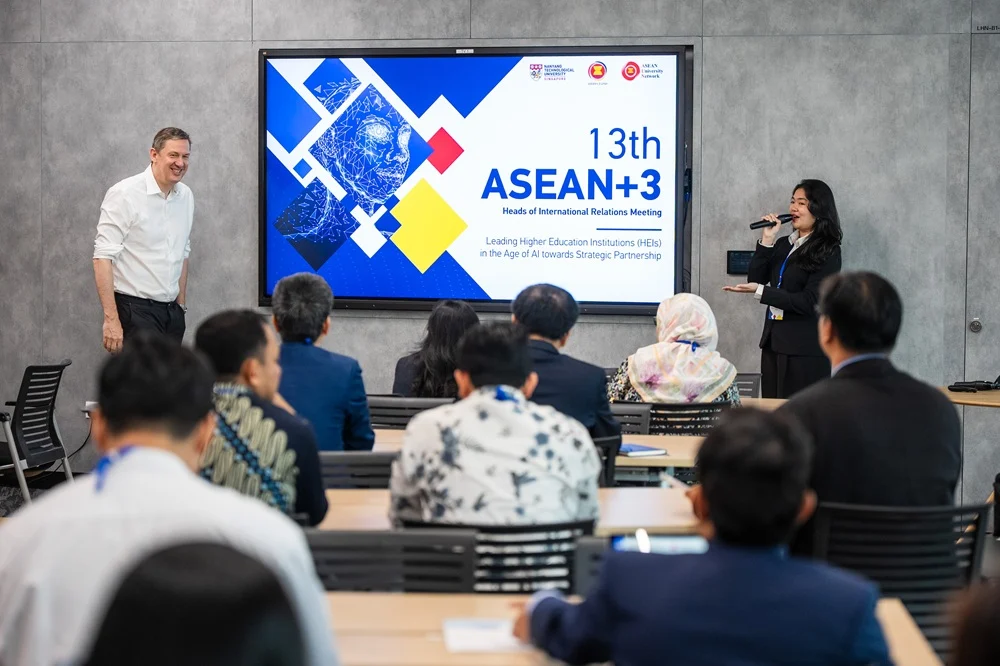
NTU Singapore welcomed senior university leaders from across ASEAN, China, Japan, and South Korea for the 13th ASEAN+3 Heads of International Relations Meeting on 16–17 April 2026. The meeting explored how higher education is not merely adapting to artificial intelligence (AI); but is being redefined by it
Rethinking relevance in an AI-pervasive world
While universities have traditionally evolved at measured pace, the acceleration of AI development is forcing institutions to rethink not just what they teach, but how quickly they can transform. In his keynote address, NTU Deputy President and Provost Prof Christian Wolfrum framed the challenge starkly: no single institution, or even country, has the capacity to navigate this transition alone. The implication was clear: competitiveness in higher education will increasingly depend on collaboration, not differentiation alone.
This view was echoed by PhD students on a panel, who offered candid perspectives on how AI is reshaping their learning experiences and expectations of higher education. They highlighted how AI is exposing structural vulnerabilities across institutions, from curriculum rigidity to uneven digital readiness, while also creating opportunities to leapfrog traditional models of teaching and research.
 A shift from discussion to decision-making tools
Participants confronted pressing questions at a facilitated workshop discussing challenges and opportunities posed by AI. They shared how AI might shift international partnerships from traditional mobility-focused models towards deeper collaboration. Such partnerships can include co-developing AI-enabled curricula, sharing of digital infrastructure, and jointly addressing data governance and talent development.
The participants also challenged conventional assumptions about continuity in academia, raising, for example, the possibility that universities may need to deprioritise certain legacy practices to remain relevant.
These exchanges culminated in the co-development of a practical framework designed to help institutions navigate digital transformation in the AI era. Rather than being prescriptive, the framework serves as a decision-making tool, supporting institutional leaders in assessing readiness, identifying trade-offs, and prioritising areas for intervention within their own contexts.
 Collaboration as capability, not just principle
A recurring insight from the discussions was that collaboration is no longer an aspirational ideal, but an operational necessity. NTU Vice President (International Engagement), Prof Lee Pooi See, noted that platforms such as this meeting are increasingly valuable not just for exchanging perspectives, but for aligning institutional responses to common challenges.
Participants also pointed to the importance of trust and openness in enabling meaningful collaboration, particularly in areas involving data, technology, and pedagogy.
Towards Singapore’s ASEAN Chairmanship in 2027: higher education as a regional lever

Looking ahead, participants underscored the role of universities in shaping a resilient and forward-looking ASEAN region. In the lead-up to Singapore taking on the ASEAN Chairmanship and the bloc marking its 60th anniversary next year, universities like NTU have a key opportunity to contribute to regional higher education priorities.
There was broad agreement that higher education institutions must move beyond incremental change and take on a more proactive role in regional capacity-building, especially in equipping graduates and faculty to operate effectively in AI-mediated environments.
The meeting closed with a shared commitment to sustain momentum, with institutions exploring concrete follow-ups in areas such as digital learning, academic mobility, and responsible AI integration.