
.jpg?sfvrsn=16a82925_3)
Advances in biology and neuroscience show how our brains and cognitive development are shaped by learning experiences and the environment. The Master of Science in Science of Learning (MSL) is a distinctive interdisciplinary programme where students will acquire a strong foundation in science of learning, and learn how the latest advancements in neuroscience, cognitive science, and technologies bear on fundamental questions of education--how people learn and the tools we can use to optimise learning.
Students will have excellent opportunities to design progressive learning solutions and new experiences to meet Singapore’s smart and future-ready workforce.
Curious to know what our faculty and students think about our programmes? Click here to find out!
NIE is ranked #3 in Asia and #8 globally for Education in the 2026 QS World University Rankings by Subject.
The programme leverages the strength of the National Institute of Education (NIE) in education research and seeks to extend and integrate evidence-informed research into practice. For more than a decade, NIE has spearheaded education research and contributed to major advancements in knowledge and research to improve teaching and learning in Singapore schools and the wider education community.
The Lee Kong Chian School of Medicine (LKCMedicine) has deep expertise in biological domains and cognitive neuroscience. Rich theoretical insights through cross-disciplinary integration from both the fields of education and neuroscience will foster the critical scientific discussions necessary for evidence-informed science of learning in education.
The students will be experienced professionals in:
- Early childhood, K12, Tertiary, and Adult education
- Healthcare education
- Professional and staff development
- Quality assurance and regulation of educational institutions, e.g., Council for Private Education (CPE)
- Continuing education and training (CET)
- Science, technology, engineering and mathematics (STEM) practitioners interested in education and learning
Graduates will be thought leaders and innovators in learning who will make important contributions in the following ways:
- Critical thinkers, better informed prosumers*, and communicators of research in the fields of cognitive sciences, neuroscience, and education
- Actively able to integrate learning in interdisciplinary fields for effective translation into teaching and learning
- Able to advance a novel area of inquiry to optimise teaching and learning
- Possess scientific expertise to examine the effectiveness of education practice and policy and develop new understandings to realise evidence-informed learning outcomes
- Scientifically-proficient about knowledge of advancing technologies such as Artificial Intelligence and Neuroscience modalities, cutting-edge competencies and skills to develop learning optimisations
- Nurture other educators to realise Singapore’s national goal of optimising and lifelong learning
* Prosumers are both professionals and consumers who not only consume but also produce content
- This programme is interdisciplinary by design and underscores the importance of scientific and evidence-based rigour to examine questions and issues at the intersection of multiple disciplines. The curriculum draws upon connections in cognitive science, psychology, neuroscience, biological science, education, educational technology and computer science. Students develop interdisciplinary thinking and research analysis skills that allow for customisation based on the individual’s academic and professional goals.
- An important and critical value-added component of this programme is the synergistic partnership between the National Institute of Education (NIE), with its recognised capacity and expertise to impact educational research and practice, and the Lee Kong Chian School of Medicine (LKCMedicine), with deep expertise in biological domains and cognitive neuroscience. Theoretical insights from both the education and neuroscience fields will foster the critical scientific discussions necessary for evidence-informed Science of Learning (SoL) education enriched by cross-disciplinary integration.
- With shifts in economic focus and the growing relevance of lifelong learning, the programme offers an alternative pathway for professionals who seek graduate micro-credentials through modular courses that are stackable towards the FlexiMasters in Mind, Brain, and Education and the MSL programme.
The following are minimum admission requirements. Meeting these criteria does not guarantee admission, as selection is competitive.
- A Bachelor's degree in the following areas:
- Psychology, Education, Neuroscience, Cognitive Science, Learning Sciences, or
- Science- and technology-related area (e.g., Engineering, the Sciences), or
- Mathematics or Statistics
- A Bachelor’s degree and relevant working experience, preferably in K-12 education, teacher professional development, continuing education and training or other relevant adult education. OR
- A relevant NTU FlexiMasters with good grades and relevant working experience, preferably in K-12 education, teacher professional development, continuing education and training or other relevant adult education.
See detailed requirements for competency in English Language here.
There is generally only one intake for this programme, in January. You are advised to visit the website and look out for NIE’s announcements in May / June to confirm if the programme will be open for application at any particular intake.
Applicants who are currently working with sponsors, donors or financial institutions to fund their studies, are encouraged to submit their applications early to NIE so as not to miss out on our application period.
Applications are to be made online. Click here to sign up for an ISAAC (Integrated Student and Academic Administration System) account to apply with us. For those with an existing account, login to apply.
More information on application details can be found here.
The proposed 30-AU MSL programme consists of: four (4) core courses, two (2) specialised elective courses and either a dissertation or a coursework option, which includes an open elective and an integrative project.
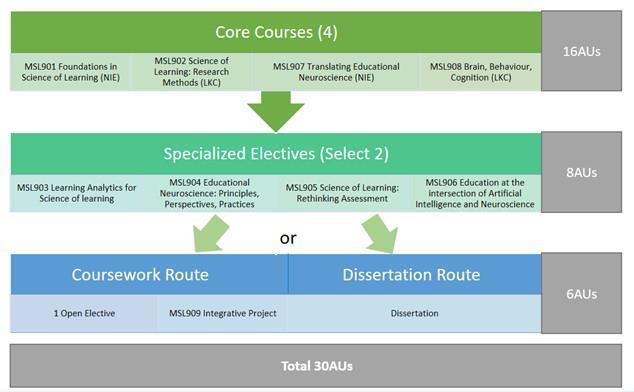
Important note for matriculated students:
Please refer to the ISAAC system for the programme structure relevant to your intake during Course Registration or consult
Assistant Professor Farhan Ali, your programme leader if you need clarifications.
This programme is offered on both part-time and full-time basis. The candidature periods are as follows:
Full-time | Minimum 1 year | Maximum 2 years |
Part-time | Minimum 2 years | Maximum 4 years |
Course Descriptors |
MSL901 Foundations in Science of Learning (4 AUs) This proposed course aims to address a key gap that exists in the translation of scientific research evidence into pedagogical practice. Specifically, the course will provide participants with the necessary foundational, broad-based understanding in philosophies and theories of the science of learning that draws upon educational neuroscience work. Strong grounding of the theoretical basis for science of learning will facilitate translation pathways of scientific research findings towards innovative learning designs and technological tools that are relevant and useful in current learning contexts. |
MSL902 Science of Learning: Research Methods (4 AUs) |
MSL903 Learning Analytics for Science of Learning (4 AUs) |
MSL904 Educational Neuroscience: Principles, Perspectives, Practices (4 AUs) These include issues such as i) early learning struggles and early intervention, ii) challenges that individual differences pose, iii) effectiveness of educational and treatment approaches to cognitive struggles and deficits, iv) widening possibilities that brain plasticity brings to normal (e.g. life-!ong learning) and more. Such a neuroscience and education convergence not only carry multiple implications for educational policy but at the same time, foregrounds the mutual benefits of the interaction between neurobiology and education, as education may also conceivably offer a naturalistic framework for research on the brain. |
MSL905 Science of Learning: Rethinking Assessment (4 AUs) But what constitutes a learning outcome, and what purposes the learning is fit for are contested and complex questions that depend on how and why such learning is assessed in the first place. Furthermore, SoL discourse assumes a paradigm and theory of learning that may be in tension with scientific notions of assessment theory. Hence, it cannot be assumed that the requisite learning outcomes from a SoL approach is compatible, let alone synergistic, with assessment practices and paradigms. It is therefore imperative to understand how assessment theories and practice posit the epistemology of learning outcomes, and how assessment theories may help or hinder the SoL agenda. In turn, advances in SoL research is an invaluable opportunity for the scientific perspectives of assessment theories to be revisited. |
MSL906 Education at the Intersection of Artificial Intelligence and Neuroscience (4 AUs) |
MSL907 Translating Educational Neuroscience (4 AUs) |
MSL908 Brain, Behaviour, Cognition (4 AUs) |
MSL909 Integrative Project (2 AUs) |
MSL910 Assessment Feedback for Improvement and Learning (4 AUs) This course seeks to provide strong fundamentals for participants to acquire critical awareness of key issues and core tenets of instructional feedback as a key assessment practice. Feedback is discoursed as integral to pedagogy and curriculum, and posited as the primary and pervasive dialogue in which learners can identify and address their learning gaps with teachers and peers. The multi-faceted dimensions and purposes of feedback practice are presented, including feedback as pedagogy and/or partnership, and feedback for performance, receptivity, and resilience. |
Courses and Study Plan
Click here for
more information.
For tuition fees, please click here.
For more information on scholarships, please click here.
For programme-related matters, please consult the programme leader, Assistant Professor Farhan Ali for more information.
Have more questions? Browse our Frequently Asked Questions