
Discover the innovations undergoing research, development and testing at NTU research centres
NTU has several research centres focusing on environmental sustainability. This includes the Earth Observatory of Singapore (EOS), Energy Research Institute @NTU (ERI@N), Nanyang Environment & Water Research Institute (NEWRI), Singapore Centre for Environmental Life Sciences Engineering (SCELSE), Singapore CEA Alliance for Research in Circular Economy (SCARCE), Future Ready Food Safety Hub (FRESH@NTU), Institute for Digital Molecular Analytics & Science (IDMxS), NTU Integrated Medical, Biological & Environmental Life Sciences (NIMBELS) and a Sustainable Learning Lab located in the National Institute of Education.
Earth Observatory of Singapore (EOS)
The Earth Observatory of Singapore conducts fundamental research on earthquakes, volcanic eruptions, tsunamis and climate change in and around Southeast Asia, toward safer and more sustainable societies. EOS aims to help build the social compact for Singapore to tackle the challenges of climate change and sustainability, which is central to the major Green Plan policy priority of the Government.

The Institute integrates research across NTU in the context of the energy challenge, and then helps translate outcomes into industry and practice. ERI@N's research focuses on a host of
Interdisciplinary Research Programmes, Flagship Programmes, Consortium Platform and an Accelerator Programme that covers the energy value chain from generation to innovative end-use solutions, motivated by industrialisation and deployment.
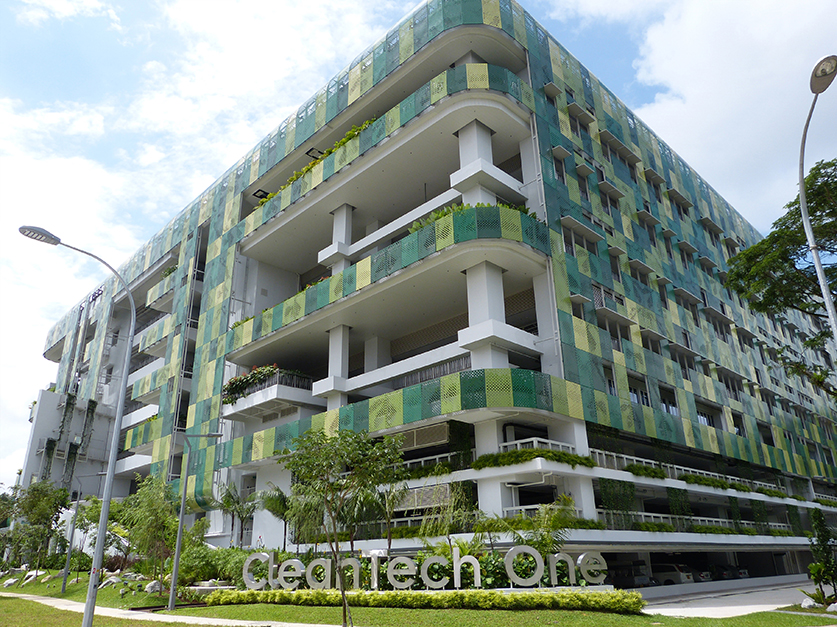
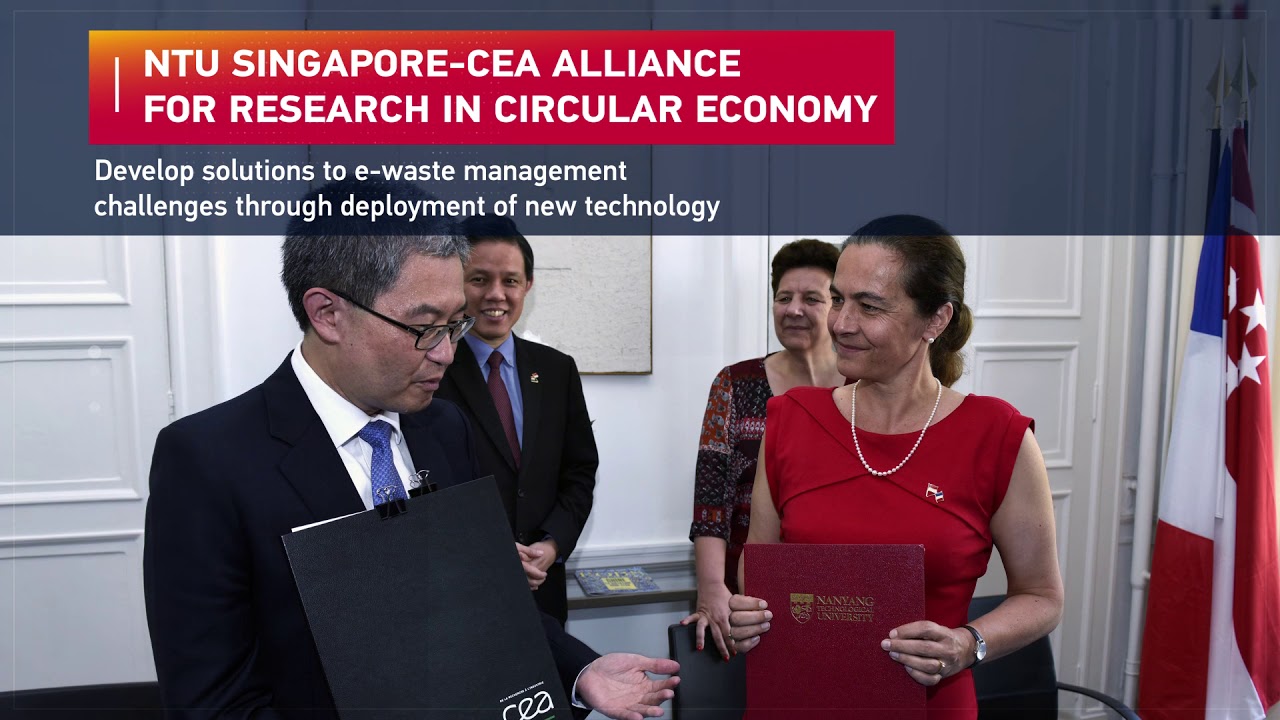
Singapore CEA Alliance for Research in Circular Economy (SCARCE)
A joint laboratory between NTU Singapore and the French Alternative
Energies and Atomic Energy Commission (CEA). The joint venture will synergize the expertise of researchers from Singapore and France to address the recycling and recovery of materials from electrical and electronic waste (e-waste), such as discarded lithium-ion
batteries and printed circuit boards. In addition, the laboratory will explore advanced separation and extraction processes of e-waste which are less energy intensive and toxic as compared to current practices. The overall aim is to develop innovative
and energy efficient solutions to recycle and recover e-waste.
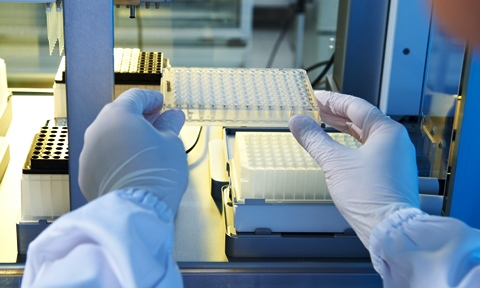
Singapore Centre for Environmental Life Sciences Engineering (SCELSE)
Hosted by NTU in partnership with NUS, SCELSE is linking new insights from the life sciences with expertise from the emerging technologies in engineering and natural sciences to understand, harness and control microbial biofilm communities and microbiomes. The exploratory power available to SCELSE researchers, from laboratory-scale to full-scale environmental, medical and engineered systems, combined with an unrivalled level of interdisciplinary expertise places SCELSE in a unique position, to deliver a comprehensive understanding of all aspects of a microbial system.
Future Ready Food Safety Hub (FRESH@NTU)
Set up as a national research platform under the Singapore Food Story R&D agenda, the Future Ready Food Safety Hub (FRESH) provides expert counsel and food safety research services to public and private organisations working to bring novel foods to Singapore. Leveraging our expertise in food toxicology and risk assessment science we help ensure that foods, even those without prior history of safe consumption, can be safely eaten.

Institute for Digital Molecular Analytics and Science (IDMxS)
The Institute for Digital Molecular Analytics and Science (IDMxS), is a Research Centre of Excellence (RCE) at NTU. IDMxS is an organised effort focused on interfacing the biological and living world with the world of information technology and data science.

NTU Integrated Medical, Biological & Environmental Life Sciences (NIMBELS)
NTU Integrated Medical, Biological & Environmental Life Sciences (NIMBELS) is a university-level strategic venture that brings various NTU entities together and collaborate on initiatives to promote synergistic and interdisciplinary partnerships that are critical to addressing many of today’s health and environmental challenges.

Sustainability Learning Lab (SLL) at NIE
The Sustainability Learning Lab (SLL) is a formal center of excellence situated within the National Institute of Education, Nanyang Technological University. Set against a backdrop of rapid climate change, widespread ecological degradation, and uneven development, sustainability is one of humanity’s grand challenges. The inception of SLL is driven by the collective aspiration of our research and teaching community to cultivate sustainability knowledge as well as foster adaptable and inclusive shared futures.
Our Industry Partners





Research News
Circular economy education: The time is now
Education is critical in ensuring students understand, respect and appreciate a “life cycle mindset”, where products are made to be used as long as possible. But, why is it important for institutions to embrace the circular economy?
Every day, we throw away something in the bin at home and at public places. Most of us buy things without asking ourselves, “Do I need it?”, “How long will it last?”, “Is it healthy and environmentally friendly?”, “Who made it?”, “Where & How is it made?” and “How is my consumption behavior related to carbon neutrality?”.
The consequence of our “unquestionable” consumption and its continuously growing production has polluted our air, trashed our land, and contaminated waterways from canals and rivers to the ocean. Meanwhile, we are depleting our natural resources, from energy to materials, and continuing the growth of greenhouse gas emissions.
We know the “Take-Make-Consume-Dispose” linear economic model is not sustainable.
Imagine waste we dispose of daily in the bin can be transformed into material feedstock and energy to produce value-added products or nutrients for plants/food production. Imagine energy production is from renewable sources. This requires transitioning from a linear economic system to a regenerative and circular economy. We design, produce, and use products guided by Life Cycle Thinking (LCT). Products are made to be in use as long as possible. They are designed for re-use, re-furbish/repair, and remanufacture at the component and system level. At their end of life, the materials used are recyclable and recoverable as feedstock of new products or energy. Materials and functional units are used and processed in optimal circularity to ensure energy & materials efficiency.
Today, the circularity transition has been slow in scalability due to the lack of synergised action from different stakeholders, the existing inert production and consumption system, and the lack of knowledge. Education is critical in accelerating the transition.
We need to:
i) Develop a circularity mindset;
ii) Acquire knowledge on circularity in different sectors (from policy, R&D, industries, to financing);
iii) Discover & Create exciting business opportunities;
iv) Practice Entrepreneur activities;
v) Understand how circularity can address the three pillars of sustainability: environment, society, and economy, accelerate the reaching of the Sustainable Development Goals (SDGs).
Adopting system and life cycle thinking with an entrepreneurship mindset in our education curriculum, we can nurture the next generation leaders and workforce to drive green and digital transformation through the adoption of AI and Big data analytics, coupled with decarbonization and circularity in economic model transition, and creating a sustainability ecosystem that uses fewer resources and creates a bigger impact.
At the King Mongut’s University of Technology Thonburi (KMUTT) Thailand, a general education module GEN352- Technology & Innovation for Sustainability: Smart Circular Economy has been pionereed. We adopted the transdisciplinary approach integrating Industry 4.0 knowledge with circular economy addressing the impact on the SDGs. Students conduct value chain and supply chain analyses on innovations developed at the university and learn how to create impact through market research, business model design, marketing, and financing.

Plastics Circularity (STEAM Platform)
Since 2021, sustainability programs have been introduced as part of Nanyang Technological University (NTU) Singapore’s core interdisciplinary undergraduate program. NTU has recently been selected to host the CIFAL (International Training for Authorities and Leaders) in Singapore. In partnership with the United Nations Institute for Training and Research (UNITAR), the center offers sustainability education and knowledge sharing for government officials and leaders from the APAC region. As part of the education for future youth leaders and entrepreneurs, the Master of Science in Technopreneurship and Innovation programme held at NTU Entrepreneur Academy, students in the Ecosystem Development class in 2023 took up simulated roles of various stakeholders and practiced how to synergize solutions in driving Singapore's circular economy transition from the role of government policymaker, technology provider, investor, industry, entrepreneurs to the end community consumers. NTU will launch in September 2023 a new graduate certificate program, “Circular Economy: Enabling a Sustainable Future”.
The circular economy transition is driven by policy intervention, emerging technologies, product design & business model innovation, innovative financing mechanisms, and consumer behavior. Multi-stakeholder alignment and multi-disciplinary approach in research and education is becoming ever more critical in higher education practices. With the rapid advancement of big data analytics, digital twins, and AI, we are able to track the entire product life cycle allowing optimization of resources used, production process, usage, and end-of-use/life management. Circular product design allows us to keep the product in use for as long as possible and create new products through innovative materials technologies. Circular entrepreneurship education prepares an action-driven workforce to drive change in respective stakeholders’ roles. The convergence of emerging digital technologies (Big data, IoT, AI, Blockchain), physical (Nanotech, Robotics, Materials Science, 3D Printing), and biological (Bioenergy, Bioremediation, Microbiome, Biorefinery) technologies will accelerate the CE transformation.
By Lerwen Liu, Associate Professor in Entrepreneurship, NTU; Arslan Siddique, Postdoctoral Research Associate, UNSW Australia; and Shu Sheng Chia, MSc Technopreneurship and Innovation Alumni, NTU
The article appeared first in Issue 6 of QS Insights Magazine.
- Engineering & Technology
- Learning & Education
- Mechanical & Aerospace Engineering
- Social Sciences
- Research features
- Sustainability
