Human-Centred Technologies in Teacher Education
Reflective Writing Feedback AI Assistant
The AI Assistant aims to assist tutors of the Pedagogical Practices (PP) course in providing personalised feedback to their student teachers. When student teachers write reflections based on their lessons and experiences, they now have the option to seek immediate feedback from an AI Assistant, in accordance with NIE and MOE's frameworks and models.
.jpg?sfvrsn=5f662e9d_1 "55e81535-92c7-4980-ae1e-a174480770a4 (1)")
The cycle of reflection and feedback in student teachers’ formulation of (their) teacher philosophy, and how it feeds into the refinement of their teacher philosophy.
The AI Assistant harnesses AI to assist student teachers and tutors in reflecting on practice. Tailored to NIE's teacher preparation programmes, it draws on the Reflective Practice (RP) and Singapore Teaching Practice (STP) models to help student teachers inquire into their teaching experiences. These reflections, captured in the Digital Portfolio (DP), help student teachers visualise their learning, and connect insights across NIE courses, teacher assistantships and Teaching Practicum. The AI Assistant enhances this process by providing contextualised feedback that aligns with NIE and MOE models to scaffold various aspects of teaching and learning. Importantly, it also guides users to chart their next steps by providing further prompting questions and structured, formative feedback on the depth and breadth of reflections, highlighting areas of RP or STP that may warrant additional consideration.
As AI becomes increasingly prevalent across educational and societal domains, this initiative reflects NIE’s conscious effort to harness its efficiencies while avoiding over-reliance. Through this tool, we empower student teachers to build their conceptual maps of teaching and learning, providing scaffolded support that encourages clarity of thought and self-assessment. However, it is critical that student teachers retain agency in this process and be active meaning-makers who engage critically with the feedback they receive. Our aim is to strengthen their ability to self-regulate and direct their own learning that positions AI as a complement to, not replacement for tutor feedback.
Enhancing Reflective Practice with Timely, Personalised Feedback
The Reflective Writing Feedback AI Assistant offers timely, personalised feedback to strengthen professional inquiry and deepen reflective practice, guided by the NIE Professional Practice and Inquiry (PPI) course and supported by the DP. Timeliness is a key variable in the efficacy of reflection; being able to interrogate one’s actions while experiences remain fresh enhances insight and retention. The AI Assistant bridges temporal gaps between tutor feedback by offering just-in-time support; anytime, anywhere. Essentially, the human mentor remains central in shaping interpretation, posing metacognitive prompts, and facilitating deeper understanding-preserving the authenticity and depth of the reflective journey.
Evidence of Impact
Student teachers have responded positively to the chatbot’s contribution. Koh Eng Huat (PDGE Dec 2024 intake) noted that it helped him focus on overlooked areas and validated his existing insights. Charissa Zi Xin shared that the tool helped her refine her reflections, resulting in improved assignment outcomes. Jonson Chng appreciated how the AI Assistant supported his thinking within the RP and STP frameworks. Together, these testimonials highlight the chatbot’s role in enhancing individual empowerment and fostering self-directed learning. Furthermore, 90% of polled student teachers found the chatbot-generated feedback useful, with 86% reported being motivated to reflect more actively.
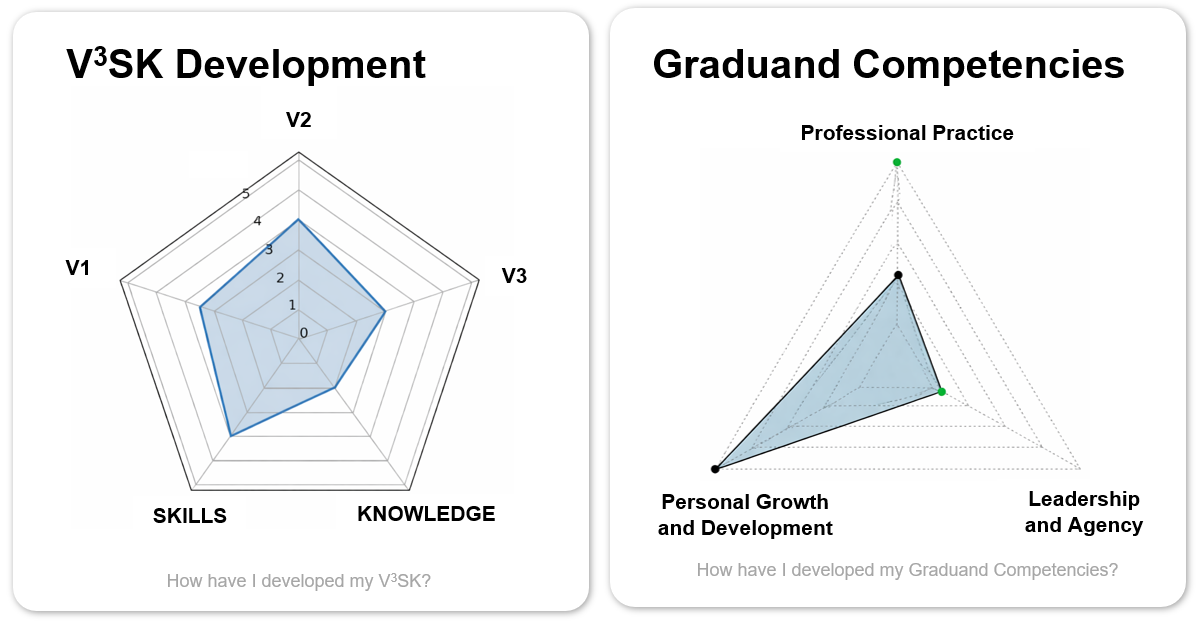
On the left: Radar diagram showing the development of Values, Skills and Knowledge.
On the right: Radar diagram showing the development of Graduand Competency Dimensions.
Tutors, too, have observed its value. PP Tutor Andy Ng affirmed that the AI Assistant sharpened his students’ reflective abilities by unpacking tacit assumptions, reframing their experiences, and enhancing the authenticity of their meaning-making processes. Importantly, Andy supplemented chatbot feedback with human-led metacognitive prompts—exemplifying how AI, when paired thoughtfully with human facilitation, can support deeper learning without displacing the tutor's pivotal role.
Broader Vision and Future Directions
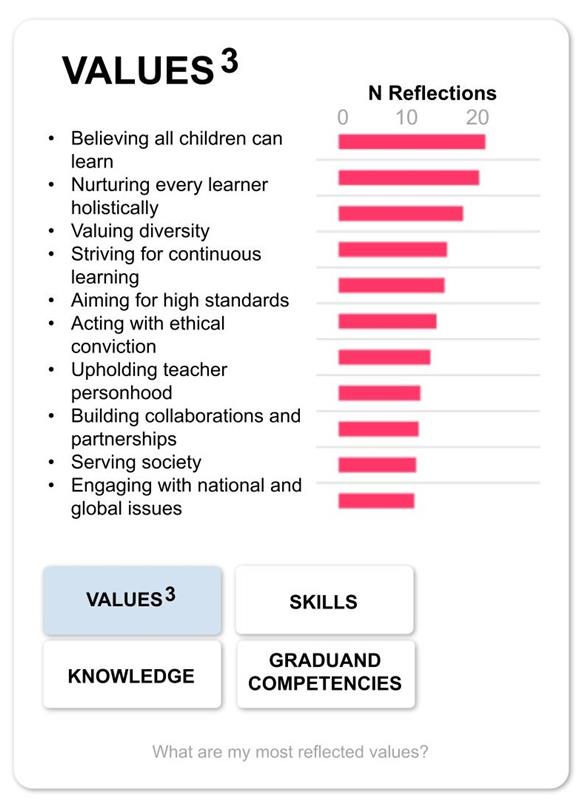
Digital Portfolio Competency Tracking Dashboard: Visualisations of competency attainment, strengths, and AFIs.
Our team developed this digital solution as part of a broader future-oriented vision for teacher preparation in Singapore—one that allows student teachers to document and chart their professional journeys and take ownership of their learning. It positions reflective practice not only as a method for self-inquiry, but also as a means to nurture evolving values, skills, and pedagogical orientations over time. The integration of AI into this process is not intended to supplant human judgment, but rather to enhance and scale reflective capacity while retaining the essential human touch. We remain committed to “keep humans in the loop”, recognising that teaching at its core, is a deeply human enterprise, requiring close attention to the practitioner's values, beliefs, and socio- emotional competencies.
As we expand the use of this tool to other courses and teaching models, the Reflective Writing Feedback AI Assistant represents a step forward in our broader ambitions for digitally enhanced, yet human-centred teacher preparation. It provides a springboard for research into the implications of AI in education, including its effects on motivation, cognition, and professional growth. As we move toward a more sophisticated ecosystem of competency tracking, supported by digital platforms, the chatbot stands as an example of how AI can support professional learning.
In conclusion, the Reflective Writing Feedback AI Assistant is more than a digital innovation; it is a pedagogical innovation to inform NIE of its values-based teacher education programmes, which call for commitment to the learner, to the profession, and to the community. This initiative empowers student teachers to actively reflect on practice, develop digital confidence and competency, and take ownership of their learning trajectories. It honours the principles of student teacher agency, and values-centricity, which will help our future educators remain grounded against rapidly changing times.
"Our team developed this digital solution as part of a broader future-oriented vision for teacher preparation in Singapore—one that allows student teachers to document and chart their professional journeys and take ownership of their learning.”
Authors:
References:
Chua, B.L. & Lim, M. (2025, June 2). Teacher Education in the Digital Era: The Grounding and Guiding Role of Teacher Beliefs and Values. [Seminar presentation]. Ethics and Character in the Age of AI.
Evans, A. C., Jr., Garbarino, J.,Bocanegra, E., Kinscherff, R.T., & Márquez-Greene, N.2019, August 8-11). Gun violence: An event on the power of community [Conference presentation]. APA 2019 Convention, Chicago, IL, United States. https://convention.apa.org/2019-video
Source: Learning@NIE 2026
Read the full issue of Learning@NIE 2026 here. Permission required for reproduction.
.tmb-listing.jpg?sfvrsn=dbe5f6c7_2)