I remember the first time I logged into Knowledge Forum (KF) in a Master class in NIE some twenty years ago. That was ICT Masterplan 2. I wasn't the most impressed with it but nevertheless, as a HOD/ICT the notion of idea-building in knowledge building intrigued me sufficiently to give it a try.
I was curious—with a huge tinge of scepticism —about how my students would take to this new workspace.
The second time I logged into KF, I was with a group of Secondary 2 Normal (Technical) students. I remember we were learning about food science nutrition. I invited the students to bring a food item from home or from the canteen and it could be just a food wrapper. As usual, only a quarter of the class did. We were in a computer lab where I organised the students into 5 groups, making sure each group had someone who brought in a food item. I told them to study the food item and write any ideas they have on the food item on the Knowledge Forum. One condition: they are to use the scaffold provided (e.g., sentence starter – “I need to understand”, “My idea is" etc). I quietly walked around the lab to observe the students. What unfolded took me by surprise. Within minutes, these students, who were often bored quickly, were writing questions and ideas on KF. I remember them nudging each other in their very colloquial way, something like “why that one, expensive right!”. The energy that day felt different from any lessons I had seen. I remember projecting KF on the screen, reading through their ideas as a class, sensing a level of attention that I have never seen before. Later, they agreed that they wanted to find out more about yoghurt. This led us to an experiment of yoghurt-making in class.
That moment changed the educator in me. I knew the theory that each student coming to us doesn’t come with a blank mind, but seeing what they have in mind as laid out on KF, and being discussed and talked about, was powerful to me. When learners are given a shared space where their ideas matter, something profound happens. They start to see themselves not just as a receiver, but as a valued contributor to the knowledge.
Since then, my work at University of Toronto, at the Ministry of Education (MOE) and later in NIE has centred on helping teachers and learners experience the potential of building ideas. Knowledge Forum, an extremely novel concept from three decades ago (as the first generation of Computer-Supported-Intentional-Learning-Environment) has become powerful not because it is “high-tech” and “fancy” but because it brings us back to what matters most in education: ideas, curiosity, and collective growth mindset.
What is Knowledge Forum?
Knowledge Forum is an online discourse environment designed to support Knowledge Building (KB) — a pedagogy where learners collaborate to improve ideas. It emphasises on authentic problems that students care about (or grow to care about) and it always circles back to developing agency, curiosity and a sense of purpose in learning (Fig. 1. Knowledge Building Pedagogical Model (Teo, 2023)).
.jpg?sfvrsn=4ecbf698_1 "KB pedagogy screenshot (1)")
Knowledge Building Pedagogy
What sets KF apart is how it serves as an online workspace that nurtures exploration, inquiry and idea improvement by working with one another. Knowledge building comprises information sharing and getting some factual answers for a more complete explanation of a complex problem. But it also asks for more – when students post, they are not merely sharing answers. They are using the scaffold support such as “I need to understand”, “My Theory,” “New Information,” and “This theory doesn’t explain…” to generate diverse ideas about the topic, and through connection, move toward a more coherent reasoning. KF is a space where naive ideas or incomplete ideas/ thinking are visible so that they can be improved upon.
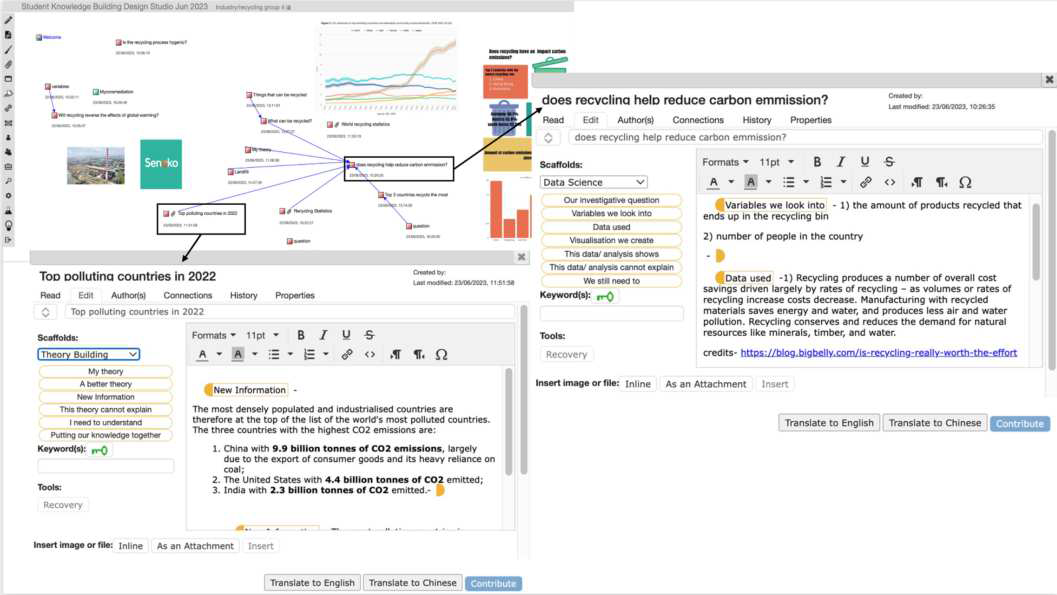
A Knowledge Forum View and Knowledge Forum notes showing students collaboratively analysing real-world data.
Why KB and KF Matters for Teacher Education
At NIE, we grow our teachers' commitment to develop their students holistically, balancing soft skills (21CC) and content knowledge. Knowledge Building classrooms have been shown to boost basic literacy such as reading and writing and disciplinary thinking (e.g., science, history, social studies), and heightened students’ ability to work with knowledge, i.e. how they question, evaluate information, and build explanations.
Some of the common benefits shared by teachers practising knowledge building are:
1. Levelling-up:
Teacher-learners often share how they see a different engagement from their students when they introduce KB and KF to their students, especially for quieter students.
2. Sustained work with ideas:
Students could revisit their earlier ideas written on KF notes, compare perspectives, and refine explanations. When these KF are highlighted in classroom discussion, it helps them see themselves to be more contributing to the understanding of the topic. It also makes KF a valuable tool for reflection.
3.Collaborative mindset:
When learners see one another supporting and improving ideas, a classroom culture built on curiosity, respect, and shared responsibility is built.
KF in NIE Courses: What It Looks Like
Across NIE, colleagues and I have introduced KF into modules such as Foundation of Learning, Computer-Supported Collaborative Learning, and Methodology courses. We also run a holiday programme – Student Knowledge Building Design Studio – every six months in which primary and secondary students come into NIE to experience a knowledge building environment on sustainable living.
Join the KB Journey!
You do not need to redesign your entire course to begin. Many of us start with one big question; one inquiry cycle; and one KF space and for you and your class to experience the joy of building knowledge together. As long as you or your students have an idea worth working on, there is a place for Knowledge Forum.
“When learners are given a shared space where their ideas matter, something profound happens. They start to see themselves not just as a receiver, but as a valued contributor to the knowledge.”
Author:Dr Teo Chew Lee, Centre for Research in Pedagogy and Practice
Reference:
Teo, C. L. (2023). A teacher’s playkit for knowledge building: Creative ways to make students’ ideas come alive. Routledge.
Source: Learning@NIE 2026
Read the full issue of Learning@NIE 2026 here. Permission required for reproduction.

.tmb-listing.jpg?sfvrsn=dbe5f6c7_2)