
AI Empowerment for Science Teacher Education in NSSE
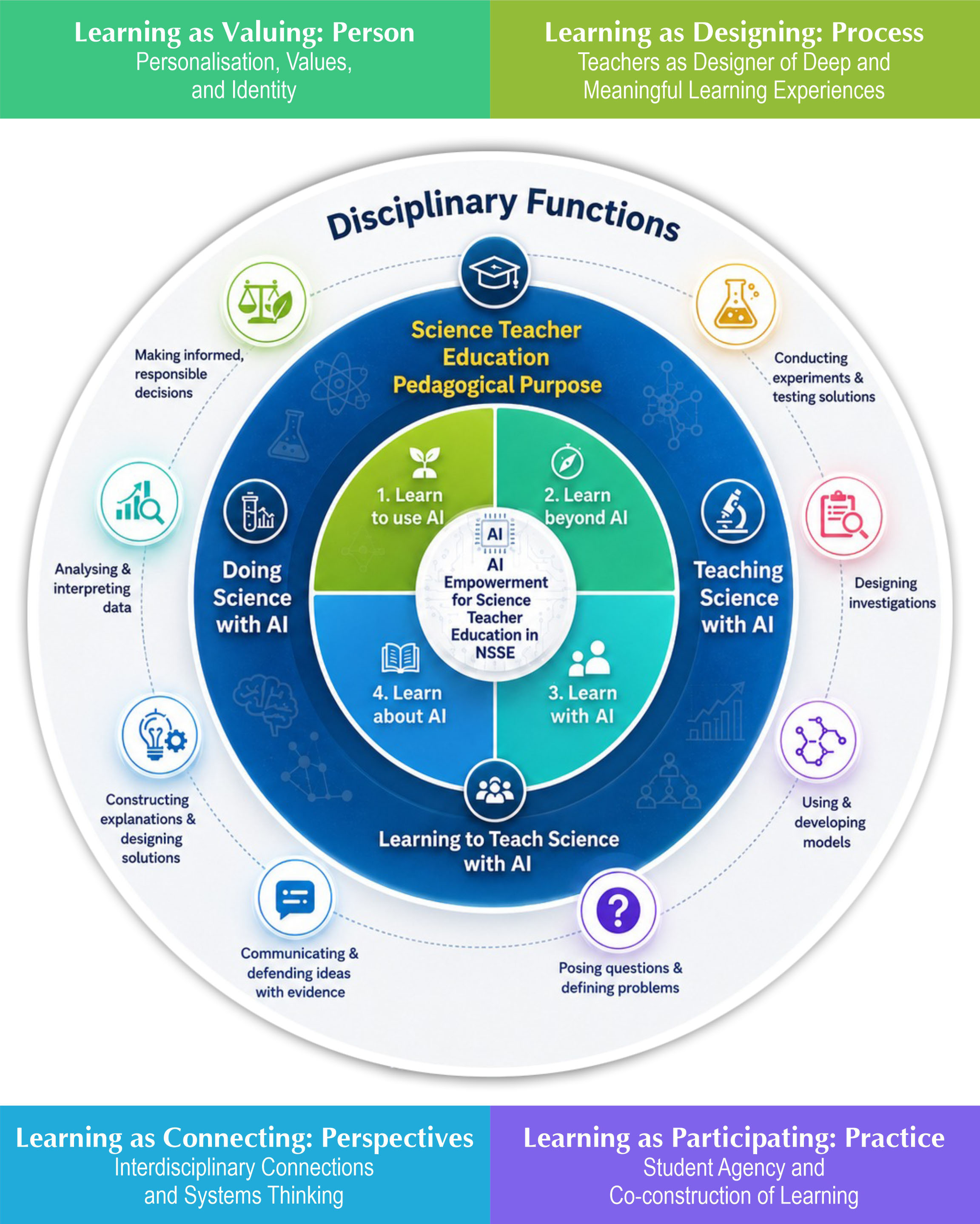
The AI Empowerment for Science Teacher Education in NSSE is set against the backdrop of Learning@NIE: Learning as Valuing (Person), Learning as Designing (Process), Learning as Connecting (Perspectives), and Learning as Participating (Practice).
In designing AI-supported learning experiences, three key constructs inform professional decision making in NSSE – (1) the 4-Learns framework, (2) Do-Teach-Learn science teacher education pedagogical purpose, and (3) disciplinary function.
The 4-Learns (Tan, 2026[1]; Ministry of Education, 2026[2]) serves to enable faculty members to consider the purposes of AI in the learning experiences of student-teachers.
Learn About AI describes opportunities presented to learners to understand the nature of AI, how it works, its capabilities and inherent limitations.
Learn to Use AI describes learners’ engagement with appropriate AI tools to gain practical and meaningful skills to use them effectively and safely to enhance learning.
Learn With AI describes learners’ different interactions that learners have with AI in learning activities to deepen their disciplinary learning and mastery.
Learn Beyond AI describes the development of critical thinking to evaluate, challenge and improve AI-generated outputs to extend their learning. Learning beyond AI is characteristic of knowledge creators and is a desirable outcome of all learning experiences.
The Do-Teach-Learn science teacher education pedagogical purpose is a thinking frame intended to facilitate science educators’ reasoning in the role that AI plays to develop science teachers’ competencies.
Doing science with AI describes the use of AI in authentic scientific research and this is commonly used in graduate level programmes and final year projects where students participate in science research in the laboratories.
Teaching science with AI describes how faculty use different AI tools to design learning opportunities for students to learn scientific concepts.
Learning to teach science with AI describes how faculty facilitates learning and development of pedagogical and teaching competencies for preservice and inservice teachers.
The outermost ring shows the science disciplinary practices and outcomes that can be supported by using AI thoughtfully in lesson planning. These science disciplinary practices are described as Ways of Thinking and Doing Science (WOTD) in Singapore science curriculum framework (Curriculum Planning and Development Division, 2022[3]). WOTD are fundamental outcomes in science learning. Competent teachers can create meaningful learning experiences for students to engage with WOTD.
Investigating includes (1) posing questions and defining problems, (2) designing investigations, (3) conducting experiments and testing solutions, and (4) analysing and interpreting data.
Evaluating and Reasoning includes (1) communicating, evaluating, and defending ideas with evidence, and (2) making informed decisions and taking responsible actions.
Developing Explanations and Solutions includes (1) using and developing models, and (2) constructing explanations and designing solutions.
When engaging students with WOTD, it is also important for students to relate the scientific practices to science, technology, society and the environment (STSE) and for students to understand the nature of science (NOS). Having these three components of WOTD, STSE and NOS as Practices of Science (POS) will empower students to achieve the twin goals of science for life and society.
[1] Tan, S. C. (Apr, 2026). How to support students to learn from, with, about, and beyond AI. Times Higher Education. Downloaded from https://www.timeshighereducation.com/campus/how-support-students-learn-about-and-beyond-ai
[2] Ministry of Education (Apr, 2026). AI in higher education- Hype or hope. Speech by Minister for Education Mr Desmond Lee at the Straits Times (ST) Education Forum. Downloaded from https://www.moe.gov.sg/news/speeches/20260401-speech-by-minister-for-education-mr-desmond-lee-at-the-straits-times-st-education-forum-ai-in-higher-education-hype-or-hope
[3] Curriculum Planning and Development Division, CPDD (2022). Science teaching and learning syllabus: Primary three to six standard/foundation. Singapore: Ministry of Education.
| DOING Science with AI | TEACHING Science with AI | LEARNING to Teach Science with AI | |
Learn to Use AI
| Using data, graphs, or models generated by AI | Checking if AI gives correct answers Comparing AI answers with trusted source | Identifying mistakes Improving AI outputs |
Learn About AI
| Understand what and how AI tools have been used in specific scientific research | Writing clear questions for AI | Understanding how AI tools work and the limits of tools |
Learn With AI
| Asking AI to show sources or steps | Asking AI to explain ideas simply | Giving AI a role such as acting like a teacher |
Learn Beyond AI
| Identifying and justifying when AI tools such as chatbots should be incorporated into lessons Interrogating and making sense of research evidence on effectiveness of AI in education. |
1. AI as a generate-then-critique tool — "Learn to Use AI"
ACY32B Chemistry Planning and Instruction / QCY12B Praxis of Chemistry Education — Under "Lesson Planning," it is stated that: "Use GenAI to generate lesson plan followed by critique, before doing up final revised lesson plan for classroom-based instruction. AI positioned as a first-draft generator whose output is treated as a starting point for critical revision, not a final product — a pattern that recurs across several other Chemistry-pedagogy courses (e.g. data-based question design, automatic assessment of student drawings).
2. Understanding AI tools and their limits – “Learn about AI”
MSC911 AI and Emerging Technologies in Science Education where AI literacy is explicitly introduced through relevant frameworks and applications in science education. Students examine how AI can be critically, ethically, responsibly, and pedagogically integrated into science teaching and learning. AI is used for data analysis and data sensemaking. AI is used critically for designing AR/VR-based lessons.
3. AI as a dialogic tutor/interlocutor — "Learn with AI"
AAB30C Animal Physiology — Students talk directly to AI about specific physiological concepts (diffusion, osmosis, active transport, co-transporters) with the explicit goal of "changing AI understanding of these concepts" — i.e., students probe and correct the AI's explanations as a way of testing and deepening their own understanding. AI is a sparring partner for misconception-checking rather than a source of answers.
4. AI use anchored in human judgement and ethics — "Learn beyond AI"
QCP52A Understanding the Physics Curriculum (mirrored in ACS20A and ACP22A) — Student teachers design a customised GenAI chatbot for their own future lessons, as "Student teachers will critically consider the appropriate role of GenAI in science teaching, ensuring that human judgement, student agency, responsible use, and ethical considerations remain central." The activity (chatbot-building) is technical, but the stated learning goal is deliberately about keeping AI subordinate to human pedagogical judgement — a good example of role and activity being consciously decoupled.
More detailed examples
Click on each Course Code to download detailed descriptions.
| Course Code | Learning@NIE | Four LEARNS | Do-Teach-Learn |
☐ Learning as Valuing ☐ Learning as Designing ☐ Learning as Connecting ✅ Learning as Participating | ☐ Learning About AI ✅ Learning to Use AI ✅ Learning With AI ☐ Learning Beyond AI | ☐ Doing Science ✅ Teaching Science ☐ Learning to Teach Science | |
☐ Learning as Valuing ✅ Learning as Designing ☐ Learning as Connecting ✅ Learning as Participating | ☐ Learning About AI ☐ Learning to Use AI ✅ Learning With AI ☐ Learning Beyond AI | ☐ Doing Science ☐ Teaching Science ✅ Learning to Teach Science | |
☐ Learning as Valuing ☐ Learning as Designing ☐ Learning as Connecting ✅ Learning as Participating | ☐ Learning About AI ☐ Learning to Use AI ✅ Learning With AI ☐ Learning Beyond AI | ☐ Doing Science ✅ Teaching Science ☐ Learning to Teach Science | |
☐ Learning as Valuing ☐ Learning as Designing ☐ Learning as Connecting ✅ Learning as Participating | ☐ Learning About AI ☐ Learning to Use AI ✅ Learning With AI ☐ Learning Beyond AI | ☐ Doing Science ☐ Teaching Science ✅ Learning to Teach Science | |
☐ Learning as Valuing ✅ Learning as Designing ☐ Learning as Connecting ✅ Learning as Participating | ✅ Learning About AI ☐ Learning to Use AI ☐ Learning With AI ✅ Learning Beyond AI | ☐ Doing Science ☐ Teaching Science ✅ Learning to Teach Science | |
☐ Learning as Valuing ✅ Learning as Designing ☐ Learning as Connecting ✅ Learning as Participating | ✅ Learning About AI ☐ Learning to Use AI ☐ Learning With AI ✅ Learning Beyond AI | ☐ Doing Science ☐ Teaching Science ✅ Learning to Teach Science | |
☐ Learning as Valuing ✅ Learning as Designing ☐ Learning as Connecting ✅ Learning as Participating | ✅ Learning About AI ✅ Learning to Use AI ☐ Learning With AI ✅ Learning Beyond AI | ☐ Doing Science ☐ Teaching Science ✅ Learning to Teach Science |
| DOING Science with AI | TEACHING Science with AI | LEARNING to Teach Science with AI | |
Learn to Use AI
| AAQ20E, AAQ20A, AAQ20D, AAQ20G, AAQ30A, AAQ30C, AAQ40A, AAQ40C, AAQ40D, AAY10A, AAY20C, AAY30B, AAY40A, MLS929, AAY10C, AAY20B, MLS921 | AAB30C, AAP30A, QCX12A, QCX12B, QCX12C, AAB20G, AAB10B, AAQ10B, AAQ10C, AAQ30B, ACQ32A, ACQ42A, AAB20C, ACY42A | MSC906, AAQ20C, ACQ42B, ACP42A, QCQ53A, QCQ53B, QCQ53C, MSC911, ACY32B, ACY42A |
Learn About AI
| AAQ10A, AAQ20E, AAQ20G, AAQ30C, AAQ40A, AAQ40C, AAQ40D | AAB30C, MED900, QCX12C, ACQ22A, ACQ42A, ACY22B, ACY42A, ACY42C | ACQ42B, MSC911, ACY22B, ACY32B, ACY42A, ACY42C |
Learn With AI
| AAQ20D, AAQ20G, AAQ30A, AAQ30C, AAQ40A, AAQ40C, AAQ40D, AAY10A, AAY20C, AAY30B, AAY40A, AAY20B, MLS921 MLS929 | AAB30C, AAY20E, AAB30D, AAB10D, MED900, AAB20G, AAB10B, AAQ10C, AAQ30B, AAB40B, AAB20D, AAB20C, ACY22B, ACY42A, ACY42C, AAY10A, AAY20C, AAY30B, AAY40A, AAY10C, AAY20B | ACY22B, ACY42A, ACY42C, ACB22A, ACB32A, ACB42A |
Learn Beyond AI
| QCP52A, ACS20A, ACP22A, ACP42B |
Pre-service science teachers experience AI-supported learning across year levels, programmes, and purposes. The intentional incorporation of AI across the three key areas of science learning (Doing science, Teaching science, and Learning to teach science) ensures that ALL science teachers develop their competencies and confidence in embracing ethnical and meaningful use of AI tools and technologies in science teaching and learning.