Dr Wong Lung Hsiang Gives Keynotes on Seamless Learning
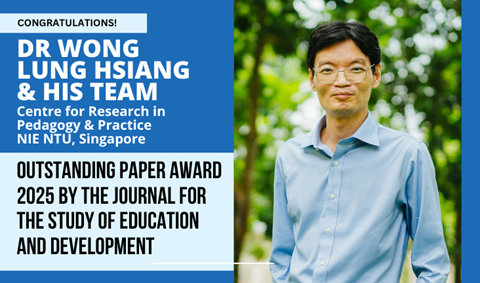
Dr Wong Lung Hsiang at three separate conferences
OER Senior Research Scientist Dr. Wong Lung Hsiang was invited to give three keynote addresses between November and December 2019 pertaining to his decade-long research in seamless learning.
His first keynote address entitled “Seamless Learning Across Physical, Social and Technological Contexts – Implications for Business and Management Education” was delivered at the International Conference on Multidisciplinary Research on Sustainable Development in Pune, India, which took place between 14-16 November 2019. In his keynote, he explained how seamless learning may extend beyond classroom instructions to college-level business and management curricula, with students sharing authentic experiences (e.g., their internships) through social media to co-construct and advance their relevant knowledge and skills.
Dr Wong delivered his second keynote at the International Congress on Education and Technology in Sciences, which took place in Arequipa, Peru between 10-12 December 2019. Entitled “Removing Seams in Learning Science: From Proof-of-Concept to Scaling Up Seamless Science Learning in Singapore”, Dr Wong traced the decade-long trajectory of NIE’s research program on one-to-one (one-mobile-device-per-student) seamless science learning, which was eventually scaled up to 11 schools. He also described the subsequent seamless curriculum redesign to overcome the infrastructure constraints of most K-12 schools in facilitating one-to-one learning.
Finally, at the International Joint Conference on Information, Media and Engineering, held in Osaka, Japan between 17-19 December 2019, Dr Wong gave a keynote entitled “Mobile Seamless Learning (MSL): What is the Conceptual and Practical Niche?”. His address unpacked the salient features of seamless learning at both conceptual and practical levels, and how this concept differs from other overlapping learning notions such as blended learning, self-directed learning, self-regulated learning, lifelong learning and flipped learning.
.tmb-listing.jpg?sfvrsn=9546f249_2)