Sand Mining Is Destabilising the Mekong Delta Far More Than Previously Understood, NIE, NTU Singapore Study Finds
A first-of-its-kind study directly quantifies sand mining's contribution to riverbed erosion and saltwater intrusion using a novel counterfactual modelling approach.
SINGAPORE — Scientists from the National Institute of Education, Nanyang Technological University, Singapore (NIE, NTU Singapore), have found that sand mining is a far greater driver of environmental degradation in the Vietnamese Mekong Delta than previously understood. Using a first-of-its-kind computer modelling approach, the researchers showed that sand extraction is responsible for approximately 25 to 30 per cent of total riverbed erosion and 16 to 30 per cent of salinity increases observed across the delta.
Published in Science Advances, the study is the first to use a counterfactual modelling approach to isolate the impacts of sand mining from other environmental pressures such as upstream dams, sea-level rise, land subsidence and climate change. Unlike earlier studies that relied on hypothetical extraction scenarios, the researchers incorporated real-world sand mining data from 131 active mining zones across the Mekong Delta. By combining these observations with a counterfactual modelling framework, they were able to compare present-day conditions against a virtual scenario in which no sand extraction occurred, providing an unprecedented assessment of sand mining's environmental impacts.
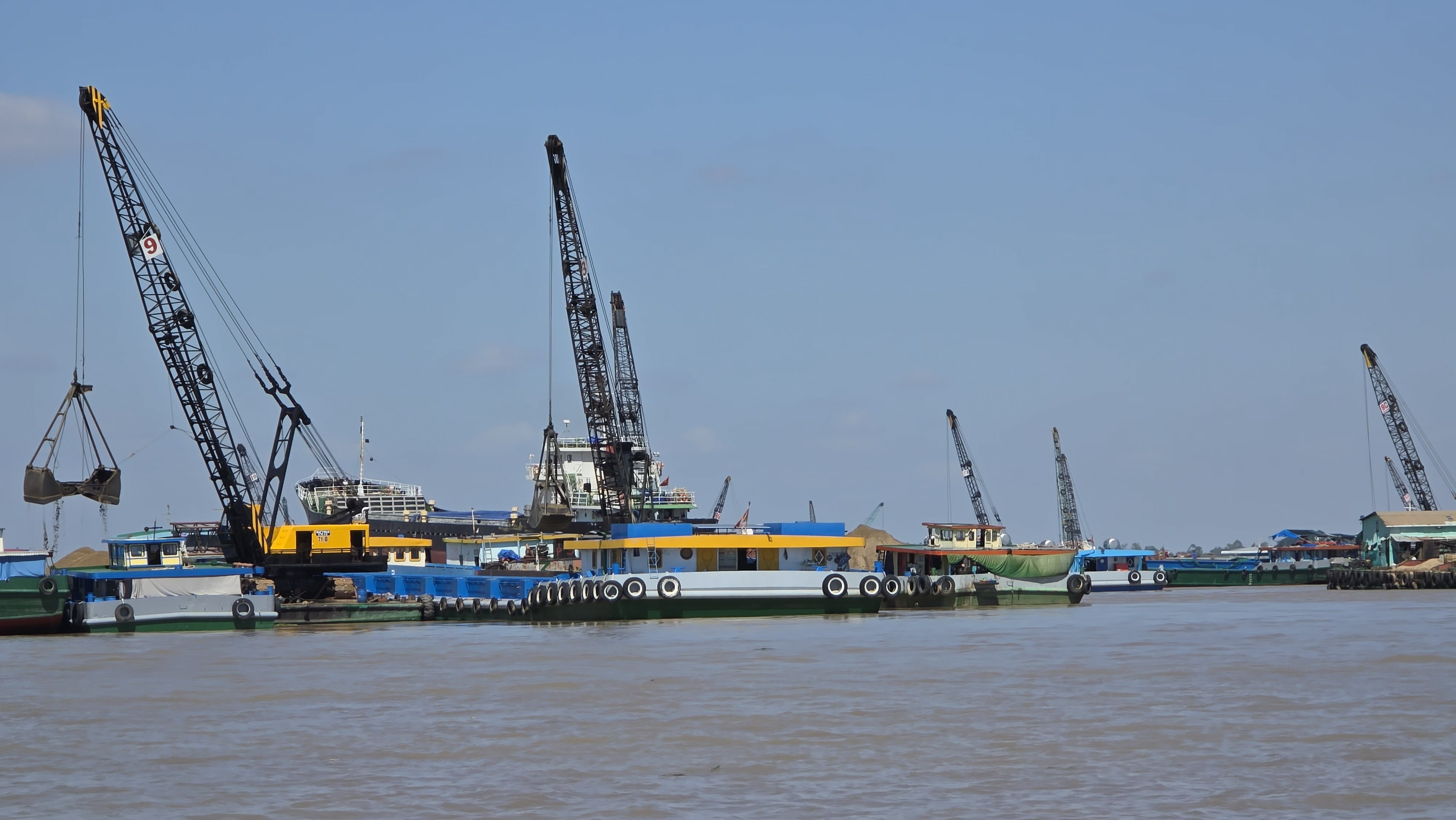 Sand mining barges operating along the Mekong River near the Cambodia–Vietnam border in the Vietnamese Mekong Delta. The image shows crane-equipped barges transferring extracted sand between transport boats. Photo credit: Dr. Sonu Kumar
The Vietnamese Mekong Delta, home to millions of people and one of Southeast Asia's most important food-producing regions, is one of the world's most intensively mined river systems. The researchers found that annual sand extraction exceeds the river's natural sediment replenishment by six to fifteen times. This imbalance is driving widespread riverbed erosion, altering river flows, reducing sediment transport and enabling saltwater to penetrate further inland.
The researchers found that sand mining alone can extend saltwater intrusion by up to 1.5 kilometres further inland during the dry season, threatening freshwater resources, agriculture and ecosystems in a region that supports millions of people and serves as one of Southeast Asia's most important food-producing areas. Approximately 65 per cent of the active river channel network experienced erosion linked to extraction, with the riverbed lowering by an average of about 0.10 metres per year.
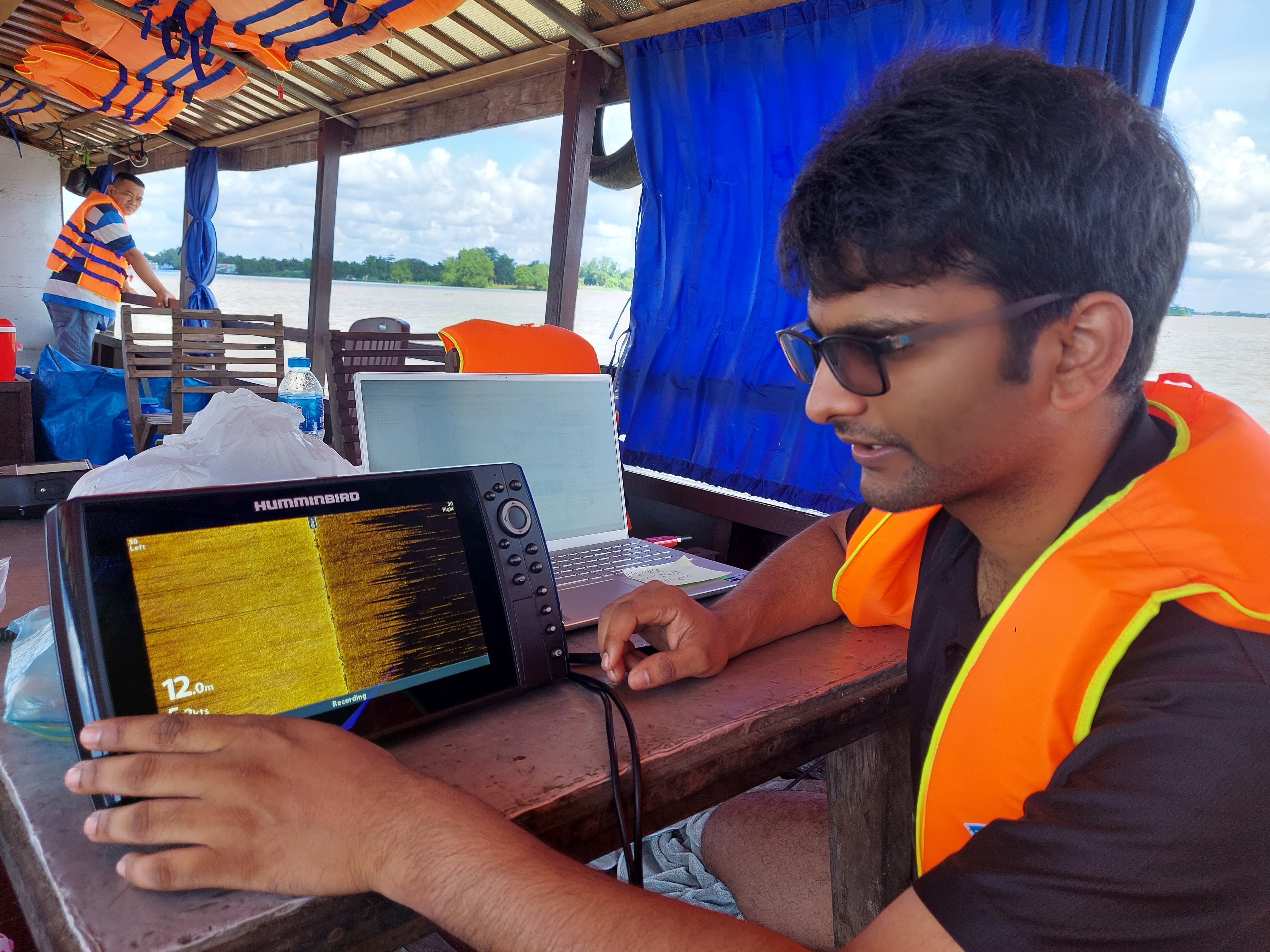
Caption 2: Dr. Sonu Kumar, lead author of the study, conducting river bathymetry measurements in the Mekong Delta to characterize riverbed levels and channel morphology. The research used real-world sand mining data and numerical modelling to isolate the impacts of sand extraction on riverbed erosion and salinity intrusion.
Photo credit: Professor Edward Park
Dr. Sonu Kumar, lead author of the study and Research Fellow at Earth Observatory of Singapore (EOS) and formerly a doctoral researcher at the NIE, NTU Singapore, said: "Sand mining has long been recognised as a problem, but until now it has been extremely difficult to separate its impacts from those of dams, climate change and other environmental pressures. By creating a virtual Mekong Delta without sand mining, we were able to isolate its effects and directly measure its contribution to riverbed erosion and salinity intrusion.
He added: "People often think of climate change or dams when discussing the Mekong Delta's future. Our study shows that sand mining is also a major part of the story. By removing sediment faster than nature can replace it, we are effectively lowering the riverbed and making it easier for saltwater to move inland."
Professor Edward Park, corresponding author of the study from NIE and EOS, said:
"The Mekong Delta is one of the world's most productive and densely populated deltas, but it is also highly vulnerable to environmental change. Our findings demonstrate that sand mining is not simply a localised river-management issue. It is a major driver of delta-wide instability with consequences for freshwater security, agriculture and long-term resilience."
"For the first time, we can quantify how much environmental change is directly linked to sand mining. This provides policymakers with a much clearer evidence base for managing extraction and protecting vulnerable delta systems."
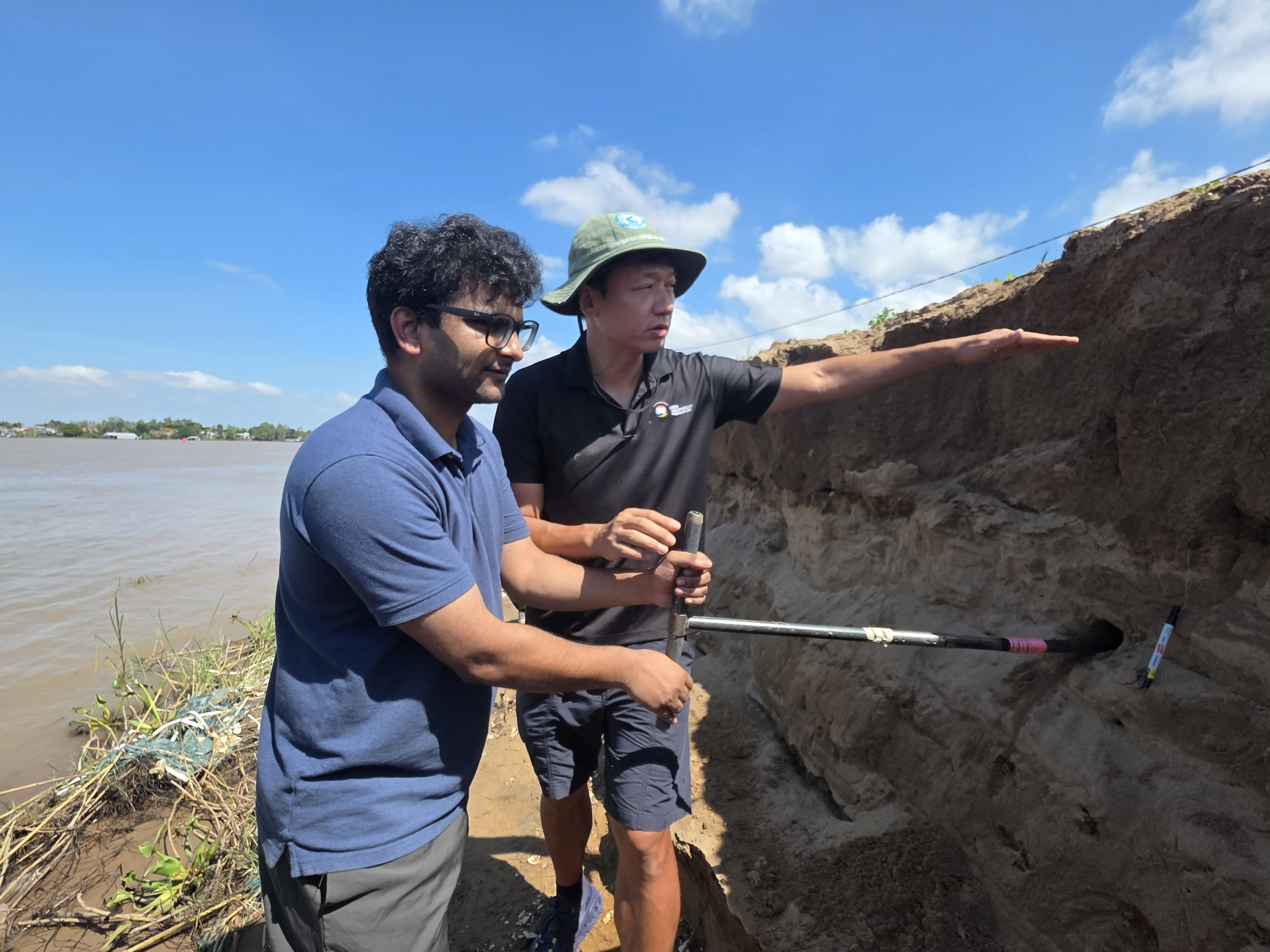
Caption 3: From left to right: Dr. Sonu Kumar and Professor Edward Park, corresponding author of the study, examine riverbank geometry and bank-material conditions in the Mekong Delta to assess riverbank collapse risk associated with sand mining.
Photo credit: Jiachun Huang, PhD student at NIE and co-author of the study.
Using a long-term numerical model combined with real-world sand mining data, the researchers found that extraction volumes averaged approximately 48 million cubic metres annually between 2017 and 2021. Over the same period, sand mining created a cumulative sediment deficit exceeding 250 million cubic metres, resulting in widespread channel deepening and long-term changes to river dynamics.
Beyond the Mekong Delta, the researchers say the findings have implications for river deltas worldwide, many of which face growing pressure from urbanisation, infrastructure development and increasing demand for construction materials.
The modelling framework developed in the study can also be applied to other river systems to help scientists and policymakers better understand the environmental impacts of sand extraction and identify more sustainable approaches to managing river resources.
As global demand for sand continues to rise, the researchers hope their findings will support evidence-based policies that balance development needs with environmental sustainability, freshwater security and long-term delta resilience.
About the Study
The study, "Counterfactual Modelling Isolates Sand Mining Impacts, Revealing It as a Key Driver of Mekong Delta Destabilization", was published in Science Advances on 8 July 2026.
The research is led by NIE and the Earth Observatory of Singapore (NTU Singapore) in collaboration with Can Tho University (Vietnam), Vietnamese-German University, Kyoto University (Japan) and Brandenburg University of Technology (Germany).
Read the published article on Phys.Org.