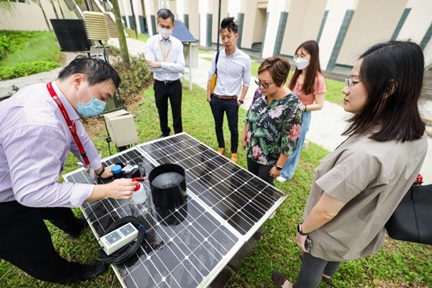
Repeated Year After Year: Indonesia’s Toxic Haze Traps Southeast Asia
Southeast Asia is experiencing its most severe transboundary haze crisis in more than a decade. Forest and peatland fires in Sumatra and Kalimantan have affected Indonesia, Singapore, Malaysia, Brunei and the Philippines, disrupting schools, flights, outdoor activities and daily life. By the end of September, about 1.92 million hectares had reportedly been burnt in Indonesia.
Assistant Professor Wang Jingyu, a meteorology and climate expert at the National Institute of Education, said the present crisis is distinguished by its prolonged duration, high pollution levels and almost uninterrupted impact. Although its peak pollution and burnt area remain below the record-breaking 2015 haze, its persistence has been more extreme.
A/P Wang explained that the strong El Niño brought an earlier and longer dry season, causing vegetation and peatlands to lose moisture. Once ignited, fires can spread into underground peat layers and smoulder for weeks, even after surface flames have been extinguished. This makes peat fires especially difficult to control without sustained rainfall. However, El Niño worsens the conditions rather than creating the fires, which are largely linked to human activities such as land clearing, burning and peatland drainage.
A/P Wang also highlighted the challenges of pursuing accountability across borders. Much of the evidence is located within Indonesia, while cloud cover can create gaps in satellite monitoring. Existing regional agreements also lack direct enforcement and prosecution mechanisms.
The report argues that lasting progress requires moving beyond monitoring and emergency responses towards prevention. Recommended measures include peatland restoration, transparent fire-source tracking, stronger regulation of concession holders and supply chains, alternative livelihoods that do not depend on burning, and scientifically determined thresholds that automatically activate regional assistance.
Read the original article on 凤凰卫视 and 凤凰周刊.

.tmb-listing.jpg?sfvrsn=41a4c4ea_2)