Knowledge Building Community Network Learning 2021
The Knowledge Building Community Network Learning (KBCNL), titled “Bridging research and practice in Knowledge Building: Drawing insights from neuroscience and psychology research” was held on the 15 September 2021, hosted by the Center of Research in Pedagogy and Practice, NIE. More than 50 teachers and researchers from Hong Kong, Shenzhen and Singapore came together for an afternoon of cross-community discussion of Knowledge Building (KB) practice and an interactive talk on cognitive development and KB.
KB stories from across the world
The session started with Ms Jiang Yu, a KB teacher from Shenzhen Songhe Primary School, sharing her KB science lesson, titled “Sink or Float”, with her fifth-grade students. This is Ms Jiang’s first attempt in KB, and she shared how she created opportunities for students to engage in ideas and ask question that they were genuinely interested to explore. She used Knowledge Forum (KF)—an online platform to facilitate KB inquiry—and KB scaffolds to support her students in identifying promising research problems and to build knowledge on buoyancy, gravity and density. She highlighted how KB impacted her students and she observed them developing mindset of a scientist, constantly inquiring and improving ideas.
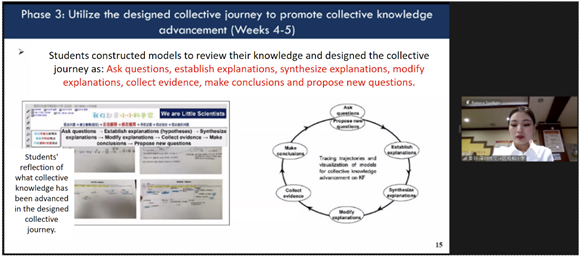
Ms Jiang shared her Knowledge Building story where she promoted collective knowledge advancement in her 5th grade class.
KB and Art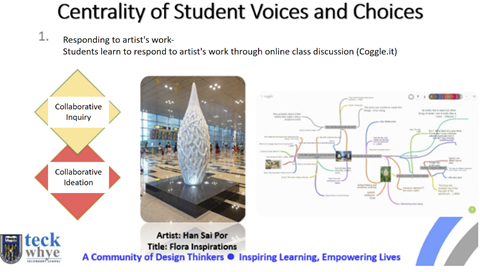
Ms Catherine, a KB teacher from Teck Whye Secondary School shared her KB story titled “Enabling Student Agency in Art Education”. Catherine’s story offered insights in using KB in Art. She described how her Normal Technical students became more interested in art lessons and motivated to improve their artwork as she gave them space to share ideas and to build knowledge with each other. Her strategies focuses on these three principles, (i) centrality of student voices and choices, (ii) culture of building on and (iii) culture of rising above which provided opportunities for students to generate and improve on their competencies in Art.
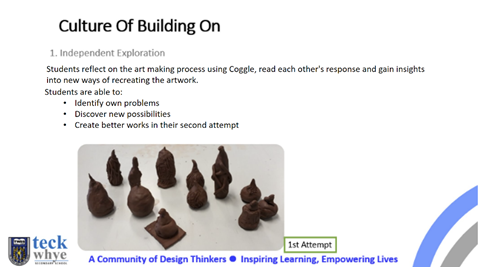
Catherine started her students in replicating professional sculptures with complex designs. This process of replication involved students studying the artist’s original work and students generating ideas about the artist’s thoughts (which was recorded on an online mapping tool, Coggle). When students encountered problems in replicating the artist’s original work using clay, she promoted peer sharing and self-directed learning by getting them to help each other improve their replications. She observed immediate improvement in the clay models built by students. Students were collectively reflecting, discovering new possibilities, and improving their second attempts.
Once a collaborative culture was built among students, she moved them to create theme-based artefacts. She saw a new level of peer-learning when students learned from each other’s productions, she saw risk-taking and creativity in trying new ways of expression, and more importantly, she saw an open-mindedness in embracing diverse ideas. Catherine concluded with her own learning, she saw the importance of being aware of students’ socio-emotional development and how that prompted her to give more positive endorsement to students’ performance. The experience challenged her mindset about the effectiveness of teachers’ demonstration versus students’ peer learning. We saw the power of teacher’s trust and how the students responded positively and performed beyond their usual standards.
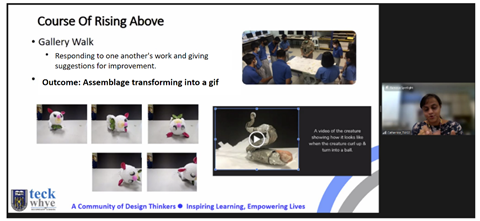
Catherine designed three activities, guided by the KB principles, to allow her students’ voices to be heard, encourage them to build on to each other and rise above.
The Psychology and Neuroscience of Knowledge Building
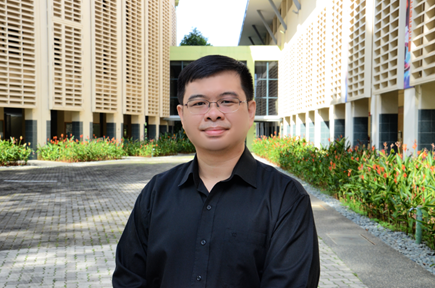
Following this, researchers from the Centre for Lifelong Learning and Individualized Cognition (CLIC), Nastassja and Timothy, led the second half of the KBCNL, to explore the micro-level measures of knowledge building competencies, and what neuroscience says about the impact of KB on students. Nastassja shared on how the human brain develops from childhood to adulthood and she highlighted the importance of the learning environment and the needs of the individual, which can influence changes in the brain. Nastassja followed on with a lively discussion with the participants on this topic on KF:
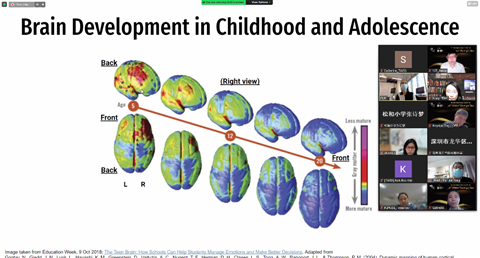
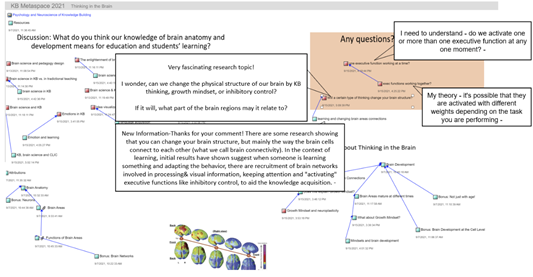
Nastassja shared how the human brain develops across childhood to adulthood and engaged the teachers on what brain development means for teaching and learning using the KB metaspace 2021 community.
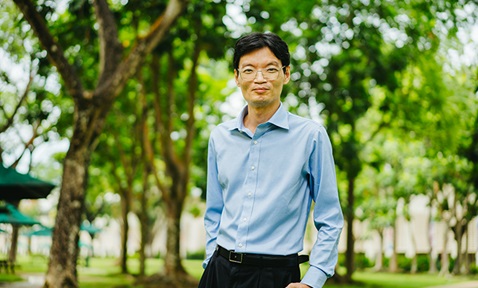
Next, Timothy engaged participants in exploring and understanding how students’ executive functions are used when students engage in KF and KB discussion. Timothy shared a video of students in a KB classroom who were asked to reflect on their discussion. He explained how the interactions can help the students exercise and develop their cognitive flexibility. Timothy shared practical advice on how teachers could promote development of cognitive flexibility in students by using the KB scaffolds and analytics tools on KF to get students to appreciate the diverse forms of thinking and discussion that are possible. Timothy closed the session with a discussion on the inter-relatedness of the executive functions and KB practice, supported by the KB metaspace 2021.
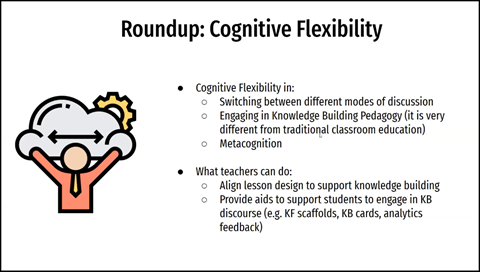
Timothy summarised how cognitive flexibility may be observed in the KB classroom and strategies for teachers.
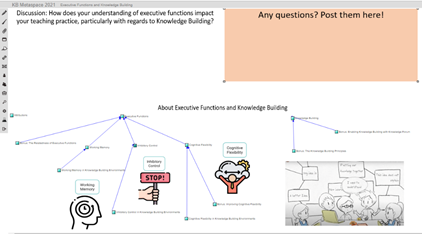
Teachers discussing their understanding of executive functions and impact on Knowledge Building practice on the KB metaspace 2021 community
This network meeting is supported by a virtual “KB Metaspace” designed on Knowledge Forum. The “KB Metaspace 2021” is a virtual community space built to support teachers in cross-community sharing of their KB stories. Different analytic lenses are applied to these stories to help the community see aspects of KB practice that may not be quite as visible before. For example, in a seemingly divergent online discussion that is leading nowhere, a 21CC critical thinking lens could be applied to see if students are indeed thinking critically and that is why they cannot conclude too quickly. This lens requires us to examine the text written by students and analyse how they treat conflicting ideas, and to focus the way they responded, their assumptions, and the understanding we see in the students’ written notes. Or for example, the use of phrases such as “maybe”, “what if” is a demonstration of students exploring possibilities. All these examples may be lost if we are using the regular lens to map against learning objectives.
If you are interested to join the KB metaspace and/or the next KB Community network learning, please leave your email in the link: https://forms.gle/wYvAzWxjHaNWcEoL8.
.tmb-listing.jpg?sfvrsn=c964312a_2)