Congratulations to Dr Sonu Kumar on receiving the NTU PhD Medal of Honour for AY2025/2026!
Awarded the NTU PhD Medal of Honour for AY2025/2026, the University's highest accolade for a graduating PhD student in their field of specialisation, Dr Sonu Kumar has been recognised for research that combines artificial intelligence, satellite remote sensing and environmental modelling to address one of the world's most pressing environmental challenges: unsustainable river sand mining.
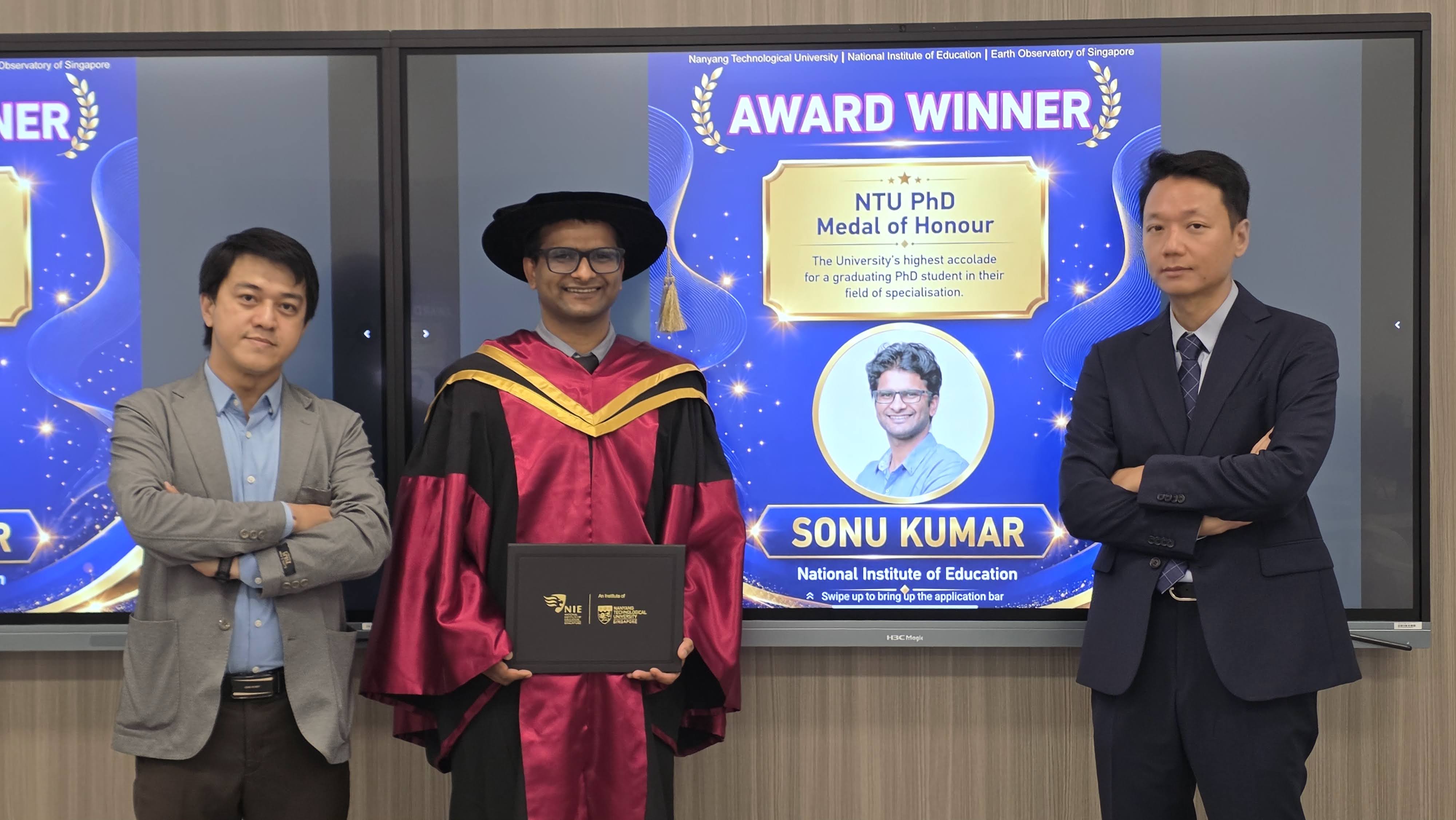
Conducted at the National Institute of Education, Nanyang Technological University, Singapore (NIE NTU, Singapore), his research has produced practical tools to help governments better monitor sand extraction, understand its environmental impacts and make more sustainable management decisions. His findings have been published in leading international journals, including Science Advances.
In this interview, Dr Kumar reflects on the inspiration behind his research, the breakthrough moments that shaped his PhD journey, and how he hopes his work will make a lasting difference for river communities around the world.
1. If you were explaining your PhD research to a friend or family member over coffee, what would you say? Why should people care about this research?
Sand is one of the world's most important natural resources. It's used to build our homes, roads and cities, but much of it comes from rivers. The challenge is that sand mining often happens underwater, making it difficult to monitor how much is being removed and what impact it has on the environment.
My PhD developed a way to tackle this problem from start to finish. I used satellite imagery and artificial intelligence to detect sand-mining activities, computer models to measure their environmental impact, and a decision-making framework to identify where sand could be extracted more sustainably.
I tested this approach in the Vietnamese Mekong Delta, where around 45–50 million cubic metres of sand are extracted each year, far more than nature can naturally replace. My research suggests that a more sustainable level would be around 9–10 million cubic metres annually.
People should care because excessive sand mining can deepen rivers, increase erosion, damage infrastructure, and allow saltwater to move farther inland, threatening freshwater supplies, agriculture and the livelihoods of river communities. Although my research focused on the Mekong Delta, the same approach could help protect vulnerable rivers around the world.
2. Every PhD has an "aha!" moment. Was there a discovery that made you think, "This is really exciting!"?
My biggest "aha!" moment came when I compared two versions of the Mekong Delta using computer models, one representing today's conditions with sand mining, and another showing what the river would look like if sand mining had never taken place.
Many people associate the Mekong Delta's environmental challenges with climate change, sea-level rise, upstream dams and land subsidence. These are all important, but my results showed that poorly managed sand mining is also a major driver of environmental change.
We found that sand mining contributed around a quarter of the riverbed erosion across the delta and accounted for up to 30% of the increase in saltwater intrusion during the dry season.
What made this exciting was that, for the first time, we could clearly separate the effects of sand mining from all the other pressures affecting the delta. That means policymakers now have concrete evidence that improving sand-mining management can make a real difference. These findings were later published in Science Advances.
3. Winning the NTU PhD Medal of Honour is an incredible achievement. Looking back, what part of your research are you proudest of?
I'm proudest that my research didn't just identify a problem, it also offered a practical solution.
The work combines satellite imagery, artificial intelligence and environmental modelling into a single framework that can detect illegal or excessive sand mining, measure its environmental impact, and help authorities make better decisions about where and how much sand can be extracted sustainably.
I believe it stood out because it brought together expertise from several disciplines, including AI, remote sensing, environmental science and public policy, to address a real-world challenge. Seeing different parts of the research published in leading journals such as GIScience & Remote Sensing and Science Advances, and now progressing towards real-world applications through NTUitive, has been especially rewarding.
4. Imagine it's five years from now. What do you hope people will say about your research?
I hope people will say that this research helped make sand-mining management more transparent and evidence-based.
I'd like to see governments using satellite monitoring to identify mining hotspots, computer models to understand the environmental risks, and science-based tools to decide where extraction can happen more sustainably. Ultimately, that could help protect freshwater resources, reduce riverbank erosion and improve the resilience of communities that depend on these rivers.
As someone based at NIE, I also hope the research shows students that solving complex environmental challenges requires collaboration across disciplines. By bringing together AI, geography, environmental science and public policy, I hope it encourages future researchers to develop solutions that have real impact on society.
More broadly, I hope the framework can be adapted for other vulnerable rivers around the world.
5. If my PhD research had a tagline, it would be...
"From hidden extraction to sustainable action."
Sand mining often happens out of sight beneath the water's surface. My research helps make that invisible activity visible, measures its environmental impact, and turns scientific evidence into practical solutions for more sustainable river management.