
Pedagogical Showcase
Discover how our faculty are reimagining teaching and learning. The Pedagogical Showcase highlights innovative practices that are transforming the learning experience across NIE.
Be inspired by stories of experimentation, collaboration, and educational excellence from our faculty, many made possible through close partnerships with IN-Learning and supported by the Incentivising ICT Use Innovation Grant (i3G). The i3G grant empowers faculty to bring bold, technology-enhanced ideas to life and supports NIE’s efforts to advance ICT integration in teaching and learning.
Do check out the Learning@NIE publications for more insights and innovations in teaching and learning.
ALEX+ :AI-Powered Learning Experience Design Partner
Meet ALEX+, the Generative AI partner helping faculty create aligned, engaging learning experiences.
ALEX+ is context-aware, intuitive, and collaborative course design partner that supports end-to-end learning design and integrates seamlessly with their existing workflows. ALEX+ delivers deeper contextualisation in course design, supports pedagogical decisions, and streamlines the transition from design to course development with features such as file upload function, multimodal content development, personalised course design dashboard and integration with LIBRIS. ALEX+ helps NIE Faculty improve course quality by providing AI-powered support throughout the course design journey from initial ideas to structured learning experiences
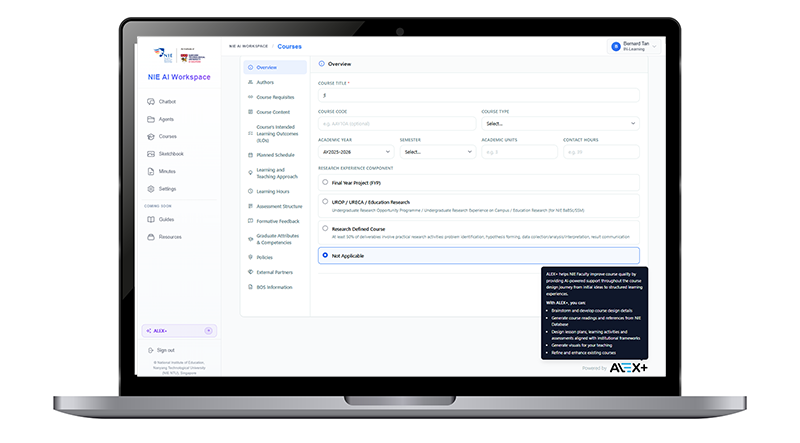
screenshot of ALEX+ user interface in NIE AI Workspace
PALAS
What If Learning Adapted to You?
Discover how PALAS uses AI to personalise the journey of mastering Malay Morphology.
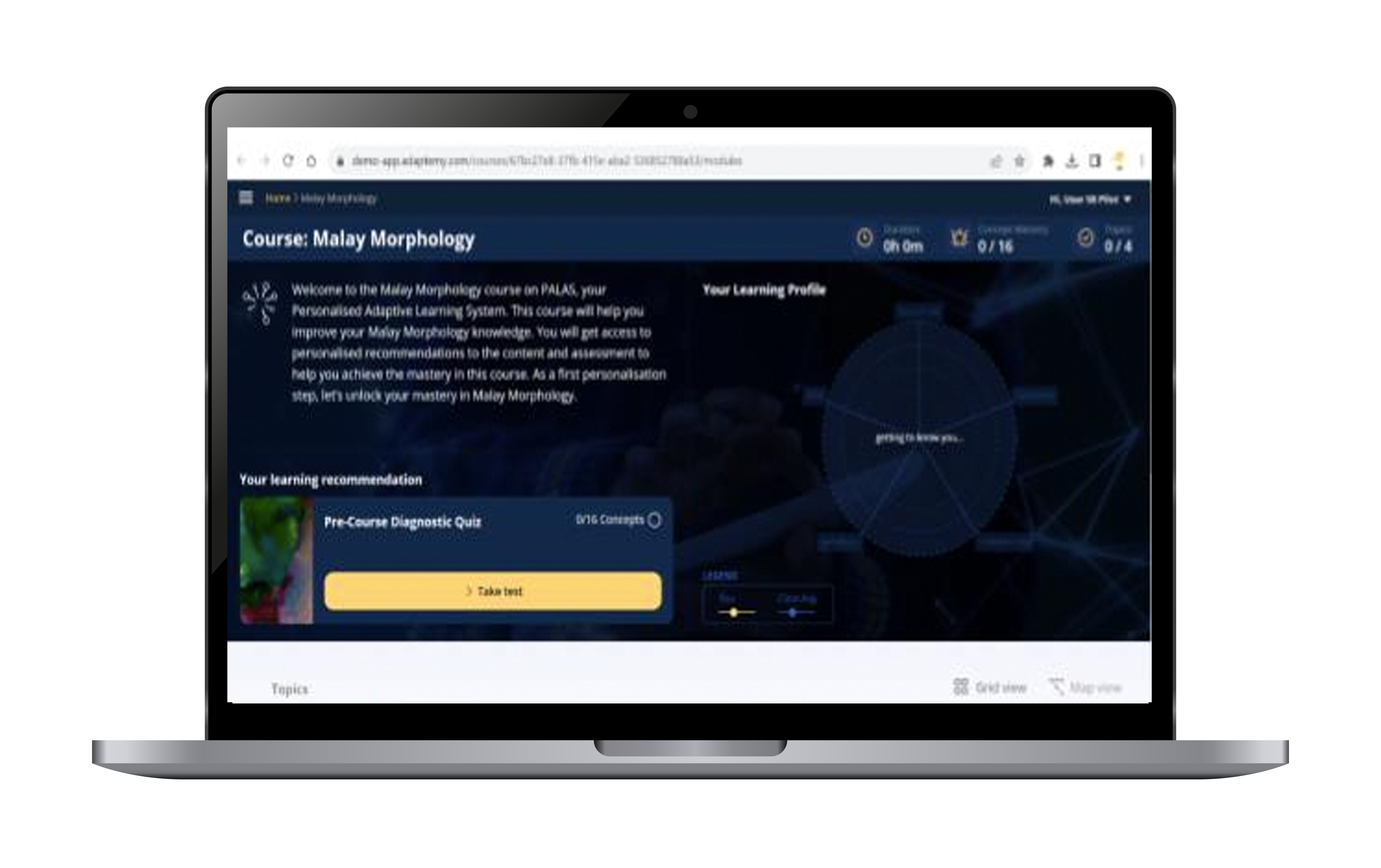
In the Malay Morphology module, student teachers often start with varying levels of prior knowledge. To address this challenge, the Personalised Adaptive Learning and Assessment System (PALAS) was developed as an AI-enabled platform designed to personalise learning and assessment. Leveraging adaptive learning principles, PALAS dynamically adjusts instruction and practice based on each learner’s progress, enabling a more tailored and self-directed learning experience.
Key Features of PALAS
- Learner-Centric Design: Offers each learner a unique pathway, allowing progression at an individual pace.
- Integrated Access: Delivered seamlessly through Blackboard NTULearn with single-login access.
- Adaptive Mastery Loop: Uses real-time diagnostics to estimate mastery levels and recommend next steps for learning.
- Actionable Analytics: Provides instructors with detailed data to support timely intervention and content adjustment.
Development and Pilots
The system was conceptualised and developed between July 2022 and December 2023 through collaboration among experts in linguistics, pedagogy, assessment, and educational technology. Two pilot runs were conducted with student teachers in 2023. Pilot 1 (March 2023) involved 44 users and focused on initial usability testing while Pilot 2 (October 2023) introduced improved UI/UX and recorded positive engagement and higher effect sizes in learning outcomes. Analytics from both pilots indicated strong concept coverage, high pass rates, and encouraging feedback from learners, including increased motivation and confidence in teaching Malay grammar.
Pedagogical Framework
PALAS is underpinned by a robust framework consisting of:
- Curriculum Mapping: Breaking lessons into assessable concepts.
- Content Authoring: Creating instructional and assessment items with calibrated difficulty.
- Mastery Loop Design: Guiding learners through Engage, Present, Guided Practice, and Assessment stages.
- Adaptive Feedback: Offering immediate feedback and personalised recommendations based on mastery estimates.
Through continuous monitoring and adaptive adjustments, PALAS enables differentiated learning pathways while equipping faculty with data to inform lesson redesign and intervention strategies.
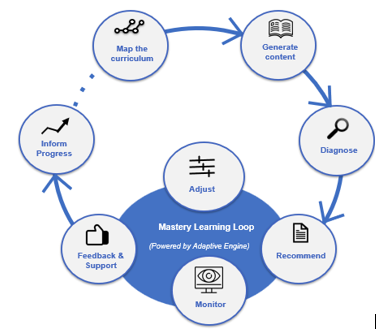
PALAS Pedagogical Framework
Explore the full story of PALAS here.
Project PI: Dr Suryani Binte Atan, Teaching Fellow, ALC
Supported by: Ms Punithavathy Palanisamy, Learning Specialist, IN-Learning
Pedagogical Showcase Videos:
Critical Visual Literacy
Dr. Alexius Chia from ELL shares his approach to teaching critical visual literacy, a skill that has become increasingly vital in today’s world of pervasive visual media. His students reflect on how learning to critically engage with visuals helps them make sense of and navigate their everyday lives.
Watch the video here.
Independent Learning with Branching Videos
Dr. Roszalina Rawi from ALC introduces branching videos as an engaging tool for independent learning. Through their experiences, learners share how this approach enhances their autonomy and deepens their understanding through providing an interactive means of self-revision.
Watch the video here.
Knowledge Building Pedagogy
A/P Tan Seng Chee and Dr. Teo Chew Lee reflect on the growth of Knowledge Building Pedagogy at NIE since the early 2000s. They share strategies for designing lessons around its 12 guiding principles, while learners share how knowledge building has supported and enriched their learning experiences.
Watch the video here.
AVAIL
AVAiL is an AI-powered video analytics platform that seeks to understand learner engagement in an online synchronous lesson. Funded by the I3G, it tracks online learners’ facial expressions in real time and allows tutors to make data-informed decisions through their learner’s affective engagement and emotional connection to their learning. Faculty will receive real-time and post-lesson data on the affective, cognitive and behavioural engagement of learners through a Zoom-based dashboard. The end goal is to enable faculty to improve the design of lessons and student engagement, adapt their teaching strategies, and foster a more inclusive and effective learning environment.
Project PI: Wang Qiyun, Associate Professor, LSA
Supported by: Wang Luhao, Learning Data Specialist, IN-Learning
Learning Buddy
Learning Buddy is a Gen-AI empowered self-learning platform to enhance student learning by providing a personalised, engaging, and interactive platform that supports self-regulated learning. Funded by the I3G, the platform integrates self-assessment strategies, Gen-AI driven feedback, and real-time feedback, analytics and prompts to promote self-reflection. This is achieved by guiding students in setting goals, conducting diagnosis quizzes, monitoring and tracking progress through self-assessments, and prompting students with questions at key points in their learning to encourage self-reflection and critical thinking.
Project PI: Dr Chua Kah Loong, Deputy Head, PCHD
Supported by: Ms Punithavathy Palanisamy, Learning Specialist, IN-Learning
Coaching Observation Tool
The Coaching Observation Tool (COT) is an AI-powered application that provides timely and meaningful feedback to sports practitioners to help them improve their craft in the aspect of values-driven teaching or coaching. Funded by the I3G, this technology-enabled learning solution aims to contribute towards values teaching and learning practices not just in PE and CCA but also across all other academic subjects taught in schools. With coding of both live teaching and recorded footage, the sports practitioner can make a comparison between his/her values-driven lesson plan (i.e. planned) and the statistic provided by the app (i.e. actual).
Project PI: Koh Koon Teck, Associate Professor, PESS
Supported by: Ahmad Adil Irfan Bin Muhammad Yusman, Digital Media Specialist, IN-Learning
.png?sfvrsn=a77780ad_1)