
College News and Events







School of Humanities
Read More




The issue of metaphorical universality

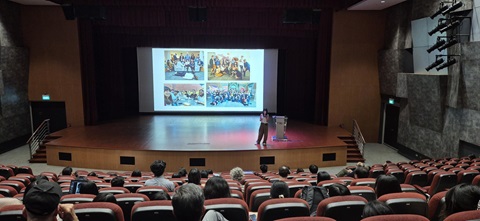
In this talk, I raise a vitally important theoretical issue concerning conceptual metaphors and cognitive linguistics in general: Can conceptual metaphors be universal? To answer this question, I rely on a large-scale study my colleagues and I conducted on metaphors (and metonymies) of anger in twenty-five languages, encompassing eleven language families (Kövecses, Benczes, and Szelid, eds., 2025). Overall, we have identified about 400 conceptual metaphors in the twenty-five languages we investigated. Our results indicate that there are no conceptual metaphors that promise to have universal status in an absolute sense. What we found was that human beings around the world make use of the creative potential they are endowed with and create their metaphors systematically in congruence with the totality of their experiences. It is in this sense that I contend that universal metaphors for anger (or for whatever abstract concept) are theoretically possible, but highly unlikely.
References:
Kövecses, Zoltán, Réka Benczes, and Veronika Szelid, eds., 2025. Metaphors of anger across languages. Universality and variation. Berlin: De Gruyter.
Professor Zoltán Kövecses is a Professor of Linguistics at Eötvös Loránd University, Budapest, with research focused on metaphor, the conceptualisation of emotions, and the relationship between language, mind, and culture. He is the author of a significant number of influential works, including Metaphor in Culture and Metaphor and Emotion. In addition to his academic work, he is a lexicographer, having published Hungarian-English and English-Hungarian dictionaries. Professor Kövecses has lectured at leading universities such as UC Berkeley, Rutgers, and the University of Nevada, Las Vegas. He serves as an editor of Metaphor and Symbol and has made significant contributions to the field of cognitive linguistics, with his work inspiring scholars worldwide.

2df84a40-9c4d-4906-b426-a5b55a819997.tmb-listing.jpg?Culture=en&sfvrsn=1b9ad63e_1 "600x400_Sitefinity Thumbnail (1)")
.tmb-listing.jpg?Culture=en&sfvrsn=592d16ac_1 "600x400_Sitefinity Thumbnail (62)")
.tmb-listing.jpg?Culture=en&sfvrsn=9f7ed0da_1 "600x400_Sitefinity Thumbnail (63)")
a7fb7826-b6c5-41be-b788-e1bd24d8f663.tmb-listing.jpg?Culture=en&sfvrsn=73160f08_1 "600x400_Sitefinity Thumbnail (57)")
.tmb-listing.jpg?Culture=en&sfvrsn=b2181cba_1 "600x400_Sitefinity Thumbnail (60)")
edc9e8e3-cce8-4c19-b901-256c5190dff3.tmb-listing.jpg?Culture=en&sfvrsn=28c0a899_1 "600x400_Sitefinity Thumbnail (53)")
36a334bd-e758-4405-b6e5-df69b05f948a.tmb-listing.jpg?Culture=en&sfvrsn=83ad9e4b_1 "600x400_Sitefinity Thumbnail (56)")
.tmb-listing.jpg?Culture=en&sfvrsn=cab228c6_1 "600x400_Sitefinity Thumbnail (61)")
.tmb-listing.jpg?Culture=en&sfvrsn=ebd4b7fb_1 "600x400_Sitefinity Thumbnail (8)")
.tmb-listing.jpg?Culture=en&sfvrsn=dde745f_1 "SSS Level 1 Screen (SMU NTU)")


.tmb-listing.jpg?Culture=en&sfvrsn=fd769440_1 "SSS Level 1 Screen (Nilanjan Raghunath)")
.tmb-listing.jpg?Culture=en&sfvrsn=749a58e_1 "Conference Day 1 (4)")





.tmb-listing.png?Culture=en&sfvrsn=40347725_1 "Thumbnail (800x600 px)")