PhD Student Ma Zhaoyi Receives Top Postgraduate Honour at NZASIA Conference
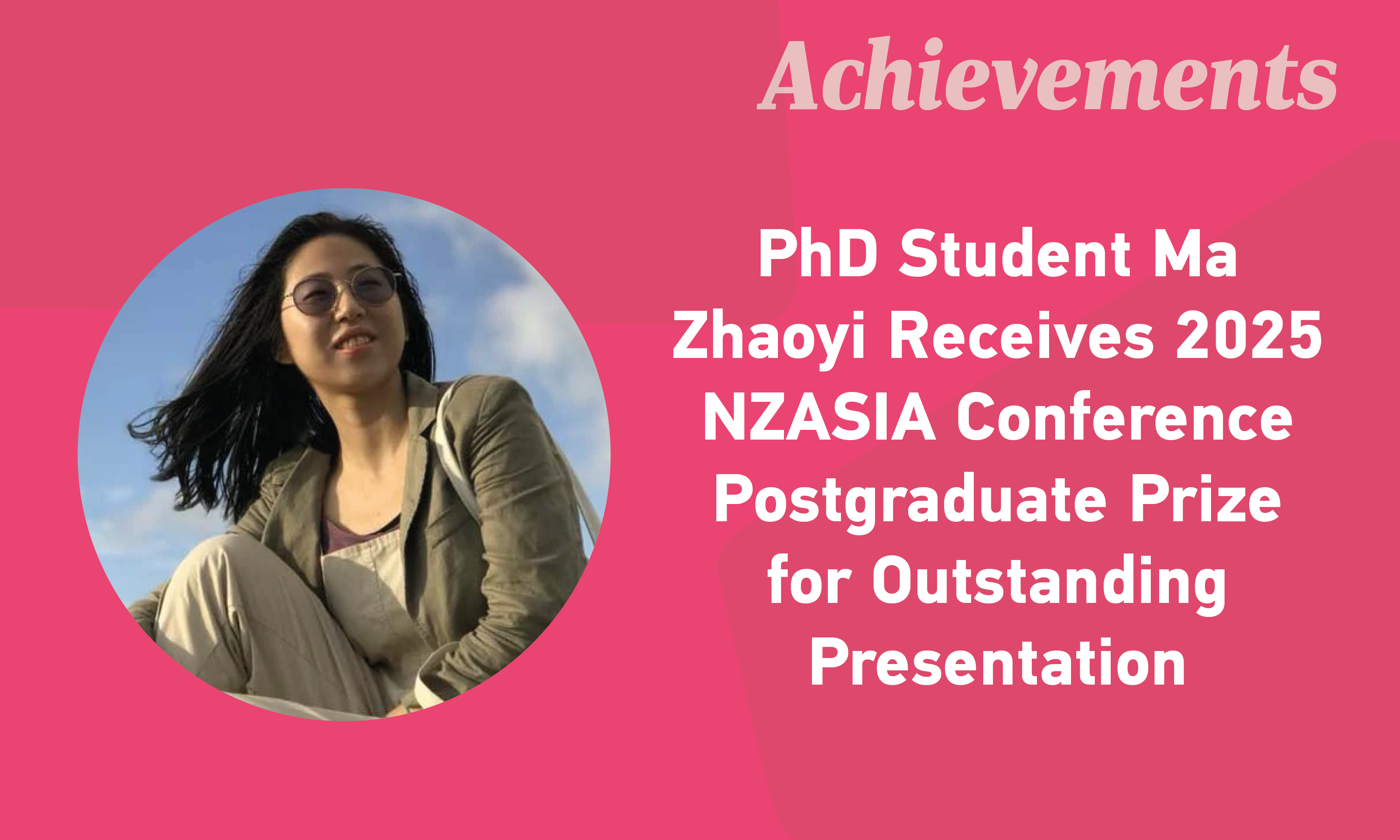
We're excited to share that our PhD Student Ms. Ma Zhaoyi has received the NZASIA Conference Postgraduate Prize for best conference paper presented at the 26th NZASIA International Conference.
The biennial conference was held in New Zealand last week. The prizes recognize outstanding student achievement in research on Asia and award students who display a high level of scholarship in their work.
Zhaoyi's paper was on Reimagining British Descriptive Geometry in Late Qing Imperial Construction (1875–1878): Cosmotechnics from Arsenals to Tombs
This study examines how late Qing China (1875–1878) negotiated British descriptive geometry—an emblem of industrial modernity—through cosmotechnical synthesis, offering strategies for non-Western societies confronting global technoscience. Analyzing Jiangnan Arsenal’s technical translations and Yangshi Lei architects’ imperial blueprints, the research reveals a dual reconfiguration of spatial concepts: Han Technocrats embedded Euclidean and analytic geometry within Confucian ti (ontological substance) and Daoist dao (cosmic principle) for militarized production by reframing orthographic projection as xian zhenxing (顯真形, revealing primordial forms). Manchu-Supervised Craftsmen crafted a Daoist divine gaze perspective as yong (tools) for imperial construction management by fusing British aerial projections with geomantic dipan yang (地盤樣) and 3D jiehua (界畫). This stratified adaptation transcended the ti-yong binary: geometry geometry became neither Western abstraction nor Chinese tradition, but an interface between industrial precision and cosmological order. By comparing the Qing’s shift (ti to yong) and Britain’s trajectory (Euclidean to analytic geometry), the study argues that cosmic resonance universally precedes technoscientific domination. The Qing’s cosmotechnical synthesis epitomizes how non-Western technocultures absorbing cross-cultural technical rigor without surrendering cultural agency.
Congratulations, Zhaoyi!