
Assessment Principles
- Assessment planning should be conducted in tandem with curriculum design. Both for formative and summative assessments should be included within the assessment plan.
- Assessment should promote understanding of goals and criteria, and the fulfilment of learning outcomes.
- Assessment should focus on learner's progress and not be concerned with the rank-ordering of learners.
- Feedback should be timely, clear and constructive. Opportunities to use the feedback for improvement should be provided.
- Assessment should be primarily aligned to intended learning outcomes. Assessment could also support learners in developing a range of relevant skills and attitudes.
- Evidence of learning should be collected using a range of assessment methods that allow learners to clearly demonstrate their proficiency levels.
- Assessment processes should be clear and consistent.
- Assessments should try to align as close as possible to actual contexts of where the knowledge and skills are to be applied.
- Information on assessment aims, method, procedures and performance criteria should be communicated to learners and staff in a clear, accurate and timely manner.
- Assessment should be set at an appropriate level and manageable for learners. If possible, autonomy could be given to learners to demonstrate their learning achievements.
- Assessment, should not disadvantage any groups or individuals. Learners should have full access to demonstrate their learning achievements.
- Assessment should provide learners with constructive guidance to improve and to develop self-assessment.
- Assessment should take into consideration ways to empower and engage learners. As far as possible, learners should be actively involved in the assessment process.
- If possible, technology-mediated assessment, with semi-automatic and automatic feedback, should be harnessed to increase learner autonomy.
- Assessment should be set up to minimize potential negative consequences on learners' well-being.
- Assessment, whenever appropriate, should be concerned with psychosocial competencies of students. If possible, students should receive feedback related to growth in psychosocial domain.
Learning As a Community (Videos)
Fundamentals of Assessment: Principles and Practices for the Classroom
Chapter 1: Assessment Principles in Practice -> Click here to view the video
Chapter 2: Assessment and Examination Policies in the Singapore Education System -> Click here to view the video
Recommended Readings
Featured Assessment Textbook
Browse our recommended assessment textbooks, designed to support educators, researchers and students in understanding contemporary assessment practices.
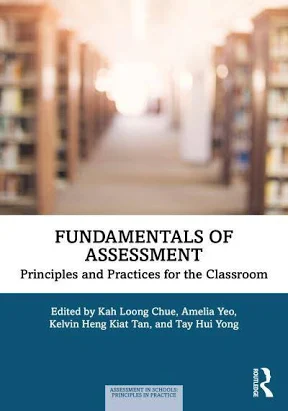 | Fundamentals of Assessment: Principles and Practices for the Classroom Description Offering a valuable introduction to those beginning their journey into educational assessment, this book provides both teachers and students insights into the challenging world of designing, implementing, and interpreting classroom assessments. School-based assessments are essential in planning for quality teaching and learning, but getting assessments "right" can be a challenging task for teachers, especially those who are new to the profession. It is exacerbated by the fact that because learners often experience assessment last in the lesson cycle, it is also the last consideration in teachers’ minds. This text is divided into four sections: (a) “Foundations of Assessment”, (b) “Assessment Design and Development”, (c) “Approaches to Formative Assessment”, and (d) “Sustainable Assessment for the Future”. By the end of the book, readers will have a solid understanding of classroom assessment practices and be equipped to design and implement assessments that support student learning, promote equity and inclusion, and take into account the important psychosocial aspects of assessment (e.g. how it impacts students’ well-being). It is a must read for trainee teachers, education policymakers, and in-service teachers looking to freshen their knowledge of the latest educational assessment innovations. [Learn more about the book and purchase a copy from the publisher] |
| Bookmark this page and check back regularly, as we continuously update our recommended reading list with new books in assessment and evaluation. |