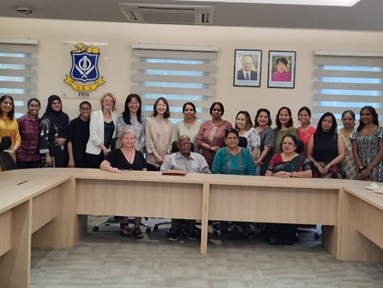
Engaging Students with Special Educational Needs through the Arts
NAC-AISS 1/22 JWPC - Artist-in-Schools Scheme (AISS) in SPED Schools: Examining AISS through the lens of student engagement and pedagogies in and through the arts
"The work in drama and dance classrooms predominantly centers around movement and fiction, leading students through journeys of creative play and performances to explore narratives and identities. These lessons often challenge the students with SEN to pretend and engage in imagination.”
"The artists suggested that a collaborative relationship with teachers will ensure that the drama or dance programs were planned and conducted to serve the needs of the students more accurately as the teachers had more intimate knowledge of the students’ capabilities. At the same time, the partnership between the teachers and artists could also ensure that the positive changes witnessed in the students during the drama or dance lessons were sustainable and extended beyond the arts programs when teachers continued working with the students in and through the arts."
Project Team
PI: Dr Jennifer Wong
Co-PIs: A/P Lum Chee Hoo, A/P Leonard Tan, Asst/P Rebecca Heaton, Dr Kehk Bee Lian, Mr Alvyn Tan
Collaborators: Ms Juliana Chen (Media, Arts and Social Sciences, Singapore Polytechnic), Ms Cheryl Yee (Senior Specialist, SPED, Ministry of Education), Ms Moritza Lum (Special Education Officer, Ministry of Education)
Research Associates: Ms Sin Hui Xing, Ms Chong Gua Khee
Project Description
Artist-in-Schools Scheme (AISS) in SPED Schools: Examining AISS through the lens of student engagement and pedagogies in and through the arts, conducted between 2022 and 2024, was the result of a partnership grant by the National Arts Council (NAC) in Singapore and focused on understanding i) the pedagogies of teaching artists working in SPED schools in Singapore; and ii) the benefits and impacts of engaging the students in and through the arts. Data for the project included: (i) survey responses from 78 students, 16 artist-educators, 26 teachers, and 80 parents/caregivers; (ii) interviews with 8 students, 18 artist-educators, 14 teachers, and 10 parents/caregivers; and (iii) approximately 32 hours of classroom observations of 6 case studies.
Project Implications
Findings from the study shed light on the person-centred and flexible approaches adopted by the teaching artists to foster enjoyment, communal and individual identities as artists, enhanced motivation to go to school, and improved social-emotional skills.
Recommendations for SPED Schools interested in including arts programmes:
- Active partnership between the teachers and the teaching artists to trial arts pedagogies to engage the diverse learning styles and abilities in the class.
- Ensure that each arts programme is offered over a substantial period of time to allow teaching artists to develop an in-depth understanding of the students’ needs and abilities in tandem with the development of a person-centred artistic approach to engage the students
- Offer arts programmes to all students who are interested instead of selecting students who have demonstrated ‘talents’ in the arts.
- Support the teaching artists by assigning teachers, teaching assistants or volunteers, especially in classrooms for students with severe disabilities and/or needs, as active participants in the programmes.
Recommendations for artists interested in teaching in SPED schools:
- Acquire knowledge and skills about special educational needs and disabilities prior to designing and enacting arts programmes in the SPED schools.
- Adopt a person-centred approach in the design and enactment of the arts programmes.
- Form or join a community of practice with other teaching artists who conduct arts programmes in SPED schools to learn and share effective pedagogies and strategies to better engage the students.
- Possess deep knowledge and skills in the art form to support the development of a flexible yet robust arts programme
- Seek mentorship from teaching artists who are experienced in teaching in SPED schools.
Resources
Selected Talks:
Practices-in-Progress: Learnings and Hopes in Special Education Arts Classrooms, Symposium at St. Andrew’s Autism Centre
Practices and Intentions: Engaging Children and Youth with Special Education Needs through Drama, a keynote presentation at Sensitive Spaces: Performative approaches for an inclusive education from primary school through to university organised by Aix-Marseille University, Provence, France
Music and Movement to Engage Children with Cerebral Palsy: Sharing Pedagogies and Practices from a Singapore Practitioner, a conference presentation at Sensitive Spaces: Performative approaches for an inclusive education from primary school through to university organised by Aix-Marseille University, Provence, France
Selected Articles:
Wong, J., & Lum, C. H. (2025). What Does It Take? Pedagogies and Practices in the Drama and Dance Classrooms in Special Education Schools in Singapore. In Arts Education and Sustainability in a Time of Crisis (pp. 29-41). Singapore: Springer Nature Singapore.
.tmb-listing.jpg?sfvrsn=15a05377_2)
.tmb-listing.jpg?sfvrsn=6da54113_2)