NTU–Wuhan University Study Redefines Global River Channel Patterns
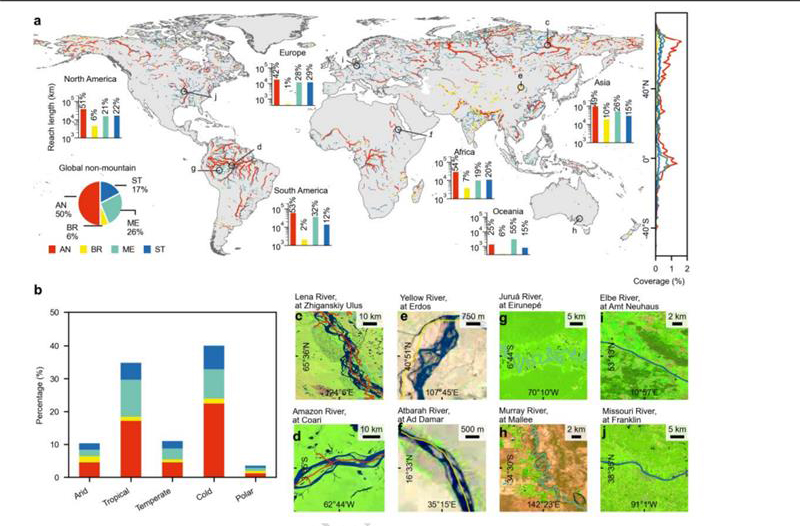
A major international study co-led by Nanyang Technological University (NTU) and Wuhan University, China, has delivered a fundamental advance in fluvial geomorphology by revealing how rivers are organized globally. Published in Nature Communications, the research presents the first comprehensive global classification of alluvial river channel patterns, showing that anabranching channels dominate more than half of the world’s alluvial rivers—a finding that challenges long-standing textbook assumptions in river science.
Drawing on high-resolution satellite imagery and global hydrographic datasets, the team systematically mapped and analysed river planforms across diverse climatic and tectonic settings. The results demonstrate that anabranching channels are not rare or transitional forms, but a globally prevalent and persistent river pattern, occurring from lowland floodplains to mountainous regions. These findings have far-reaching implications for understanding sediment transport, flood dynamics, river resilience, and how rivers respond to climate change and human pressures.
This landmark study represents over five years of collaborative research involving scientists from multiple countries and institutions, and was jointly led by NTU and Wuhan University. As a significant conceptual contribution, the work helps to reframe the foundations of fluvial geomorphology, providing a new global perspective on river form that will inform future research, environmental management, and Earth system modelling.
Associate Professor Edward Park is one of the lead authors for the paper under the Climate Transformation Programme project. Read more about the project here.
Read the paper here: https://www.nature.com/articles/s41467-026-68569-z