NIE-NTU Researchers Conduct Mekong Delta Field Campaign on River Dynamics and Sediment Processes
VIETNAMESE MEKONG DELTA, 3-13 December 2025, A research team from the National Institute of Education (NIE), Nanyang Technological University (NTU), Singapore, completed an 11-day scientific field campaign along the Hau and Tien Rivers in the upstream Vietnamese Mekong Delta.
Led by Associate Professor Edward Park, the campaign focused on field-based investigation of river dynamics, sediment transport, and sand mining impacts, contributing to ongoing research on sustainable river management in the region.
The team conducted boat-based surveys, in-situ measurements, sediment sampling, water-quality monitoring, and real-time onboard data processing, covering multiple cross-sections of two of Southeast Asia’s major river systems. Team members included Dr Dung Duc Tran (Research Fellow), Mr Sonu Kumar (PhD Student), Ms Jiachun Huang (PhD Student), Mr Abhishek Kurmi (PhD Student), and Ms Kai Wan Yuen (Research Associate), working closely with Mr Thien Duc Nguyen and supported by local partners in Dong Thap and An Giang provinces.
During the expedition, the team deployed Acoustic Doppler Current Profilers (ADCPs), water-quality sensors, and bottom-grab samplers to obtain high-resolution measurements of river flow, sediment characteristics, and water chemistry. Fieldwork was conducted primarily by boat along key reaches of the Hau and Tien Rivers and complemented by riverbank investigations and sediment profiling.
These observations help clarify how river morphology, hydrodynamics, and human activities ( particularly sand mining) interact to influence channel stability and delta processes, with implications for flood risk, navigation, agriculture, and long-term environmental resilience. The data collected will support NIE and NTU’s ongoing research on sustainable river management, sand mining governance, and climate resilience in the Mekong Delta, and will contribute to future academic publications and engagement with regional stakeholders.
“This fieldwork provides essential ground-level observation of the interactions between water, sediment, and human activity” said Associate Professor Park.
In addition to its scientific objectives, the campaign provided valuable opportunities for research training, teamwork, and cross-cultural collaboration, reflecting NIE’s commitment to field-based learning and international research cooperation.
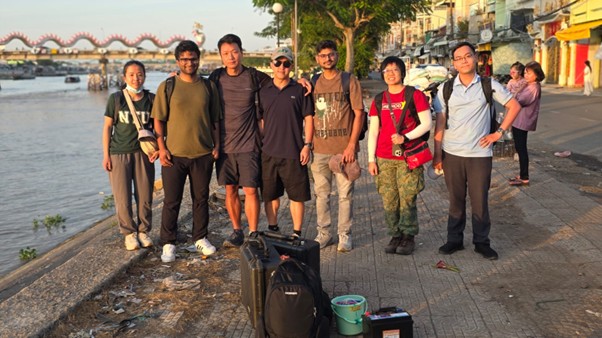
Group photograph of the research team following completion of the field survey on the Tien River, Dong Thap Province, 7 December 2025. From left to right: Ms Jiachun Huang (PhD Student), Mr Sonu Kumar (PhD Student), Prof. Edward Park (Associate Professor), Dr Dung Duc Tran (Research Fellow), Mr Abhishek Kurmi (PhD Student), Ms Kai Wan Yuen (Research Associate), and Mr Thien Duc Nguyen (Local Research Collaborator)
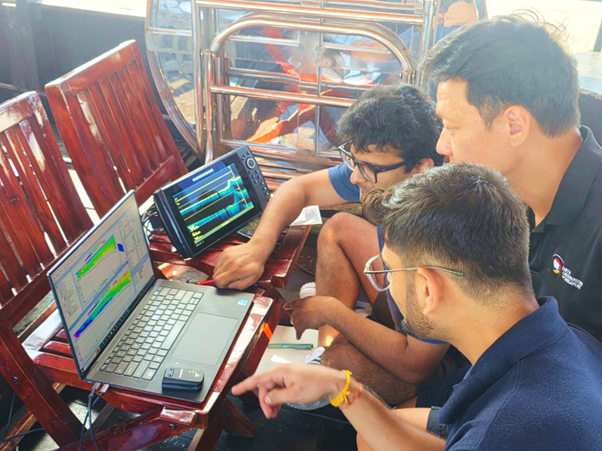
Onboard analysis of ADCP and Humminbird data during river survey operations. Prof. Edward Park discussing real-time hydrodynamic and bathymetric profiles with Mr Sonu Kumar and Mr Abhishek Kurmi on the survey vessel. The team is interpreting velocity structure and sediment distribution to identify early indicators of sand mining impacts on river morphology and vertical sediment profiles.
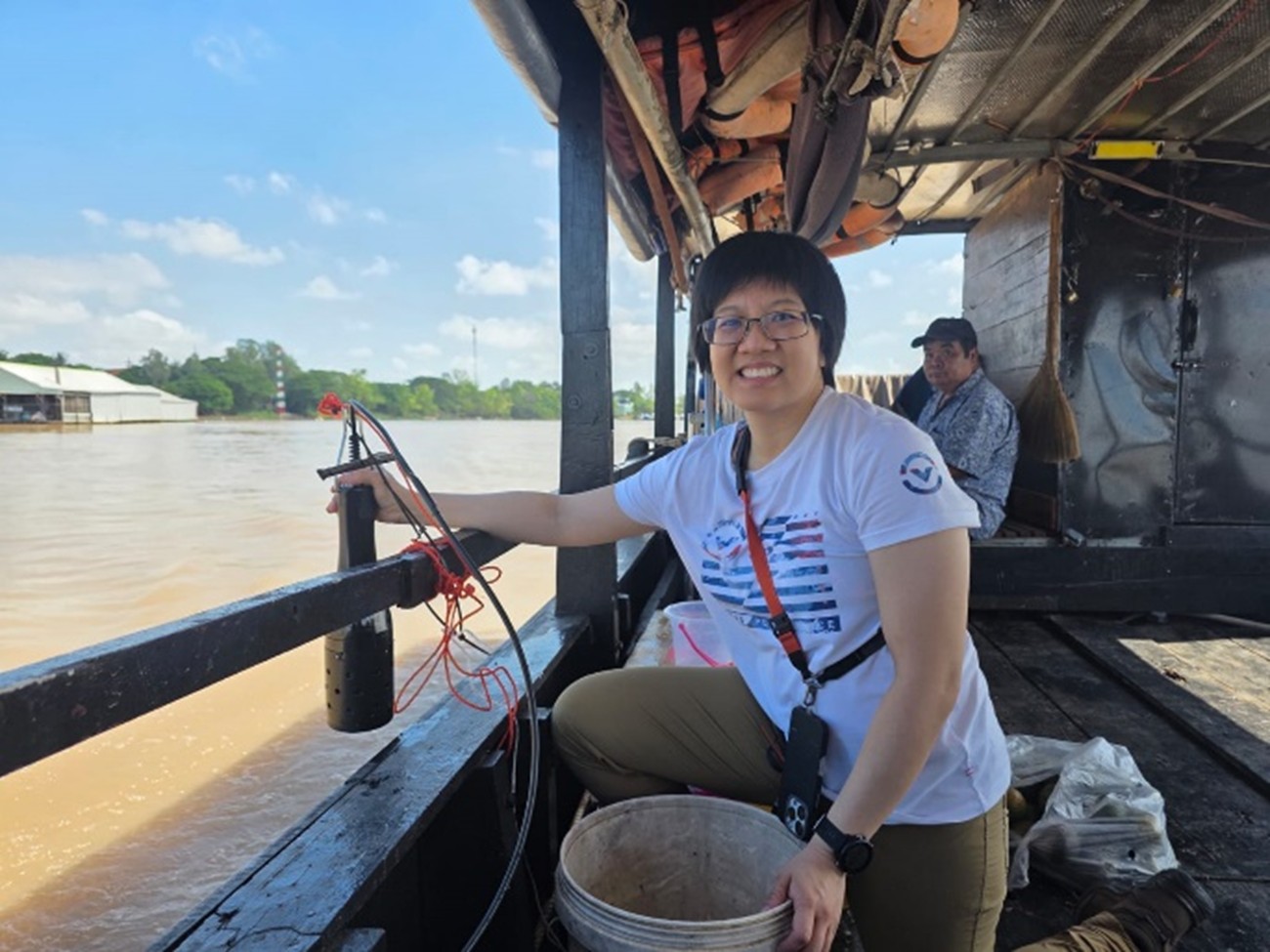
Deployment of water-quality sensors during river survey operations. Ms Kai Wan Yuen preparing and lowering water-quality instrumentation into the river to obtain in-situ measurements of key physicochemical parameters, supporting assessment of hydrological and environmental conditions.
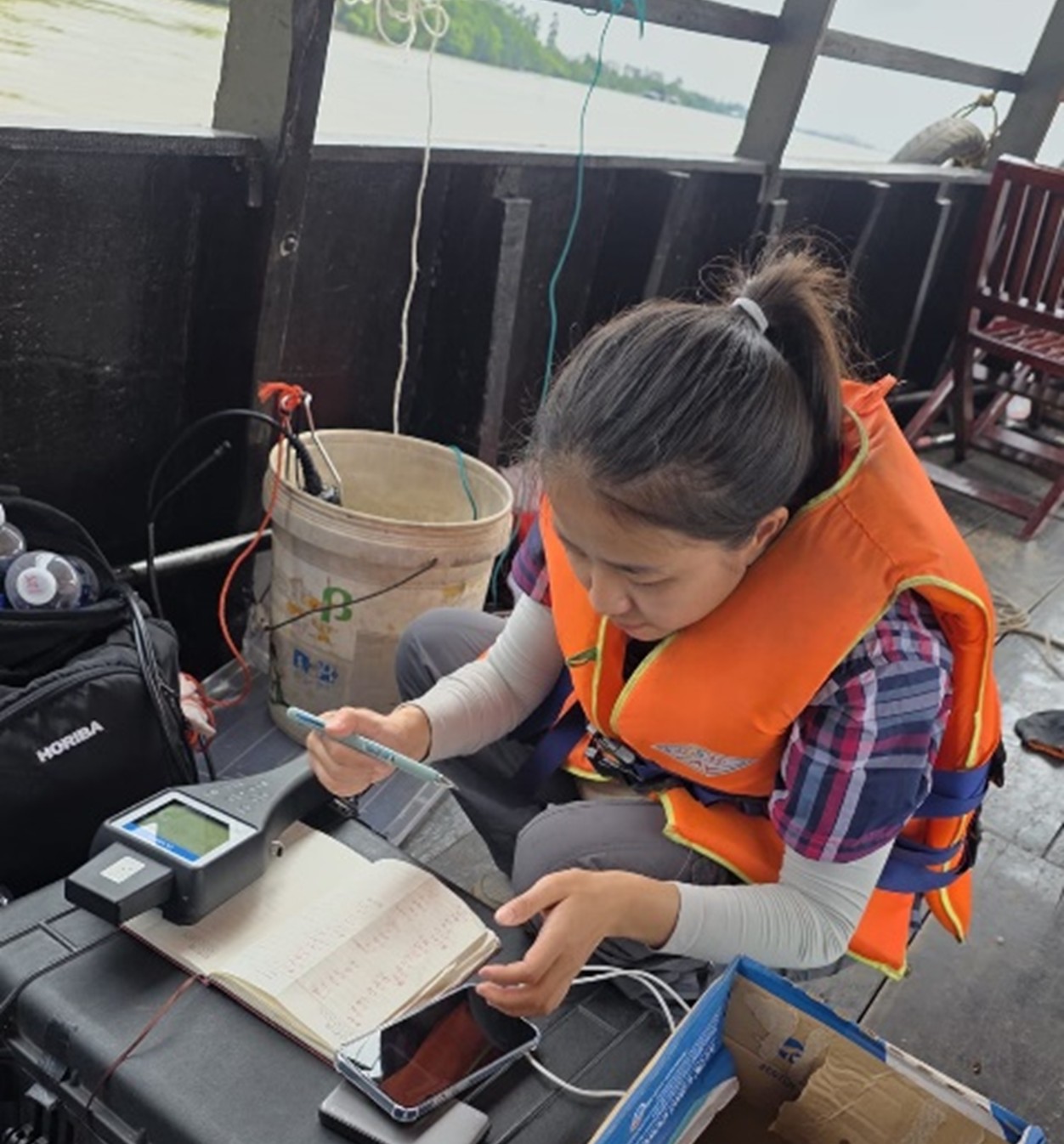
Onboard water-quality analysis and field data recording. Ms Jiachun Huang conducting real-time analysis of water-quality parameters and logging observations during the survey, ensuring continuous data integration with hydrodynamic and sediment measurements.
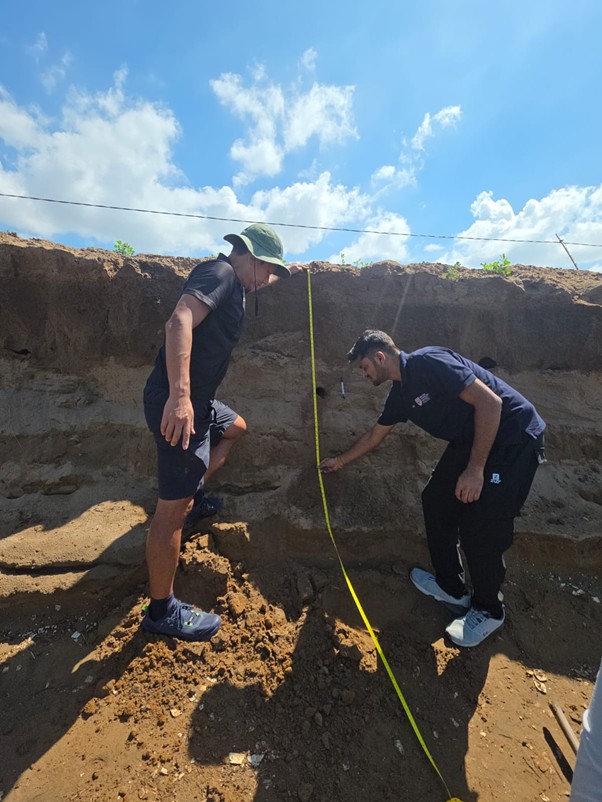
Riverbank profiling and sediment characterization. Prof. Edward Park measuring riverbank height and stratigraphy with Mr Abhishek Kurmi (PhD Student) to document bank material composition, erosion features, and geomorphic responses associated with channel instability and sand mining impacts.