Art as a Tool for Inclusive Education
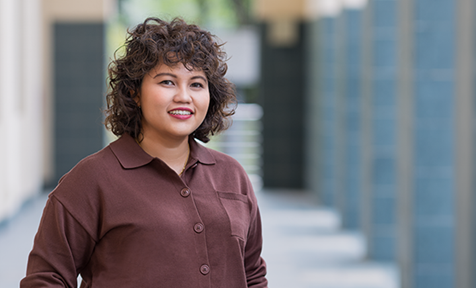
Blending art with pedagogy, award-winning visual artist Sarah Choo Jing, Class of 2016, moves between gallery and classroom with quiet intensity, crafting inclusive learning spaces where stillness and sincerity speak louder than words.
Ms Sarah Choo Jing, a graduate of the NIE’s PGDE (Secondary) course, doesn’t see a clear divide between her roles as artist and educator. “For me, teaching and artmaking are not separate tracks,” she says. “They’re parallel and deeply entangled.” As an art teacher at Raffles Institution and a multidisciplinary fine artist known for evocative visual narratives, Sarah continues to lecture, mentor and collaborate with students of all levels — even though her exhibitions travel far beyond conventional classrooms.
“My students challenge me to articulate my ideas more clearly, while my practice helps me stay honest, vulnerable and present in the classroom.” Sarah prefers to view her journey as an expansion of two interconnected roles. She devotes nights and weekends to her independent art practice while reserving the daytime for formal teaching. “The most fulfilling part is this: creating work that asks something of the world, while still being able to walk back into a classroom and grow alongside young artists. It’s in that cycle of giving, reflecting and questioning that I feel most alive.”
Sarah’s artistic practice often revolves around solitary figures, fragmented memories and fleeting gestures — yet, these seemingly intimate themes are what enable broader conversations about identity and inclusion. “Solitude is a universal language,” she explains. “So are longing, memory and identity. These aren’t niche themes — they’re deeply human. When I bring my work into educational spaces, they spark dialogue about who we are, how we see others and what often remains unsaid in our daily lives. They help students realise that art doesn’t require grandeur, but truth and sincerity.”
Her 2024 photographic series, Gestures of Affection, commissioned by Maison Valentino, exemplifies this approach. The work features seven Asian women, each embodying a lunar phase and a value — sensuality, resilience, empathy, individuality, freedom, passion and vulnerability. Rooted in the subjects’ personal experience, the series transforms these narratives into universal reflections of femininity, identity and human connection. “With every project, I begin by listening,” says Sarah. “Inclusivity isn’t something you add at the end — it starts at the start of the conversation.”
This philosophy shapes both her art and teaching. Sarah often brings her works into the classroom — not to explain them, but to invite responses. In one memorable session, students engaged with her multimedia installation, The Hidden Dimension, by creating their own audio narratives. “The variety was astonishing: some wrote poems, others made soundscapes. It became clear the work wasn’t the end, but the beginning of a dialogue,” she recalls.
For Sarah, art is inherently inclusive: “It meets people where they are. It doesn’t demand a shared language — just presence, attention and feeling.” She recounted working with students of mixed learning profiles using only light, shadow and gestures as prompts for storytelling through paper. “Some spoke, some folded, some drew and some simply held still. That, to me, is the definition of an inclusive learning space: where expression is invited, not prescribed.”
Her time at the NIE continues to shape this mindset. “The NIE gave me both structure and soul. It taught me that education goes beyond delivery of content — it’s about experimentation and discovery. Creativity is not just an outcome — it’s a way of being in the world with curiosity and compassion.”
Technology, too, plays a role in her inclusive pedagogy and Sarah uses tools like 360° video, responsive sound and digital archives to offer multisensory modes of learning. “Technology, when used with care, can serve as a bridge — extending access, customising experiences and creating immersive spaces without overwhelming students, whatever their background or ability.”
When asked how educators can integrate interdisciplinary practices to better engage diverse learners, Sarah advises, “Start by letting go of silos. Invite students to bring their full selves into the space. Let art intersect with science, storytelling, movement — even coding! Art isn’t just a creative exercise — it’s a way to connect meaning across disciplines.”
To aspiring artist-educators hoping to build a more inclusive world, Sarah offers a gentle challenge: “Be brave enough to be soft. Be curious enough to listen. And be humble enough to know that you don’t have to have all the answers. As an art practitioner and an educator, your role isn’t just to lead but to walk alongside.”
She draws on the words of bell hooks — education as the practice of freedom — to frame her philosophy. “To practice freedom is to listen, question and walk alongside. That’s the art. That’s the work. And it’s never done alone,” Sarah concludes.
The article was retrieved from NIEWS Issue 132.