
NIE Graduate Research Conference 2026:
Bridging Academia, Technology, and Industry in Education in the Age of AI
As AI reshapes teaching and learning, educators, researchers, and industry practitioners must move beyond initial excitement to examine what truly works. This graduate research conference invites scholars and educators to critically explore how AI can be integrated into education in ways that are meaningful, evidence-based, and sustainable. By bridging academic inquiry, technological innovation, and industry practice, we foster dialogue on the opportunities, limitations, and ethical dimensions of AI in education. The central question is not whether AI belongs, but how it can best serve learners, educators, and communities.
Conference Details
📅 2 October 2026 (Friday)
📍 In-Person @ NIE, Lecture Theatre 2
All Day : Poster Presentation
- 0800 - 0900 : Registration and Arrival
- 0900 - 0915 : Welcome and Opening Remarks by Professor Chang Chew Hung, Dean GPL
- 0915 - 0955 : Keynote Address by Associate Professor Caroline G. Lee
- 0955 - 1000 : Group Photo
- 1000 - 1130 : 3MT Competition
- 1130 - 1230 : Lunch and Brew & Banter with GPL Deanery
- 1230 - 1430 : Oral Presentation Session
- 1430 - 1500 : Afternoon Break
- 1500 - 1600 : CrossSolve Showcase
- 1600 - 1630 : Break and Lucky Draw
- 1630 - 1700 : Awards and Closing
- Keynote Speech: An invited address by a distinguished scholar that opens the conference and offers insights into the theme of AI in education.
- Poster Presentation: A visual research showcase where presenters display A1 posters and engage attendees in one-on-one discussions about their work.
- Oral Presentation: A formal session for graduate researchers to present their findings through structured talks, followed by audience Q&A.
- 3-Minute Thesis (3MT): A fast-paced communication challenge in which presenters distill their research into a clear, engaging three-minute talk for a general audience.
- CrossSolve Showcase: An interdisciplinary team event in which researchers from different fields collaborate to propose solutions to real-world problems in education.
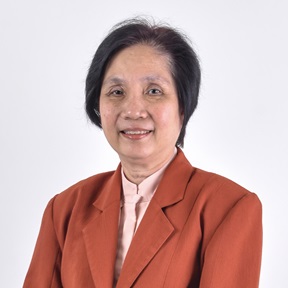
A/P Lee Guat Lin, Caroline
Vice Dean, NUS Graduate School
Associate Professor, Department of Biochemistry, Yong Loo Lin School of Medicine, NUS
Associate Professor, Duke-NUS Graduate Medical School
Principal Investigator, National Cancer Centre
About the Speaker: A/Prof Caroline G.L. Lee is Associate Professor at the Department of Biochemistry, Yong Loo Lin School of Medicine, NUS, Principal Investigator at the National Cancer Centre, and Associate Professor at Duke-NUS Medical School. Her research focuses on the functional genomics of hepatocellular carcinoma and pharmacogenetics. Prior to her current appointments, she completed postdoctoral training with Dr. Michael Gottesman at the National Cancer Institute, National Institutes of Health, USA. She holds a Ph.D. from Baylor College of Medicine, USA.
Abstract
Artificial intelligence is rapidly transforming how graduate students learn, search the literature, write, code, analyse data, generate hypotheses and communicate their work. It can compress weeks of effort into hours, widen access to expertise and make previously difficult questions more approachable. Yet speed is not understanding, fluent answers are not knowledge, and polished outputs are not scholarship.
Drawing on the Chinese Room thought experiment, this keynote examines what graduate education must preserve, redesign and strengthen in an AI-rich world. For Master’s students, AI can support personalised learning, rapid upskilling and more sophisticated real-world problem-solving. For PhD students, it can accelerate discovery and expand the research frontier. But the central responsibilities of scholarship remain profoundly human: asking consequential questions, creating original and trustworthy knowledge, validating evidence, exercising ethical judgement and accepting responsibility for the impact of one’s work.
The keynote argues that graduate education must move beyond teaching students merely how to operate AI tools. It must develop AI-augmented scholars who can think with AI without surrendering their thinking to it. As complex problems increasingly transcend disciplinary boundaries, students must also become anchored integrators—deeply grounded in one or two disciplines, sufficiently broad to understand other ways of knowing, and capable of synthesising them into new insights and novel solutions.
The challenge is not whether graduates will use AI. It is whether they will use it to take intellectual shortcuts—or to ask better questions, think more deeply and create knowledge that genuinely matters.
1️⃣ Poster Presentation
Format: Printed A1 poster, presented in-person at NIE on Conference Day
Content: The poster presentations need to be linked to the conference theme.
Participants: Graduate student researchers in Singapore or Abroad
Submission:
(1) Register through the conference website or via the event poster and submit a title and a 300-word abstract. The abstract should include the author’s name, university and school, key literature and research gaps, research question(s), key findings or research plan, and keywords.
(2) Presenters will be required to submit an electronic copy of their poster to the organising committee via their registered email closer to the conference date for programming purposes.
Award: The Best Poster Award recipient will receive a cash prize of $200, and the Runner-Up Poster Award recipient will receive $100.
2️⃣ Oral Presentation
Format: 15-minute presentation followed by 5-minute Q&A.
Content: Oral presentations need to be linked to the conference theme.
Participants: Graduate student researchers in Singapore or abroad (In-person presentations are preferred).
Submission:
(1) Register through the conference website or via the event poster and submit a title and a 300-word abstract. The abstract should include the author’s name, university and school, key literature and research gaps, research question(s), key findings, and keywords.
(2) Presenters are required to submit slides of their presentation to the organising committee when prompted through their registered email closer to the date of the conference for programming purposes.
3️⃣ Three-Minute Thesis (3MT)
Format: Three-minute presentation
Content: The Three-Minute Thesis (3MT) competition provides an opportunity for presenters to communicate the significance and impact of their research clearly and engagingly to a broad audience.
Participants: NTU/NIE students in person
Submission:
(1) Register through the conference website or via the event poster and provide the author’s name, university and school, and presentation title or topic.
(2) Presenters who use slides will be required to submit their presentation slides to the organising committee via their registered email closer to the conference date for programming purposes.
Award: The Best 3MT Presentation Award recipient will receive a cash prize of $200, and the Runner-Up 3MT Presentation Award recipient will receive $100.
4️⃣ CrossSolve Showcase
Format: 15-minute presentation followed by 5-minute Q&A
Content: CrossSolve Showcase brings together researchers from different disciplines, in teams of 4, to collaborate and propose solutions to real-world problems in education.
Participants: NTU/NIE students in person from different disciplines.
Submission:
(1) Register through the website or via the event poster. Registration should include the author’s name, university and school, major, and team members’ names (if applicable). Individuals who sign up alone will be placed into a group by the organising committee.
(2) Presenting teams are required to submit their presentation slides to the organising committee via their registered email closer to the conference date for programming purposes.
Award: The Best CrossSolve Team Award will receive a cash prize of $800, while the Runner-Up CrossSolve Team Award will receive $400.
Got a question?
Organising Committee
Learn more about the amazing team behind this year’s conference
Meet Our People