
NIE 2030: 'Empowering Educators and Co-creating Communities for Flourishing Futures'
The NIE 2030 Strategic Vision (‘NIE 2030’) charts the institute-level strategic directions and mid-term priorities of the National Institute of Education (NIE), Nanyang Technological University (NTU), Singapore for the Academic Years 2026/2027 to 2030/2031.
With the theme, ’Empowering Educators and Co-creating Communities for Flourishing Futures’, NIE 2030 is designed to grow NIE's impact in a fast-shifting global education landscape marked by the rapid ascendency of artificial intelligence and other emerging technologies. The Key Strategies and Desired Outcomes of NIE 2030 are organised around these three Key Strategic Areas:
1. Futuring Teacher Education, Learning and Teaching
2. Advancing Research for Transformative Impact
3. Nurturing a Future-focused Community
NIE 2030 was co-created over a 1½-year consultation period with faculty, staff, students and the leadership through various engagement platforms, and informed by horizon scans at key stages of the strategy development process. It is aligned to the strategic priorities of both the Ministry of Education and NTU Singapore.
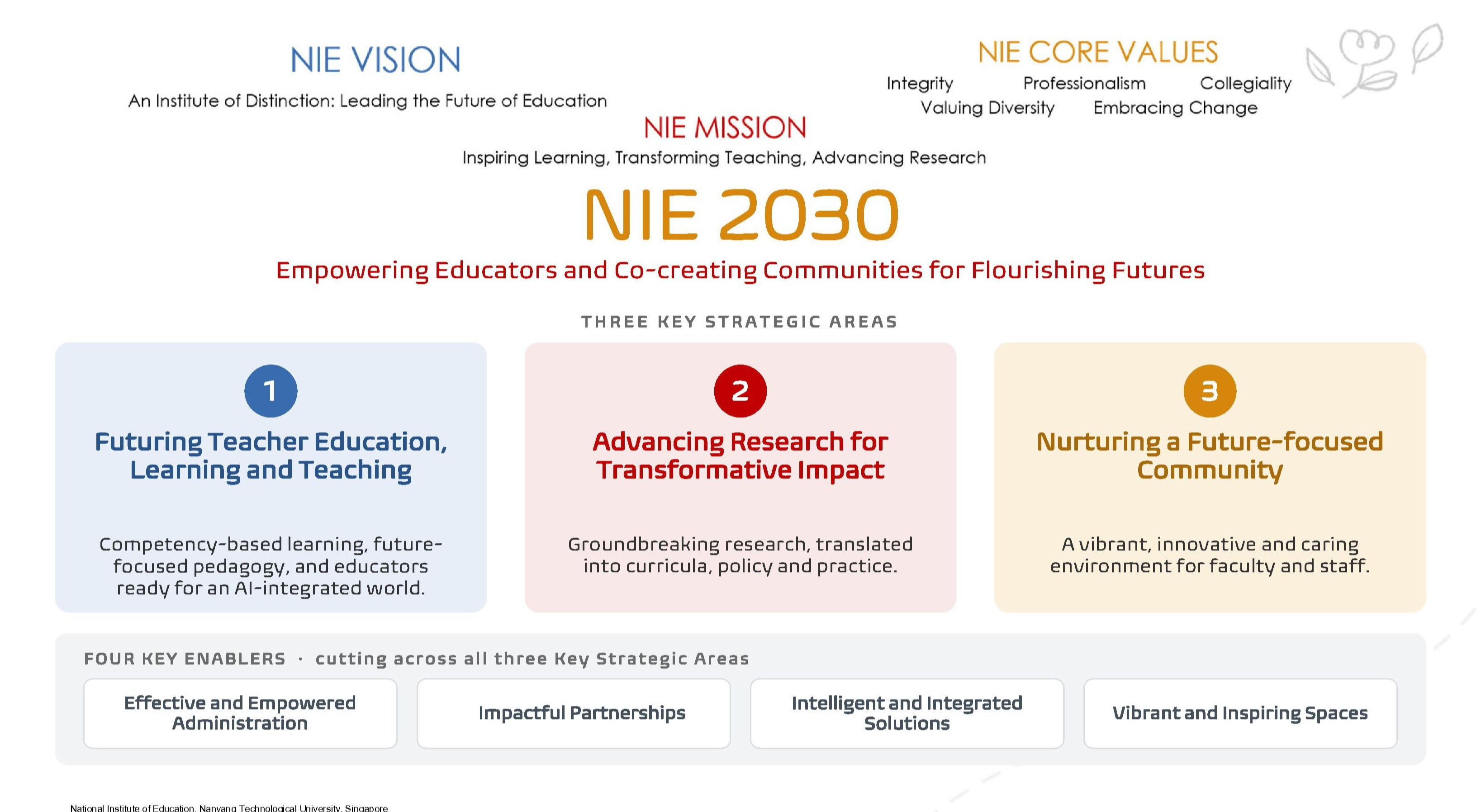
Key Strategic Areas
Futuring Teacher Education, Learning and Teaching
Values-centred learners with agency, empathy, wisdom and transformative competencies for a volatile world.
Evidence-informed and technology-integrated pedagogies that reshape teaching and learning for future skills development.
Educators equipped to apply impactful research, technology and innovative pedagogies ethically and purposefully in an AI-integrated world.
1.1 Re-envisioning initial teacher preparation, undergraduate, postgraduate and continuing education programmes.
1.2 Leading future-focused pedagogy, authentic assessment, interdisciplinary learning and technology-enabled teaching.
1.3 Deepening internationalisation and cross-cultural learning across programmes.
1.4 Leveraging Singapore's education ecosystem and global partnerships to test and scale effective practices.
Advancing Research for Transformative Impact
National and global priorities addressed, while delivering measurable value for learners, educators and the education system.
Global scholarly influence attained through distinctive, interdisciplinary and high-quality impactful research.
Strengthened pathways from research findings to policy, professional practice and public impact.
2.1 Deepening research in distinctive strengths while spearheading innovation in emergent fields.
2.2 Fostering interdisciplinary expertise and collaboration across disciplines and institutions.
2.3 Harnessing technologies to build stronger pathways from research output to impact.
2.4 Building purposeful research partnerships with schools, industries, communities and institutions.
Nurturing a Future-focused Community
An adaptive, resilient and digitally-fluent community of faculty and staff who strive for innovation and excellence.
NIE's reputation elevated as an academic institute known for attracting, developing and retaining talents through meaningful work, recognition, well-being and shared purpose.
Vibrant physical, digital and social spaces on campus that support learning, collaboration, creativity and innovation.
3.1 Developing faculty and staff capabilities through professional, leadership and future-skills development.
3.2 Accelerating adoption of innovative technologies to optimise efficiency and the student-staff experience.
3.3 Creating flexible and vibrant physical, digital and social workspaces.
3.4 Encouraging creativity, experimentation, risk-taking and continuous improvement.
Implementation Committees
Key Strategic Area | Implementation Committee |
| Futuring Teacher Education, Learning and Teaching | IGNItE (Innovation, Growth, Nexus of Intelligence, Technology, and Empowerment) |
AI for T&L
| |
| Advancing Research for Transformative Impact | NIE AIEd Research |
Technology Empowered Research | |
| Nurturing a Future-focused Community | STaRS (Supporting Talents and Rewarding Staff) |
SPARk (Simplifying Processes, Applications and Reviews) |