Why it’s time to rethink physical education in schools
PE isn’t just about the outdoors, fitness and activity. It’s critical in nurturing resilient and socially engaged young people.
At a baseball game in Chicago, Dr Don Hellison, the late American physical educator and scholar suddenly spotted a big man charging towards him from the shadows. Panic arose, until the man screamed: “Dr Hellison, you saved my life!”
This man had been one of Dr Hellison’s students decades earlier, on the brink of being ejected from school. PE had become his anchor, and given the then-student purpose and hope to work at a brighter future.
The encounter is a powerful reminder that physical education, when done right, can be far more than a “break” from academics. It is a lifeline that provides vulnerable young people self-worth and a sense of belonging even in less ideal circumstances.
Stories like this show us that physical education has a deep impact on both body and mind, which resonate with societal efforts to help people not just live longer but better. Physical health alone no longer suffices; mental resilience, social connection and a sense of purpose are now central to a good life.
Yet amid growing attention to healthcare and mental health, one lever of lifelong well-being remains underused: the subject in schools that many do not pay much attention to, physical education.
It’s the lesson that might get cancelled due to weather or when teachers need extra time to revise other subjects when exams are around the corner. It’s the lesson parents don’t often ask about when their kids come home.
Yet, PE offers young people early experiences of joy, teamwork and perseverance, the foundations of holistic wellness. For some at-risk students, a trusted PE teacher can even be the bridge that keeps them connected to school and learning.
A literature review in 2023 by Indian researchers reported positive associations between physical activity and mental health. They also noted a strong link between sedentary behaviour and poor well-being. Though the overall evidence base is still limited, we cannot dismiss the importance of PE as part of a healthy lifestyle, particularly in societies that prize academic achievements.
When structure undermines purpose
Singapore’s PE syllabus rightly aspires to nurture the whole person, physically, socially, cognitively and emotionally. Beyond athletic performance, it emphasises authentic learning through outdoor adventures, ethical decision-making and resilience in real-world settings.
However, the structure of PE lessons in many countries with advanced education systems like Singapore’s often undermines ideals such as these. Across the world, short time slots wedged between academic periods leave little time for meaningful activity.
Even an hour-long PE lesson can be whittled down to as little as 30 minutes, as I often see in schools in Scotland, if we factor in time for moving to and from the activity venue, students changing in and out of PE attire, and the fact that the teacher has to cater to a large group of students with varying levels of ability and motivation. That’s too little for physical progress, too short for collaboration or reflection.
The Singapore syllabus includes authentic learning experiences such as outdoor adventure camps, where students navigate team dynamics and make ethical decisions. Yet such opportunities are constrained by rigid timetables and limited resources.
Schools that prize athletic excellence can also unintentionally alienate those who struggle. Each dropped ball or slow sprint becomes a public failure, breeding a lifelong aversion to movement, the opposite of what PE should achieve.
To build genuine motivation, students need time to explore, to collaborate and to experience progress. Without it, PE risks becoming another stressful contest to win or a box to tick rather than a meaningful pathway to lifelong well-being.
From short lessons to seasons of learning
It doesn’t have to be this way. The Sport Education Model (SEM), pioneered by the late Professor Daryl Siedentop from Ohio State University, shows how restructured PE can be both inclusive and meaningful. Instead of short, disconnected lessons, SEM organises learning into longer “seasons” of sport – that is, students are immersed in a single team sport each term.
Every student takes on a valued role in addition to the player, such as coach, equipment organiser, match reporter or strategist. The focus shifts from testing ability to nurturing teamwork, belonging and growth. While some schools in Singapore are already employing this method, the benefits suggest it is worth considering implementing across all schools.
Recognition goes beyond performance. Awards like “most improved player” or “fairest team” celebrate growth, effort and sportsmanship. Students learn that success takes many forms, and participation matters as much as performance.
By turning PE into a sustained, immersive experience such as training and strategising for a game as a team or designing rules and penalties as part of a sports council, the SEM fosters responsibility, empathy and shared purpose. It becomes a genuine learning season rather than a hurried session wedged between classes.
When PE becomes a space of belonging and personal growth, the benefits reach beyond the physically gifted to those who may otherwise feel left out. The principles that make SEM effective, valuing every contribution, are a gateway to more inclusive education.
It is also worth noting that SEM’s effectiveness is backed by a large body of published research evidence since the 1990s.
Inclusion and neurodiversity: The new frontier
Inclusion in PE today extends far beyond engaging the less sporty. It also embraces neurodiversity, which in countries like the UK has recently become a focus for inclusion due to its rapidly rising prevalence, recognising the diverse cognitive, sensory and physical profiles of students.
Some learners find the bright, noisy gym overwhelming; others struggle with coordination, social cues or mobility.
Research on neurodiversity in PE is still emerging, but it underscores a crucial shift: Every learner’s path to participation is different.
A key lever is student agency. When students help design their own games, track their progress through technology or adjust rules to suit different abilities, they gain ownership and confidence.
Such adjustments, to game structure, difficulty or cueing, benefit all learners, not just neurodivergent ones.
This inclusive approach echoes the spirit of the SEM, where every student has a valued role. Recognition expands beyond the scoreboard, “most improved”, “fairest team”, “most cooperative group”, celebrating growth, fairness and collaboration.
Neurodiversity as just one trending focus for inclusion challenges us to redefine what meaningful participation looks like.
Inclusion is not about lowering expectations but broadening how success can be achieved.
When every student experiences belonging and growth, PE becomes a model for inclusive education itself.
When we get PE right
When done well, PE becomes a living classroom for ethics and empathy.
My wife, a primary school teacher, once described her 11-year-olds debating how best to penalise a team that had broken a rule during a sport education lesson.
What began as a simple game became a lesson in moral reasoning and fairness, and one that even surprised the adults observing it.
This is what happens when PE works as it should. Students learn to handle wins and losses gracefully, think critically about ethics, and practise empathy through teamwork. These lessons, resilience, fairness, and cooperation, form the value yardstick of education.
A well-designed PE curriculum can thus nurture not only stronger bodies but also stronger minds and communities.
It teaches young people that physical movement is not just exercise, but an act of engagement, with others, with values, and with the self.
From fragmentation to coherence
Realising this vision requires coordination, not just innovation.
PE teachers may champion holistic growth but are often constrained by timetables and competing academic priorities.
Curriculum writers may design forward-looking frameworks, yet without policy support or teacher training, ideals stay on paper. School leaders, meanwhile, must juggle limited space and scheduling pressures.
From an outsider looking in, Singapore already has the distinctive advantage of having an excellent university department that prepares pre-service teachers, a unit for ongoing professional training and a dedicated curriculum writing team.
Even with immense goodwill between these bodies, there is a need for greater synergy to move towards a common goal.
When all move in concert, what we aspire to in policy can finally be reflected in classrooms. Sitting at the same table to share a common vision and tackle real pain points ensures coherence: What we teach students, how we train educators and how we measure success all reinforce one another.
Only then can PE fulfil its full potential, as a powerful force for well-being, inclusion and lifelong engagement, and as an effective medium for teaching 21st-century skills.
In the end, the real question is not whether PE fits into the timetable, but whether our timetable fits the needs of the whole child.
If we truly believe in nurturing confident, resilient and socially connected young people, then it’s time to rethink not just how we teach PE, but what we want it to mean.
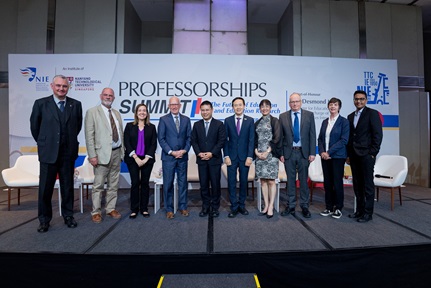
David Kirk is the 13th E.W. Barker Professor in Physical Education and Sport Science at the National Institute of Education, Singapore. He is Professor of Education and former head of the School of Education at the University of Strathclyde.
School for Humans is a new Opinion series in January that aims to deepen the conversations around education and highlight the human forces at the heart of teaching and learning.
Read the original article here.
Source: The Straits Times © SPH Media Limited. Permission required for reproduction.
.tmb-listing.jpg?sfvrsn=41a4c4ea_2)
-(1).tmb-listing.png?sfvrsn=1e533225_2)