Students in mixed-ability classes have more friends across courses
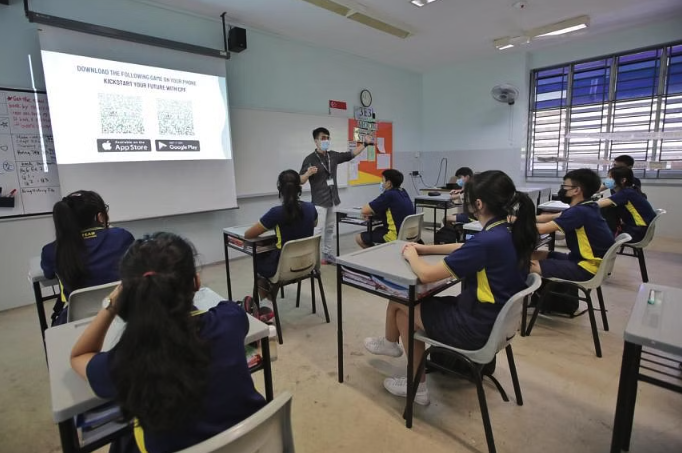
Students in schools that have done away with academic streaming have made
more friends across the different courses Express, Normal (Academic) and Normal (Technical), a study has found.
Madam Liew Wei Li, the Education Ministry's (MOE) director-general of education, said data from the first year of implementing full subject-based banding (SBB) has shown positive outcomes.
"We map out the social networks, and we can see very clearly that the students are making more friends across the different courses than if we did not have full SBB," she added.
Full SBB was piloted in 2020 in 28 secondary schools, including Ang Mo Kio Secondary School and St Andrew's Secondary School.
Under this model, students spend about a third of their time on common curriculum subjects such as physical education and art in mixed form classes, and take lessons for academic subjects like English and mathematics in different classes based on their ability.
In the National Institute of Education study that Madam Liew was referring to, researchers looked at students' interaction and peer networks in schools with full SBB.
From 2020 to last year, they studied 1,406 students across six secondary schools - three with mixed-ability form classes and three with same-ability form classes.
MOE said based on students' reports of their friendship networks, the study found that those in mixed form classes are more likely to interact with peers from different courses and have more friends from different courses.
Madam Liew said schools have also observed more confidence in students, citing a separate internal study by MOE on the 28 pilot schools. "This growth mindset that we anticipated should happen has been seen and observed in all the classes," she added.
"(Students) are focused on learning. They are not distracted, and there's a greater amount of confidence in their ability to learn."
MOE said its study showed there is a more positive classroom culture and more opportunities for students to showcase their strengths in mixed form classes.
"Feedback from teachers and students through surveys and focus group discussions also noted an increase in the proportion of students who are motivated and confident to take subjects at a more demanding level," it added.
Madam Liew said the "psychology of not being labelled creates a difference in students".
"This positive peer culture in the class carries across, throughout the lessons and the year," she added.
"Students know that if they put in effort, they can access a higher-level (subject) when they achieve."
Students across different teaching groups also learn from one another because they have varied strengths and interests, she added.
Another 31 schools adopted full SBB this year. By 2024, this will be rolled out to all eligible secondary schools and the Normal and Express streams will be scrapped.
From 2024, MOE is also extending full SBB to three schools which currently offer only the Express course: Crescent Girls' School, Tanjong Katong Secondary School and Tanjong Katong Girls' School.
But full SBB excludes specialised schools like Crest and Spectra for Normal (Technical) students, and Integrated Programme schools.
The challenge in implementing full SBB lies with the schools, said Madam Liew, with timetabling a more complex exercise.
She added: "It's a lot more complicated for the form teacher to track where his students are, and to make sure that they have enough time with all the students so that they can ensure that they follow up on pastoral care."
But overall, teachers believe in the benefits of full SBB and have been willing to put in extra effort to make changes, she said.
Students will continue to take the O- and N-level examinations until 2026. From 2027, these exams will be replaced with the new Singapore-Cambridge Secondary Education Certificate examinations. The national certification will reflect the level at which each subject is taken. This will apply from the 2024 Secondary 1 cohort.
Read the original article on The Straits Times.
Source: The Straits Times © SPH Media Limited. Permission required for reproductio
.tmb-listing.jpeg?sfvrsn=774cc2b7_1)