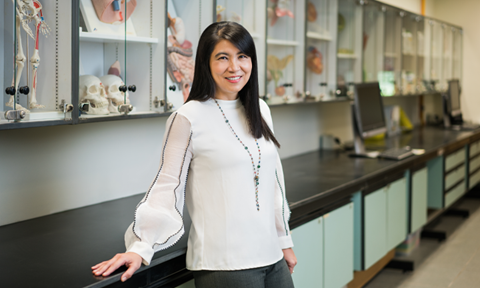
Science Language and All That Talk

One might think that a typical primary school science classroom is often about the process of photosynthesis in plants, the life cycle of a butterfly or the stages of food digestion. NIE Senior Research Scientist Dr Seah Lay Hoon feels that beyond those science-y topics lies a more important aspect within the Science subject – the science language. With over 10 years of research experience in areas related to science education, she is the Principal Investigator of a recently awarded research project “Developing Science Teachers’ Language Awareness to Enhance the Teaching of Disciplinary Literacy” that hopes to explore the impact of teachers’ science language awareness on students’ learning. She shares with us the idea behind her research study and how she hopes it can impact teaching and learning.
Q: Can you share more about your research interest in science education?
My interest has always been in understanding the challenges that students face in the use of language in the science classroom. As I understand these challenges better, I hope to support teachers in addressing them. One of my research projects looks at how we can enhance teachers’ language awareness – language awareness that will allow them to better address the language-related challenges their students face when learning science. We specifically look at how language is used in the science classroom.
Q: What is your latest research study on language awareness in science about?
This new study builds on the previous one where we explored the relationship between teachers’ language awareness and their teaching. In the previous study, we found that when teachers have a better idea of how language works to construe meaning in science classrooms, they tend to adjust their pedagogies accordingly to better address students’ language needs. However, we also realized that different teachers make use of this newfound knowledge we shared with them in different ways.
In this new study, we are curious about the extent to which teachers are able to make use of this knowledge adaptively in terms of assessing students’ language needs and addressing them. . We hope to understand the possible characteristics or indicators that teachers can use to “diagnose” themselves in terms of their language awareness. This can, in a way, allow them to reflect on their own teaching and learning journey. A second aim of this new study is to study the impacts of the teachers’ language awareness on their students’ learning outcomes.
Q: How can Science teachers benefit from this study?
We want to develop a framework based on the notion of “adaptive expertise” in the use of teachers’ language awareness. The framework will contain indicators or characteristics of adaptive use of language awareness on different levels. These indicators will allow teachers to benchmark themselves so they can understand what they can do to further enhance their use of language awareness in their teaching.
The level of teachers’ content knowledge and teaching experience can also affect their level of language awareness to a certain extent. For example, if a teacher understands one particular science topic very well and due to the amount of teaching experience he has, he will be able to understand students’ language challenges better. This in turn means that the teacher may have high language awareness and may be better able to apply their awareness more adaptively in their teaching.
Similarly, if a teacher is less familiar with a particular science topic, they may require more support in understanding students’ language challenges. As such, language awareness may fluctuate according to, perhaps, topics. So we hope this framework can help teachers track and develop their language awareness across topics.
Q: What are your hopes for this study and what kind of impact do you think it will have in the future?
There are at least two perspectives that motivate me and my team in this project. One is from the teachers’ perspective as we know that students struggle a lot with the way language is used in science.
The other is from a research or theoretical perspective where the idea of learning the language of science is really constitutive of learning science itself. This is really an important aspect that should not be neglected even though the focus on science tends to be on the content understanding rather than on the language used, which is really essentially the tool that enables us to understand the content.
As I delve deeper in my study, I really want to make a difference in the science classroom in this area – use of language. This is also the reason why I shifted my research focus from trying to understand students’ challenges to the pedagogical support that teachers can provide to students in dealing with these challenges. At the end of the day, the teachers are the ones at the frontline as they play the most important role in translating research to practice.

.tmb-listing.jpg?sfvrsn=eaf6042f_2)