Asst Prof Wang Jingyu receives new grant, publishes a journal article and a book chapter, and delivered two keynote presentations
Assistant Professor Wang Jingyu, from the Humanities and Social Studies Education Academic Department, received a new grant of $100,000 for his upcoming project titled, “Unveiling future urban heat extremes in Southeast Asia: population exposure, awareness, and readiness” This project aims to enhance our understanding of heatwave dynamics and their societal impacts by utilising a convective-permitting model (CPM) system to simulate and project heatwave events with high spatial resolution. By integrating projections of future population density and urban expansion, the study will offer a series of quantitative estimation of future urban heatwave patterns in SEA under different global warming scenarios, with a 5-year interval ranging from 2030 to 2100.
He co-published a paper titled “Comparative Evaluation of Decadal Predictions of Global SST Between CMIP5 and CMIP6 Datasets” in the International Journal of Climatology. Using the yearly initialized decadal hindcasts of the sea surface temperature (SST) from the CMIP5 and CMIP6 datasets, the team evaluated their prediction skills over the North Pacific, North Atlantic, Indian Ocean, and tropical eastern Pacific for the next 5 years.
He also co-published a book chapter alongside Associate Professor Edward Park from HSSE titled “Geographic Information Science (GISc) as a Possible Alternative to Fieldwork in Physical Geography Learning: A Case Reflection from Singaporev” in the book “In Virtual Fieldwork in Humanities Education” (pp. 217-238). The chapter discusses the merits and demerits of geographic information science (GISc) as de facto substitute to traditional fieldwork for geography learning.
On 10 May 2025, Asst Prof Jingyu Wang was invited to deliver an online keynote presentation at the 10th Youth Geoscience Forum, held at Hefei Binhu International Convention and Exhibition Center, Hefei, China. His presentation titled, “A Novel Type of Urban Flooding Revealed by Singapore’s High-Resolution Rainfall Observation Network”, discusses the emerging risk of urban flooding in Singapore. A total of 100 participants attended the presentation.
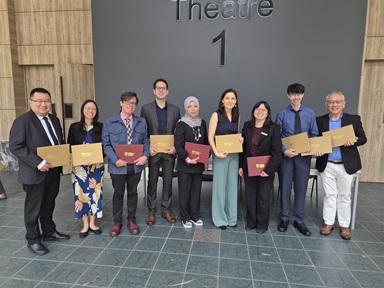
Lastly, on 26 May 2025, Asst Prof Jingyu Wang was also invited to deliver a keynote presentation at the SSHR 2025 Seed Grant Seminar, held at SHHK Building, Nanyang Technological University (NTU), Singapore. His presentation titled “Diagnosing Natural Hazards in Southeast Asia: Scientific Advances and Pathways from SSHR Seed Funding to A Larger External Grant” highlighted research breakthroughs enabled by SSHR seed funding and strategies for securing larger grants to scale impact. His talk emphasised interdisciplinary collaboration and translating findings into actionable solutions for disaster resilience in the region. A total of 50 participants attended the seminar.