
New Education Normal (NEN) Seminar series - How Reflection Mode and Prompt Specificity in Content Delivery Affect Learners’ Behaviors
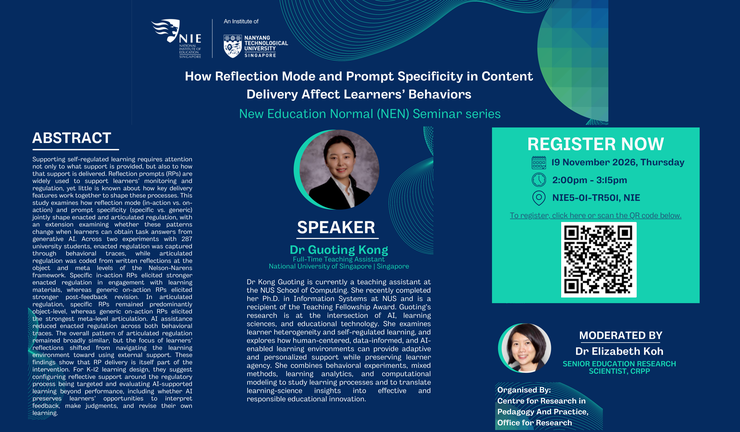
Supporting self-regulated learning requires attention not only to what support is provided, but also to how that support is delivered. Reflection prompts (RPs) are widely used to support learners’ monitoring and regulation, yet little is known about how key delivery features work together to shape these processes. This study examines how reflection mode (in-action vs. onaction) and prompt specificity (specific vs. generic) jointly shape enacted and articulated regulation, with an extension examining whether these patterns change when learners can obtain task answers from generative AI. Across two experiments with 287 university students, enacted regulation was captured through behavioral traces, while articulated regulation was coded from written reflections at the object and meta levels of the Nelson-Narens framework. Specific in-action RPs elicited stronger enacted regulation in engagement with learning materials, whereas generic on-action RPs elicited stronger post-feedback revision. In articulated regulation, specific RPs remained predominantly object-level, whereas generic on-action RPs elicited the strongest meta-level articulation. AI assistance reduced enacted regulation across both behavioral traces. The overall pattern of articulated regulation remained broadly similar, but the focus of learners’ reflections shifted from navigating the learning environment toward using external support. These findings show that RP delivery is itself part of the intervention. For K-12 learning design, they suggest configuring reflective support around the regulatory process being targeted and evaluating AI-supported learning beyond performance, including whether AI preserves learners’ opportunities to interpret feedback, make judgments, and revise their own learning.