
Emotional Energy: When Customer Interactions Energise Service Employees
.jpeg?sfvrsn=efbe72e9_3 "Group of people dancing with performers on stage")
Customer-facing jobs are often praised for their people skills, but the emotional demands that come with the role can be easy to overlook. Employees are expected to remain patient, positive, and professional, even in the face of frustrated customers and challenging interactions. Over time, that constant emotional effort can take a toll, contributing to stress, burnout, and emotional exhaustion.
However, customer interactions do not always have to be draining. Professor Julien Cayla (Nanyang Technological University) and Professor Brigitte Auriacombe (Emylon Business School) offer a more hopeful perspective in their study: under the right conditions, interactions with customers can leave service employees feeling energised, valued, and motivated.
Rethinking the Frontline: Beyond Burnout
Frontline service jobs are often portrayed as exhausting, unappreciated work in which employees must manage the demands of difficult or entitled customers. From call centres to hotel receptions, stress and emotional fatigue are seen as inevitable outcomes of constant customer contact. Yet, the authors challenge this bleak view.
Drawing on ethnographic fieldwork at Club Med, a global hospitality brand known for its immersive “resort village” experiences, the authors found that some service employees not only enjoy interacting with customers but also actively seek out more of them. For these employees, engaging with customers fuels their emotional energy, rather than depleting it.

Photo Credit: “Club Med (Punta Cana)” by Ila Mae Thie, CC BY-SA 4.0, via Wikimedia Commons
Understanding Emotional Energy and Why It Matters
Furthermore, the study draws on interaction ritual theory, which suggests that certain social encounters can leave people feeling confident, enthusiastic, and energised. Sociologists refer to this feeling as “emotional energy.” This kind of energy is generated through social interaction when people are physically present, share a focus, experience a common mood, and feel a sense of group unity.
At Club Med, these rituals take the form of lively group dances, shared meals, or spontaneous chats, activities outside formal work duties. Service staff, known as GOs (“Gentils Organisateurs”), often describe these moments as the highlight of their day. From performing in shows to sitting with guests at dinner, they feel recharged rather than worn down.
Notably, the research distinguishes between large “effervescent gatherings”, such as evening shows or group dances, and more private “intimate bubbles” like one-on-one conversations. Both types of interactions can generate emotional energy, though in different ways and intensities.
Status, Autonomy, and the Power of Choice
One key finding of the study is that emotional energy flows more freely when service employees feel a sense of status and autonomy. Unlike traditional hospitality roles where employees are expected to serve silently, Club Med’s approach blurs the lines between customer and staff. GOs are encouraged to mingle as equals, lead activities, and even become performers, thereby gaining visibility and recognition.

These moments provide what the researchers call “status elevation” or “status neutralisation.” When GOs lead a dance or become the centre of attention on stage, their perceived status rises. Moreover, when they share a joke or a story with a guest at dinner, the interaction becomes more personal and less hierarchical.
Having a sense of autonomy is just as important. Employees are more likely to feel positive about customer interactions when they have some control over how, when, and with whom they engage. When employees voluntarily participate in these rituals, they report greater enjoyment and energy. However, when participation is mandated or forced, the same activities can quickly become emotionally draining.
Managerial Implications
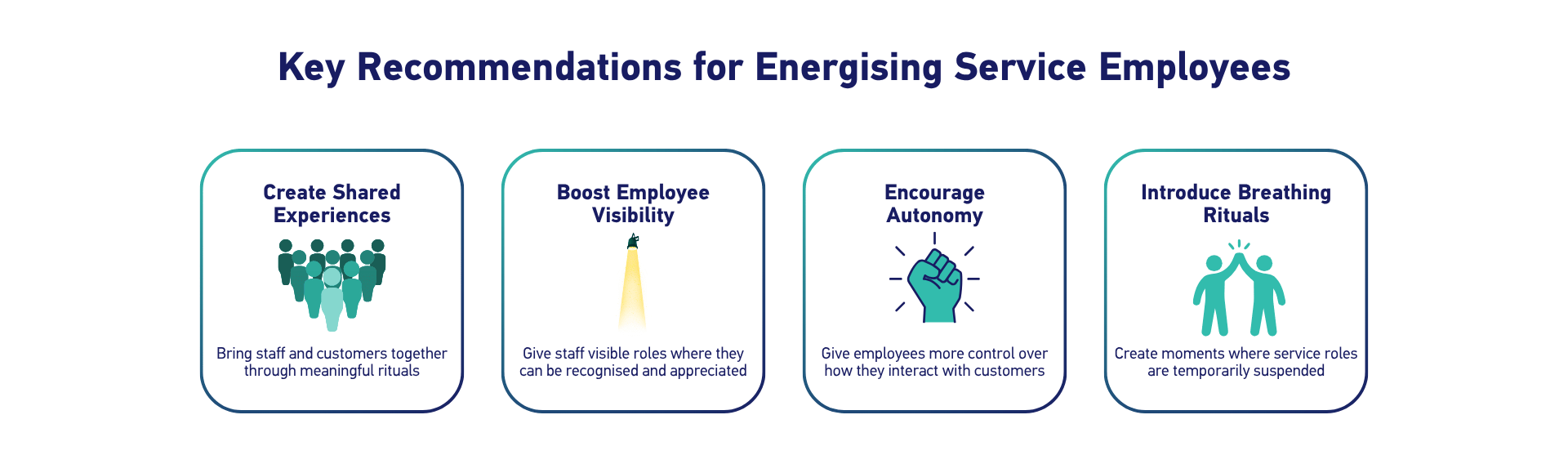 The study offers a fresh perspective on employee engagement. To build a more motivated, energised frontline workforce, businesses should move beyond standard training or incentive schemes and look at the design of everyday service interactions.
Key recommendations include creating shared experiences, boosting employee visibility, encouraging autonomy, and introducing “breathing rituals”.
- Create shared experiences: Design rituals that bring staff and customers together in meaningful, participatory ways, whether through performances, group games, or shared meals.
- Boost employee visibility: Let staff step into spotlight roles that allow them to be recognised and appreciated.
- Encourage autonomy: Give employees more control over how they interact with customers, who they engage with, and when.
- Introduce “breathing rituals”: Create moments where service roles are temporarily suspended. Think joint activities like walks, sports, or casual hangouts where employees and customers meet as equals.
For service sectors facing burnout, disengagement, and high turnover, this approach offers a powerful shift in perspective. Customer interactions do not have to be a source of exhaustion. When employees have opportunities for meaningful connection, recognition, and autonomy, the service encounter can become a source of energy, motivation, and renewed engagement.
This research paper was published by the Journal of Marketing on 28 May 2024.
Julien Cayla is an Associate Professor of Marketing at Nanyang Business School, Nanyang Technological University (Singapore). His work has appeared in the Journal of Consumer Research, the Journal of Marketing, Organization Studies and MIT Sloan Management Review. He currently serves as Associate Editor at the Journal of Consumer Research. His work has been featured in various media such as The Atlantic, the BBC, The Sun, La Stampa and Channel News Asia.
This research paper is a joint work with Brigitte Auriacombe (Emylon Business School).