Meet Associate Professor Saifuddin Ahmed at WKWSCI
At the intersection of media, technology, and politics, Associate Professor Saifuddin Ahmed investigates how communication shapes public opinion and democratic life. His academic journey began in India, where he trained in mass communication and media production, before completing his master’s at Nanyang Technological University. He later earned a PhD in Communication from the University of California, Davis, grounding himself in political communication, public opinion, and computational and experimental research methods.
For Associate Professor Saif, WKWSCI offered the perfect home. “The School is uniquely positioned at the intersection of theory, method, and real-world relevance,” he shares. “It emphasises rigorous scholarship that speaks to societal challenges, particularly in Asia, and this alignment between global research excellence and real-world impact made WKWSCI a natural fit.”
Bringing Research into the Classroom
What excites him most about teaching is working with students who are deeply curious and eager to understand how communication technologies shape power, participation, and inequality. By integrating cutting-edge research on misinformation and political engagement into his teaching, he helps students connect theory with real-world challenges.
Mentoring is equally rewarding. Many of Associate Professor Saif’s publications are co-authored with students and research staff. “Seeing students grow into confident researchers and critical thinkers, sometimes even publishing in high-impact journals, is incredibly fulfilling,” he says. Memorable classroom moments often revolve around discussions on social media and democracy, where students apply scholarly frameworks to their everyday media experiences.
.jpg?sfvrsn=e1417586_1)
Associate Professor Saifuddin Ahmed with his students and WKWSCI Chair at the 2025 Nanyang Awards ceremony.
Research that Matters
Associate Professor Saif’s research tackles pressing global challenges. He recently led a multi-country study examining citizen engagement with political disinformation and deepfakes across the United States, Europe, and Asia. His work is also central to the Social Media and Political Engagement (SMAPE) Lab, which operates under NTU’s Centre for Information Integrity and the Internet (IN-Cube) and serves as a collaborative hub bringing together students, international scholars, and policy stakeholders.
Recognition of his contributions includes the Nanyang Research Award (Young Investigator), an honour that underscores the societal impact of his research. “The award motivates me to push my work further, particularly in translating research insights into public policy, media literacy initiatives, and public engagement,” he notes.
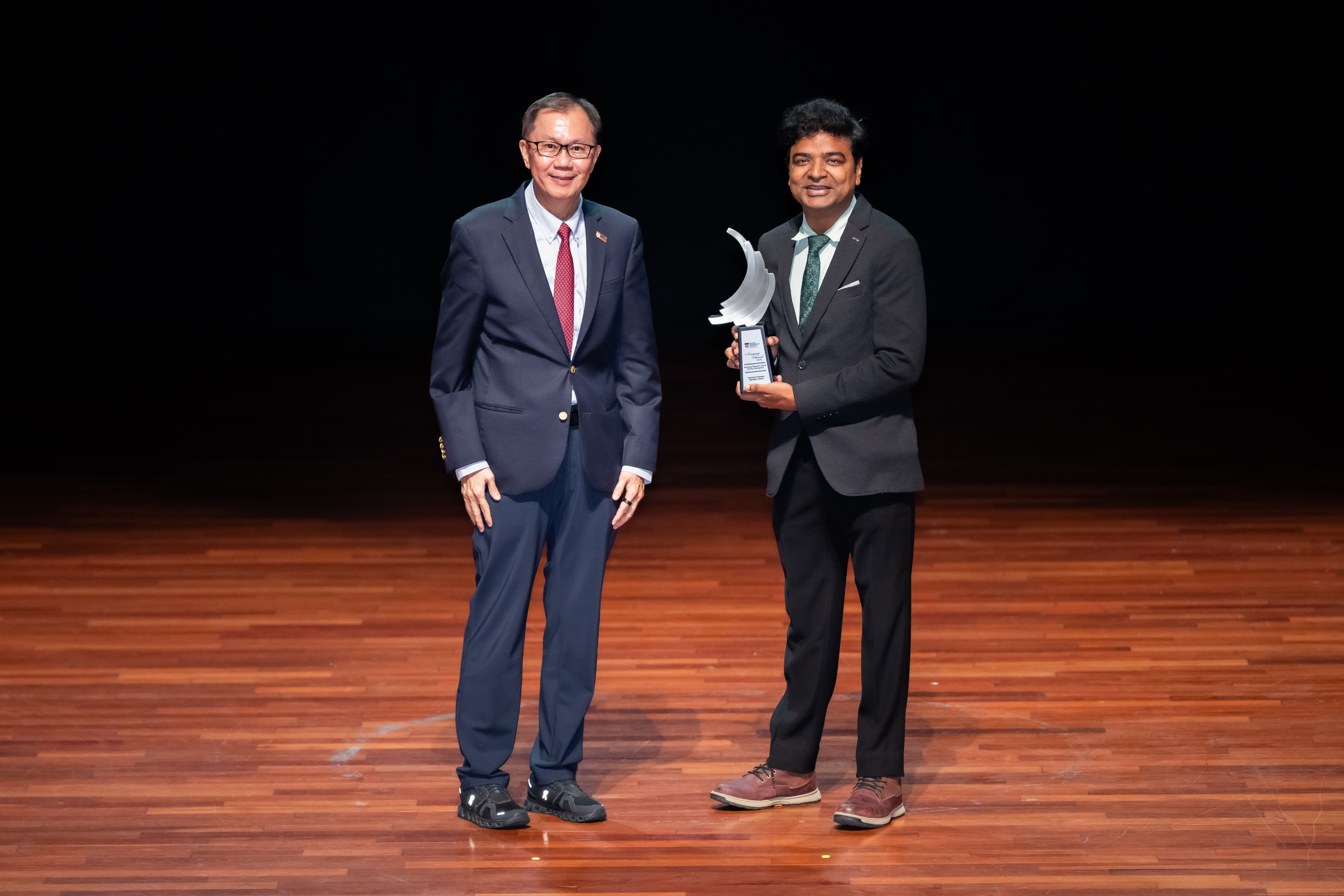
Associate Professor Saifuddin Ahmed receiving the 2025 Nanyang Research Award (Young Investigator).
Growing Together at WKWSCI
WKWSCI has been pivotal to his growth as an educator and researcher. “The School fosters a strong research culture, provides mentorship at early career stages, and encourages interdisciplinary collaboration,” he reflects. This supportive environment has allowed him to establish major research programmes while integrating teaching and mentorship seamlessly into his work.
Looking ahead, Associate Professor Saif aims to expand his research on AI-generated media and democratic trust, particularly in non-Western contexts, while continuing to nurture students as independent thinkers and researchers. His ultimate goal is to contribute both to academic knowledge and to broader societal conversations around media, technology, and democracy.