
Research: LKCMedicine Scientists Identify Urinary Proteins Linked to Severe Dengue, Contributing to Dengue Research in Asia
By Retna Devi D/O Shanmuga Retnam
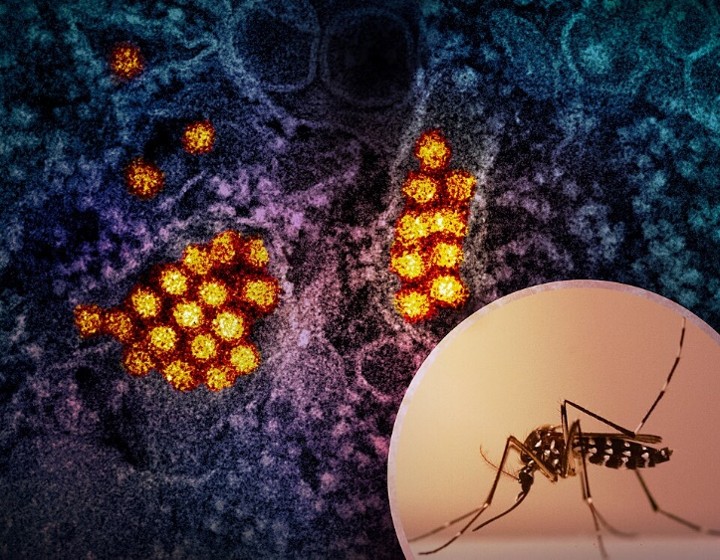 Aedes mosquito and illustration of dengue particles. (Credit: Wikimedia Commons)
Scientists from LKCMedicine have discovered a first-of-its-kind urine test to identify specific proteins in urine, which can predict the likelihood of dengue patients developing severe dengue.
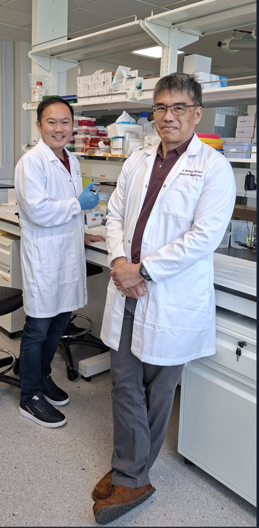
Published in Open Forum Infectious Diseases, the breakthrough, led by Senior Research Fellow Dr Andrew Teo and Associate Professor Yeo Tsin Wen, represents a significant step forward in the fight against one of the region’s most persistent infectious diseases and adopting a predictive approach to provide timely care and reduce hospital burdens.
Singapore has invested heavily in research, surveillance and innovation to improve disease management, such as Project Wolbachia and an on-going multi-centre clinical trial to test therapeutics for moderate-severe dengue supported by the Programme for Research in Epidemic Preparedness and REsponse (PREPARE), under the Communicable Diseases Agency, and the Oxford University Clinical Research Unit (OCRU) in Vietnam.
 |  |
The findings from this study add to these efforts by offering a practical, non-invasive tool that could help doctors make faster and more accurate treatment decisions.
Currently, physicians rely on a checklist of warning signs developed by the World Health Organization. However, these symptoms can be subjective and may result in patients being hospitalised as a precaution even when they may not require intensive medical care, increasing the burden on the healthcare system during a dengue outbreak.
Getting ahead of severe dengue
The LKCMedicine team sought to improve this process by studying two inflammatory proteins — neutrophil gelatinase-associated lipocalin (NGAL) and soluble urokinase plasminogen activator receptor (suPAR). By analysing urine samples from 125 dengue patients and 30 healthy individuals, researchers found that levels of both proteins were significantly higher in dengue patients.
Most importantly, the biomarkers can identify high-risk patients within the first four days of the onset of dengue, before they entered the critical phase of dengue, when severe complications typically occur. The study showed that measuring urinary NGAL and suPAR alongside existing clinical warning signs predicted severe dengue three to four times more accurately than warning signs alone.
“Dengue currently does not have an approved treatment. Therefore, it is important to improve the management of the disease and our patient care. Having a predictive tool with high accuracy can complement traditional clinical assessments and reduce unnecessary hospital admissions while ensuring that patients most likely to develop severe dengue receive timely care,” said Dr Teo.
Developing regional partnerships to understand dengue
The study also highlights the importance of collaboration within and beyond Singapore.
The LKCMedicine team worked closely with co-author Dr Chia Po Ying from the National Centre for Infectious Diseases to translate their findings into a clinically relevant solution, which can be used not only in Singapore but in other countries as well.
With Malaysia and Sri Lanka recording more than 38,000 and 55,000 cases, respectively, in the first half of 2026, dengue continues to pose a major public health challenge across Asia. Making it even more necessary to boost research capabilities and solutions that can be adapted by different countries.
“A simple, non-invasive urine test kit is appealing because of its low-cost. We foresee it benefitting low to middle income countries, such as Sri Lanka, Malaysia and Vietnam, where there are large dengue outbreaks,” observed Dr Teo and Assoc Prof Yeo.
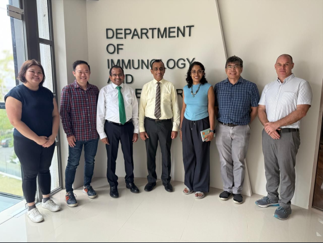
As part of validating the findings and further investigating the specific causes of severe dengue, Dr Teo and Assoc Prof Yeo have established partnerships with the University of Sri Jayewardenepura in Sri Lanka and OCRU.
These collaborations are built on a foundation of equitable and two-way knowledge exchange. By accessing on-the-ground epidemiological data that cannot be replicated in Singapore’s well-controlled setting, the researchers are able to ensure that their findings and tools are suitable to heterogeneous populations and robust enough for resource limited environments.
Building on these findings, the LKCMedicine team plans to develop an integrated test capable of detecting NGAL, suPAR and dengue proteins in a single urine sample. The long-term goal is to create a tool that could allow patients to monitor their condition in primary care settings.
“This breakthrough by Dr Teo and Associate Professor Yeo exemplifies LKCMedicine’s commitment to translating impactful research into scalable, non-invasive clinical solutions, seamlessly complementing Singapore’s robust dengue initiatives while building the regional partnerships necessary to transform epidemic management across Asia,” remarked Professor Laurent Rénia, Director of LKCMedicine’s Respiratory and Infectious Diseases Research Programme.