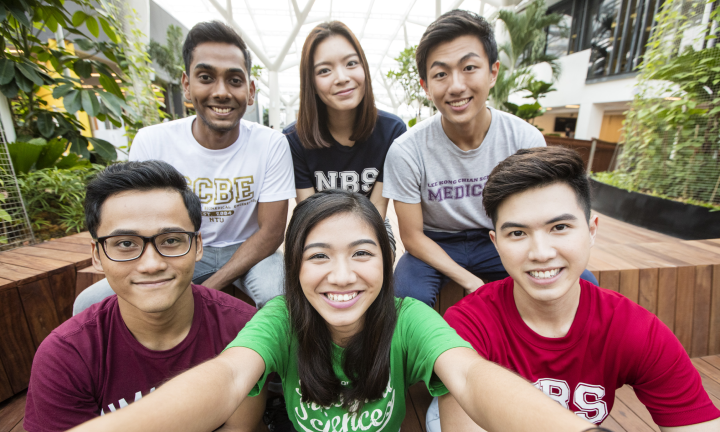
Ranked 1st in Asia and 4th in the World for Communication & Media Studies, the Wee Kim Wee School of Communication and Information (WKWSCI) offers a comprehensive and hands-on Communication Studies experience for aspiring media professionals.
Our Bachelor of Communication Studies with Second Major in Business (Honours) programme gives you the flexibility to focus on one or more areas, including Strategic Communication, Broadcast Media & Cinema Studies, Data Science and Media Studies, or Journalism and Media Policies. The curriculum combines traditional and new media courses, providing a strong foundation while preparing you for the rapidly evolving media landscape.
At WKWSCI, learning goes beyond the classroom. With state-of-the-art facilities, industry placements, and overseas opportunities, you gain real-world experience that mirrors the demands of professional media environments.
Discover our Experiential Learning opportunities here!
The programme equips you with skills for a wide range of careers—from strategic planning, advertising, and analytics to journalism, media production, and public relations. Even outside the communications field, your versatile skillset gives you a competitive edge across industries.
Graduates leave WKWSCI ready to make an impact in creative, journalistic, research, and professional fields worldwide, armed with a qualification that opens doors to limitless opportunities.
Bachelor of Communication Studies with Second Major in Business
The CSBU programme is a distinctive offering at WKWSCI, available only at the point of admission. It allows you to enjoy the full Communication Studies experience while simultaneously pursuing your interest in Business.
As a CSBU student, you will take selected courses from the Nanyang Business School as part of your Broadening and Deepening Electives, fulfilling the requirements for your Second Major in Business. This unique combination equips you with strong communication expertise alongside business acumen, preparing you for versatile careers across corporate, media, and entrepreneurial sectors.
Singapore-Cambridge GCE ‘A’ Level
If you are applying using the Singapore-Cambridge GCE 'A' level Examination in the English medium, you need to obtain the following:
- H1 level pass in Mathematics or O’ level/equivalent pass in Additional Mathematics
- B grade in General Paper (GP) / Knowledge & Inquiry (KI)
- At least two passes in subjects at H2 level
Diploma awarded by a Polytechnic or equivalent institution in Singapore
You may apply under this category if you are presenting a diploma from
- One of the five local polytechnics in Singapore namely:
- Nanyang Polytechnic
- Ngee Ann Polytechnic
- Republic Polytechnic
- Singapore Polytechnic
- Temasek Polytechnic
- Nanyang Academy of Fine Arts (NAFA)
- LASALLE College of the Arts
- BCA Academy
- National Institute of Early Childhood Development
- Institute of Technical Education (Work-Study Diploma [WSDip])
- Singapore Sports School – Auckland University of Technology (Diploma in Sports Management & Exercise Science only)
International Baccalaureate Diploma
- Mathematics at Standard Level
- Good grade in English at Standard Level
NUS High School Diploma
- Major CAP of 2.0 in Mathematics
- Good Overall CAP in English Language
International and Other Qualifications
- Additional Mathematics at Junior High School Level
- Good grade in General Paper/English at Senior High School Level
For more information on other admission types, please visit NTU Undergraduate Admission.
All polytechnic diploma holders from the five local polytechnics listed below are eligible for exemptions of up to 12 Academic Units (AUs).
- Nanyang Polytechnic
- Ngee Ann Polytechnic
- Republic Polytechnic
- Singapore Polytechnic
- Temasek Polytechnic
Exemptions are only given for non-communication courses under the Broadening and Deepening Electives category. All exempted courses do not carry any grades and will not be included in the computation of cGPA.
This is an opt-in exercise and all eligible students will receive further instructions closer to the start of their first semester.
Students who wish to be granted exemption for the business foundation courses, please refer to NBS for more information. All eligible students will receive instructions on this closer to the start of their first semester. The exemption is done on a case-by-case review, subjected to NBS’ approval.
Year 1: Foundation Courses
In the first year, students will take core courses and electives
of their choice. By receiving an interdisciplinary education, you will be
equipped with the fundamentals of theoretical knowledge and practices to
prepare you for your further progression.
Year 2: Choose a Specialisation & Overseas Exchange
Opportunities
In Year 2, students can choose to take electives in areas of
study of their choice, with the option of going aboard as part of a
semester-long exchange programme in semester 2.
Year 3: Electives & Professional Internship (PI)
When students return in Year 3, they will continue with
electives. In semester 2, all students will embark on a 22-week Professional
Internship where you will gain first-hand insights to the industry and build up
a personal network of contacts prior to graduating.
Year 4: Electives & Final-Year Project (FYP)
Final-year students embark on their capstone
projects. Many of the projects will achieve a reach wider than just the school,
receiving national and international accolades.
Students are required to complete a total of 127 AUs during their entire candidature period. The AU requirements of the various Course Types are as follows:
Students Admitted from AY 25-26
| Major Requirements | Interdisciplinary Collaborative Core (ICC) | Broadening and Deepening Elective (BDE) | Total AUs | ||||
|---|---|---|---|---|---|---|---|
| Core | Prescribed Electives | Common Core | Professional Series | Care, Serve, Learn (CSL) | Business Electives | Other Electives | |
| 20 | 41 | 14 | 18 | 3 | 30 | 1 | 127 |
Students Admitted between AY 21-22 and AY 24-25
| Major Requirements | Interdisciplinary Collaborative Core (ICC) | Broadening and Deepening Elective (BDE) | Total AUs | |||
|---|---|---|---|---|---|---|
| Core | Prescribed Electives | Common Core | Foundational Core | Business Electives | Other Electives | |
| 20 | 41 | 17 | 17 | 30 | 2 | 127 |
To meet the graduation requirement, students are also required to complete at least 69 Graded AUs from the total 127 AUs requirements.
The detailed curriculum for Communication Studies with Second Major in Business can be found below:
The undergraduate course listing can be found at this link.
Graduates from WKWSCI are highly sought after by leading organisations in Singapore and globally. Our alumni have built careers in diverse sectors, including:
Public Relations & Corporate Communications – Roles such as PR managers, corporate communications specialists, and media relations officers.
Marketing & Advertising – Positions like marketing executives, brand managers, and advertising consultants.
Media & Journalism – Opportunities in journalism, broadcasting, and digital media production.
Communication Research & Analytics – Careers in media research, audience insights, data analytics, and strategic communications research.
Event Management & Strategic Communications – Roles in event planning, stakeholder engagement, and crisis communications.
Business & Corporate Roles – Positions in management consulting, corporate strategy, business development, and entrepreneurship.
Even beyond the communications field, the versatile skill set developed at WKWSCI provides a competitive edge across industries. Our alumni network spans the globe, empowering changemakers worldwide.
Academic Integrity
The foundation of good academic work is honesty. Maintaining academic integrity upholds the standards of the University. The responsibility for maintaining integrity in all the activities of the academic community lies with the students as well as the faculty and the University. Academic dishonesty affects the University’s reputation and devalues the degrees offered.
Please refer to this list for more information.
FAQs
Please refer to this link for a list of Frequently Asked Questions (FAQs).