Pushing the Frontiers of Quantum Decomposition
Fourth-year students at the School of Physical and Mathematical Sciences (SPMS), Nanyang Technological University, have the opportunity to embark on Final Year Projects (FYPs) that challenge their understanding of scientific concepts while encouraging them to pursue original research. These projects often go beyond the classroom, drawing from cross-disciplinary interests to tackle real-world complexities in science and technology. Benchmarking of Quantum Gate Decomposition Frameworks with an Extension of Using Probabilistic Models

Dev Verma, Year 4, Applied Physics
Supervisor: Professor Gu Mile
What’s your project about – in a nutshell?
In our current age of noisy quantum hardware, the importance of efficient decomposition of abstract quantum operations down to the basis gate set that a quantum hardware can understand could not be understated. Bad decomposition leads to verbose circuits, which just cannot be run on noisy and error-prone hardware that we have today.
My project explored how different publicly available systems like IBM’s Qiskit and Classiq compare in their decomposition performance. However, I also wanted to do something new. With the rise of AI and machine learning models, I wondered if decomposition could be learned by an ML model, and if that could lead to efficiency we haven’t even come close to yet. My results indicated that this genesis of thought is a promising direction, and I intend to explore it more robustly with more nuanced learning models post-FYP.
What sparked the idea for this project?
I love playing chess, and as such, I occasionally read up about how chess engines solve this highly complicated game. Akin to a quantum system, chess has a massive state space (the space of all possible move sequences), and traditionally, classical chess engines are trained on grandmaster games and as such, they perform like grandmasters if they had more computational resources.
However, an alternate approach has emerged in recent times with the growing use of AI chess engines that are simply plunged deep into the game of chess with only the rules to guide them. Surprisingly, they often discover moves no human (or by extension, a classical chess engine) would most likely find. As I was benchmarking, I wondered if a learning model applied to quantum gate decomposition could find decompositions that we, with our deterministic and mathematical methods, are not (yet) able to find.
How did your project evolve from idea to outcome?
The first step was to begin my foray into the field of machine learning to better learn how I could use a learning model in the context of quantum gate decomposition. However, learning through lectures and course notes seemed too slow at the time, and I figured that the best way to learn is to do; and so, I dived head-first into Hidden Markov Models, which are sequential, unsupervised learning models.
“What impresses me most is how Dev taught himself Hidden Markov Models completely on his own volition. This kind of initiative is exactly what drives real breakthroughs.” – Professor Gu Mile, Supervisor
What was a tough/challenging moment, and how did you work through it?
The first time I got reasonable output from my model, the fidelity (or accuracy) of my decomposed sequence was 0.1%; in other words, my output was essentially gibberish. Improving the model’s performance was a textbook science experiment – finding out the different independent variables I could play with and tracking how they changed my dependent variable – the fidelity of my model’s output.
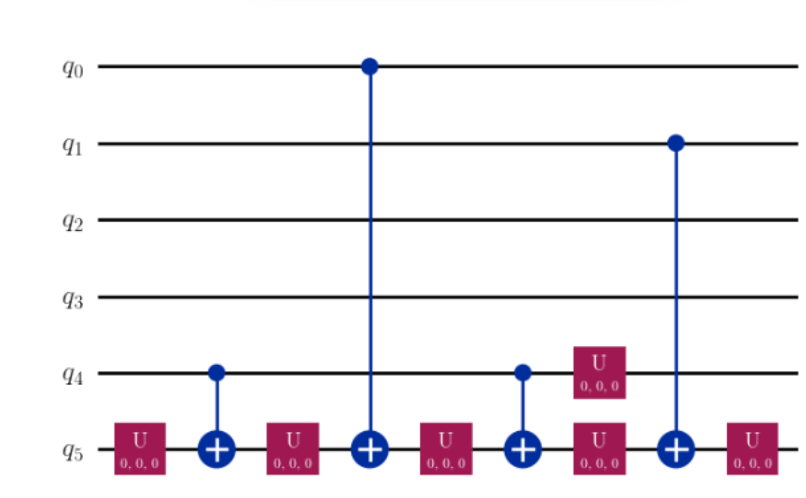
Figure 1. This is one of the decomposed circuits generated by my probabilistic model for a 5-control MCX gate (multi-control NOT gate). Enjoy the colours, just don’t ask me how accurate it is!
What was the most fun or satisfying part of doing this project?
The extension to my FYP (this exploration of probabilistic models for gate decomposition) was the most enjoyable part as it was an embodiment of the spirit of scientific pursuit – being confronted with something unknown and using our faculties to make sense of it. The most satisfying part was when my model output reached a fidelity of 37%. It was a confirmation that my direction of thought held some promise, and I’m enticed to continue exploring with more nuanced machine learning and AI models post my FYP.
One thing you learned – about the topic, or yourself?
The topic – I learned practically everything in my FYP as I went through the research project. I am lucky to have had Prof Mile’s supervision and my PhD friend Jianjun’s guidance to keep me on track.
Myself – I rediscovered the spark that first led me to physics. It is the exhilaration of approaching the unknown with an attitude of a scientist that motivates me to go deeper and deeper into quantum physics and computing.
Any advice for students starting their own final year project?
The best advice I can give is to try and connect disparate spheres of interests together and see what happens. The chemistry of thoughts can often result in explosive, fragrant ideas.
-with-the-super-resolution-microscope-developed-for-this-research-work-dr-giorgio-adamo-(top-right)-and-professor-nikolay-i-zheludev-(bottom-right)beeb24fa-d066-4cf7-ac50-8a7437ee4e77.tmb-listing.png?sfvrsn=f3d77414_1)