Seismic Tomography Reveals Structure and Stress Influence Earthquake Rupture
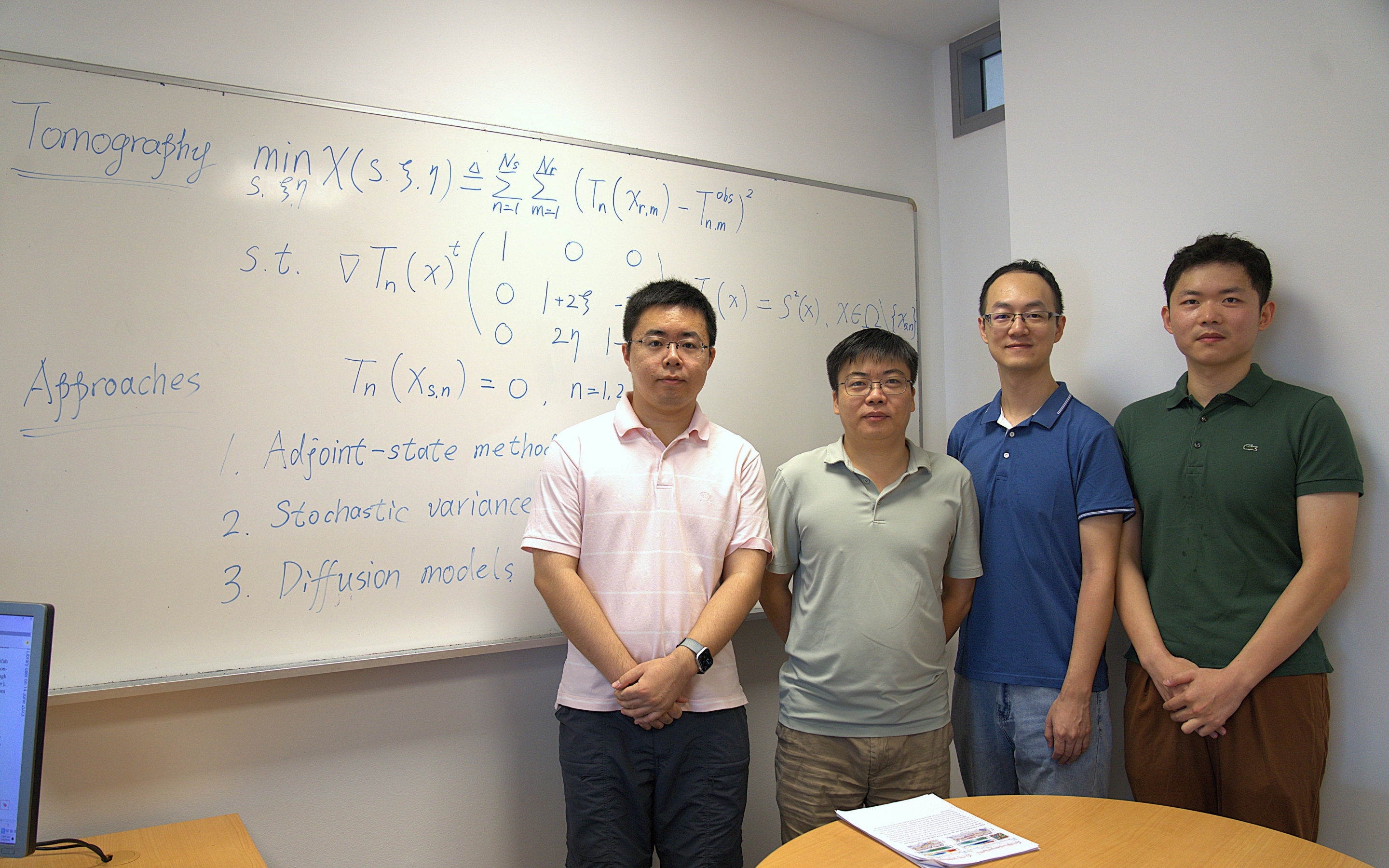
From Left: NTU Research Fellow Dr Hao Shijie, Associate Professor Tong Ping, NTU Research Fellow Dr Chen Jing and NTU Research Fellow Dr Bai Yiming.
Earthquakes occur when stress builds up in the earth’s crust and is suddenly released, often causing severe damage and loss of life. The extent of this damage can depend on deep underground geological structure that determines how quickly ruptures propagate and how strong they vibrate.
Detailed mapping of underground structure, however, is challenging and is a prototypical example of an “inverse problem”. Traditional modelling allows to estimate seismic wave patterns from a known geological structure. In contrast, inverse problems ask a different question: given the wave pattern what is the geological structure? This involves mapping out geological structure beneath the surface from, often, indirect seismic data. This inverted process is far more challenging since multiple model geological structures can produce similar seismic wave patterns.
A team of applied mathematicians at the Nanyang Technological University Singapore, led by Associate Professor Tong Ping, have developed an effective mathematical framework to extract out detailed maps of subsurface geological structure from seismic data. They do so by tracking how waves travel anisotropically (waves that do not propagate uniformly with the same speed in all directions) to decipher key features in the geological structure. They applied this methodology to a recent set of major earthquakes in Turkey and Syria in 2023 and uncovered how a set of geological structures led to a supershear (high speed) rupture that resulted in devasting damage and loss of life. This study was published by Nature Geoscience in January 2026, titled “High normal stress promoted supershear rupture during the 2023 Mw 7.8 Kahramanmaraş earthquake”.
Tracking waves through the earth
Traditional seismic tomography often trace seismic rays (the path that a seismic wave takes as it travels) in order to determine the underlying geological structure. By understanding the path a seismic ray takes, a geological structure can be mapped. Tracing such rays computationally, however, can be unstable in complex geology: algorithms often trace out the shortest path in small local regions that tend to distort the complex non-uniform geological structure over long distances. This is further exacerbated in anisotropic geology where seismic waves can propagate with different speeds in different directions. As a result, ray tracing can lead to inaccuracies particularly in mapping out non-uniform geological formations.
Instead of tracing individual paths of seismic rays, the NTU team solved wave propagation using an anisotropic Eikonal equation that allows to model the travel time for the seismic waves to propagate in space. “We solve the anisotropic Eikonal equation using the fast sweeping method, achieving stable convergence and highly accurate travel-time calculations across the entire model,” says Prof. Tong Ping. Unlike ray tracing, such travel times are in fact directly measured at seismic recording stations where arrival times of the seismic wave after an earthquake is recorded. The NTU team used their anisotropic Eikonal equation simulations of arrival times across space and compared it with the recorded arrival times at seismic stations as data inputs to estimate the nonuniform velocity and anisotropic propagation of seismic waves across the geological structure.
Anisotropic patterns flag geological stress
Key to the researcher’s new method was the ability to track seismic anisotropy: dependence of the wave speed on propagation direction. Such anisotropies are particularly useful because they can indicate geological fracture openings and closures, or stress and strain of the rocks or even subsurface fluid (e.g., magma).
By mapping the seismic anisotropy using data from a set of recent 2023 earthquakes that ruptured along the Eastern Anatolian Fault in Turkey and Syria, the researchers were able to identify regions of fluid (e.g., magma) infiltration: these are regions where subsurface magma may flow that increases fluid pressure on the fracture. Increased fluid pressure reduces the effective normal stress acting on the fault, making it easier for the fault to slip slowly. This can inhibit the build-up of stress that would otherwise facilitate more destructive supershear ruptures.
Using their algorithms, the researchers also identified a region of enhanced stress in the northeast of the geological fault and demonstrated how it leads to supershear ruptures. “Our work addresses an open question in the field: do structural features control the occurrence of supershear ruptures?” says Chen Jing, first author of the paper and a Research Fellow in the School of Physical and Mathematical Sciences, “Enhanced normal stress inhibits fluid infiltration, which favors shear stress accumulation and facilitates supershear ruptures.”
“Our results demonstrate that subsurface fault structure plays a critical role in determining whether a rupture can transition to supershear speed” adds Prof Tong Ping, “thereby advancing our physical understanding of supershear earthquake mechanisms.”
The new tomographic method demonstrates how a change in modelling perspective enables to unearth new features in seismic data previously challenging to obtain. “This work was initially motivated by a long-standing interest in using mathematics to solve real-world problems. We found that by switching to directly modelling the travel times we could describe realistic seismic anisotropies and obtain direct geophysical insight into supershear ruptures.” says Chen Jing.
Looking forward, the team anticipates applying their methodology to other fault systems world-wide, Prof. Tong Ping says “This approach can be applied to major fault systems worldwide to assess their potential for supershear rupture, thereby contributing to improved earthquake rupture modeling and hazard assessment”.
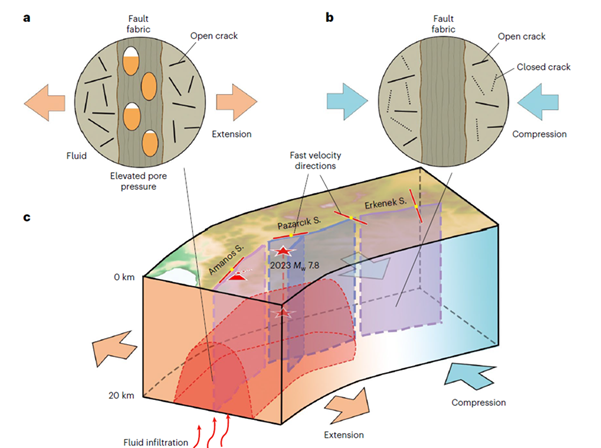
Figure. Structure of the magnitude 7.8 earthquake rupture. a. When the crust is pulled apart, fluid-filled cracks along the fault allow seismic waves to travel faster along it. b. When the crust is squeezed, cracks parallel to the fault close and block fluids, causing seismic waves to travel faster perpendicular to the fault. c. Illustration of the crustal structure beneath the magnitude 7.8 earthquake rupture zone.

-with-the-super-resolution-microscope-developed-for-this-research-work-dr-giorgio-adamo-(top-right)-and-professor-nikolay-i-zheludev-(bottom-right)beeb24fa-d066-4cf7-ac50-8a7437ee4e77.tmb-listing.png?sfvrsn=f3d77414_1)