Light is Never Straightforward
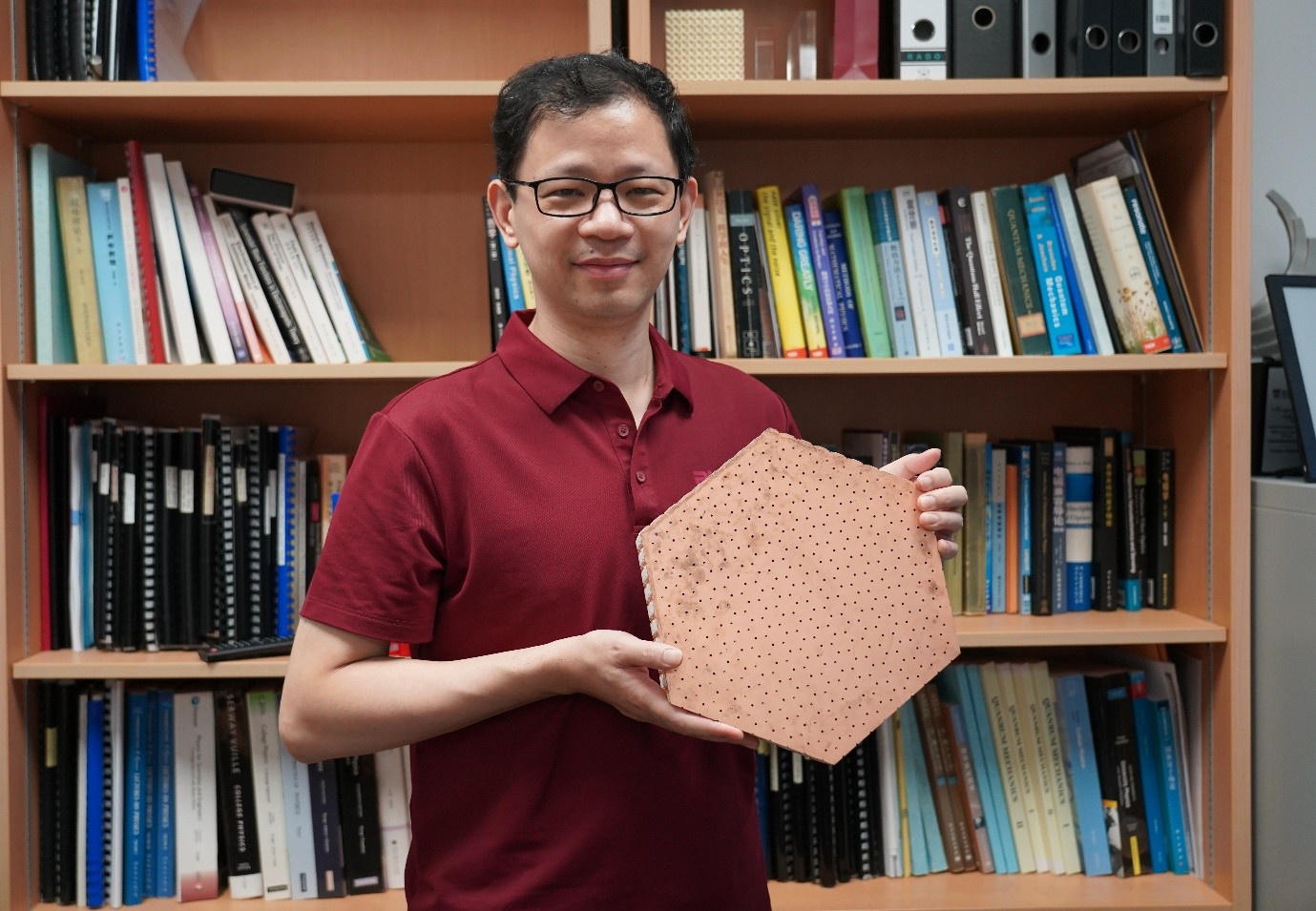
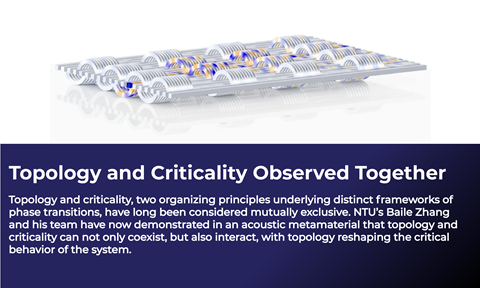
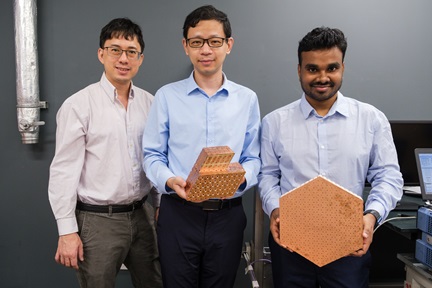
Professor Baile Zhang with the photonic axion insulator, which guides electromagnetic waves along its hinges in a zigzag network.
An electromagnetic wave travelling through one of Professor Baile Zhang’s engineered structures can take an unexpected route. At certain frequencies, it may move along a surface while the interior blocks its passage or follow a one-way path along the line where two surfaces meet. These routes arise from how the structure’s components work together. Understanding how to create and control them has become a central thread of Professor Zhang’s research at Nanyang Technological University (NTU), Singapore.
Working in NTU’s School of Physical and Mathematical Sciences (SPMS) and its Centre for Disruptive Photonic Technologies (CDPT), Professor Zhang has helped develop an expanding programme in topological photonics. Photonics is the science of generating and controlling light. Here, it also encompasses experiments with microwaves, which belong to the same electromagnetic family as visible light. Their longer wavelengths allow him to build larger structures whose wave behaviour is easier to measure.
His earlier research on engineering invisibility cloaks provided a foundation in transformation optics, an approach that uses specially designed materials to redirect electromagnetic waves. His work at NTU takes a different tack. Instead of making objects vanish from sight, he makes light move only in one direction: using topology, the mathematics of properties that remain unchanged when materials are deformed.
Guiding Light Around Obstacles
A key challenge in guiding light is preventing it from scattering or reflecting backwards when it encounters an obstacle or defect. Inside a photonic chip carrying information, even a small fabrication defect can disrupt a signal. More dependable routes could help signals negotiate tight bends and imperfect structures, potentially enabling more compact optical circuits.
One possible solution draws on a discovery in solid-state physics: some materials block electrical conduction in their interiors while allowing electrons to travel along their boundaries even when there are impurities that may ordinarily scatter and dissipate propagation. These conducting paths arise from the topology of the electrons’ collective wave behaviour.
Professor Zhang’s team engineers related effects for electromagnetic waves. Instead of topological electronics, his team studies topological photonics and acoustics – the control of light and sound. In some structures, a photonic or acoustic wave travelling along a boundary has no equivalent channel in which to travel backwards. It can therefore continue around an obstacle, provided the disturbance does not destroy the conditions supporting that channel. The strength of that protection depends on the type of photonic system.
Professor Zhang recounts how he first learned of topology from his fellow NTU Professor Yidong Chong. “Yidong and I both graduated from the Massachusetts Institute of Technology (MIT) in the same year, but we had never met before. We started talking after we both joined NTU” says Professor Zhang. “I learned a lot from him, as he approached physics from a very different angle and context.”
That context was topology; Professor Yidong Chong had helped pioneer the field of topological photonics while a graduate student at MIT. At NTU, they frequently work together and have demonstrated how different defects affected waves travelling along the boundary of an engineered structure. Some obstacles could be bypassed, but others caused reflection or absorbed the waves. The results showed that protection mechanisms developed for electrons cannot always be transferred directly to light. They also demonstrated an important distinction: preventing backward reflection does not prevent energy loss. Understanding these limits is essential for designing dependable photonic components.
Exploring Waves in Three Dimensions
A major step was extending this control from the edges of flat structures to the surfaces of three-dimensional crystals. Previously, topological photonics were largely confined to two-dimensional photonic crystals. This was challenging because moving to three dimensions meant controlling the propagation of light waves in all three spatial dimensions. Professor Zhang and his collaborators overcame this limitation with a structure that strongly coupled electric and magnetic responses allowing them to build photonic crystals in three dimensions.
The team built both non-magnetic and magnetic three-dimensional topological photonic crystals. While the former supported reciprocal propagation, the latter produced chiral waves along its surface – able to easily navigate past sharp bends and obstacles. To describe this behaviour, the team used a Chern vector: a set of three topological numbers that extends a familiar two-dimensional description into three dimensions. These numbers connect the crystal’s internal wave properties to the behaviour of waves on its boundaries. Applying an external magnetic field allowed the researchers to change the crystal’s topological properties and associated surface states. Magnetism therefore offered a way to control how electromagnetic waves could travel across the crystal.
The achievement created a controllable setting for investigating a three-dimensional topological phase that had been previously difficult to explore experimentally. Such control also points towards reconfigurable ways of routing electromagnetic signals, although translating these experiments into compact devices remains a further step.
Creating Narrow Paths for Waves
Beyond guiding waves along a structure’s surfaces, Professor Zhang investigated how to confine waves in smaller regions. In an approach known as higher-order topology, a structure can support waves along the lines where surfaces meet or concentrate them at corners. His group explored these effects using both sound and electromagnetic waves.
In one three-dimensional photonic crystal, the team measured waves confined along hinges – the lines where two surfaces meet. These channels offer a possible way to guide signals along narrow routes through future devices. At corners, topology can instead produce localised resonances, in which wave energy builds up in a small region. This is useful for components such as lasers, which need light to build up inside a cavity. The work therefore offers ways both to guide light between components and to concentrate it where a device needs it.
Zigzag Paths into Fundamental Physics
The three-dimensional research led to further advance with a photonic axion insulator, developed by Professor Zhang, Professor Chong and an international team. The engineered crystal reproduced aspects of axion electrodynamics, a theory connected to hypothetical particles that are candidates for dark matter. Electromagnetic waves travelled in one direction along its hinges, forming a zigzag network through three dimensions.
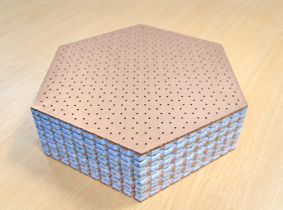
Figure 1: Photonic axion insulator made in Professor Zhang’s lab. Light propagates in a zig-zag network pattern when travelling across this exotic topological photonic crystal.
“Axions were originally proposed in particle physics and are considered as a promising candidate for dark matter,” says Professor Zhang. “However, we did not create real axions. Instead, we engineered a three-dimensional photonic crystal, whose electromagnetic response is governed by equations that are similar to axionic behaviour.”
Its importance lies in making unusual electromagnetic behaviour accessible in a controllable experiment. Real axions have yet to be detected, but the structure offered a way to examine related physics and develop more complex networks for one-way wave transport.
Beyond guiding light, topological photonics offers means to access challenging physical phenomena that do not readily occur in nature. Photonics researchers can readily design intricate structures that control electromagnetic waves at room temperature. These contrast with topological electronics experiments often performed at millikelvin temperature (thousandths of a degree above absolute zero) and require specially synthesized materials.
This “designer” approach to topological photonic structures – as a simulacrum for exotic physics – permeates much of Professor Zhang’s work. Recently, he used engineered acoustic structures to probe the extreme limits of topology and criticality – two pieces of physics that do not typically coexist. This is because topology often requires spectral gaps; criticality typically appears when energy gaps close. Professor Zhang found that topological signatures persist even when an acoustic metamaterial was pushed to its critical point.
Towards Practical Devices
Alongside these fundamental investigations, some of Professor Zhang’s work have already taken the form of device demonstrations. With others at NTU, he has demonstrated an electrically powered terahertz laser. Terahertz radiation occupies a region of the electromagnetic spectrum between microwaves and infrared light. Within the laser, electromagnetic waves circulated around a triangular cavity with sharp corners. The laser continued operating when certain defects were introduced into the structure, demonstrating how topological guidance could be used in a working device.
In a separate collaboration, Professor Zhang and colleagues slowed electromagnetic waves over a broad range of frequencies while retaining resistance to backward scattering. Slower waves have more time to interact with a material. This could help to strengthen interactions between light and matter or develop compact devices that delay signals. Achieving slow propagation across a broad frequency range is particularly useful because conventional approaches often trade slower speeds for a narrower operating range.
These devices concretely demonstrate that the unusual “topological” wave behaviour can be useful for practical tasks: producing radiation, transporting signals and controlling their interactions. Turning the waves into widely usable technologies, however, requires several problems to be solved together.
“The biggest challenge in topological photonics is moving from elegant proof-of-concept demonstrations to realistic functions that are difficult to achieve with conventional photonics”, says Professor Zhang. “This requires overcoming several challenges simultaneously, including low optical loss, broadband operation, strong non-reciprocity and compatibility with chip fabrication.”
The topological photonic structures that Professor Zhang designs provide new tools to engineer the flow of light. Not in straight lines, but around bends and defects, sometimes in a zig and then a zag – but always without stopping to ask for directions.