Boosting the efficiency and stability of perovskite solar cells with inert materials
The innovative method brings perovskite solar cells one step closer to the market.
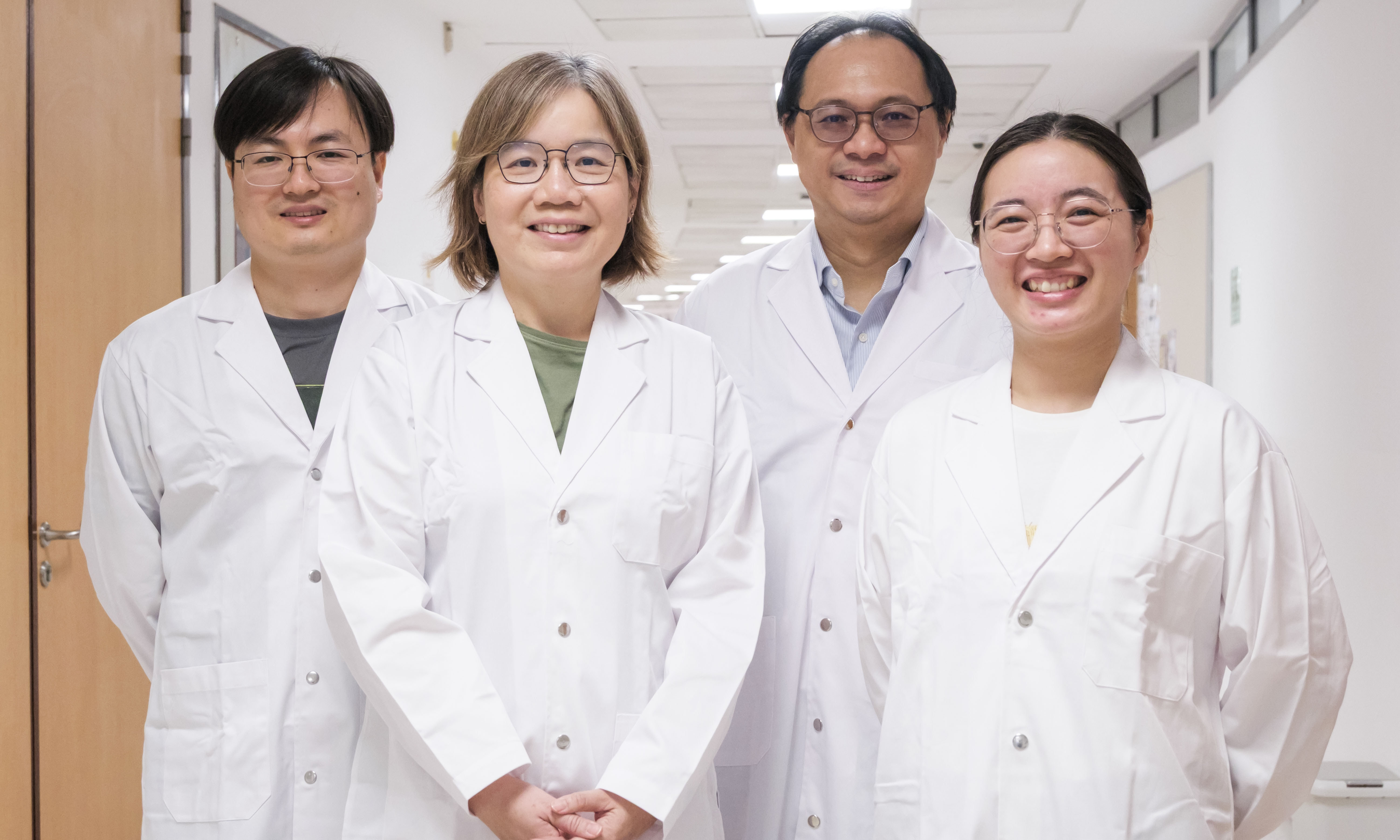 Making perovskite solar cells more stable: (from left) senior research fellow Dr Ye Senyun of NTU’s School of Physical and Mathematical Sciences; Prof Lam Yeng Ming of NTU’s School of Materials Science and Engineering (MSE); Prof Sum Tze Chien, Director of the Institute of Advanced Studies at NTU and Associate Dean (Research) of NTU’s College of Science and research fellow Dr Rao Haixia of NTU’s MSE.
Perovskite solar cells are a promising alternative to silicon-based photovoltaic technologies. However, their widespread adoption is limited by poor environmental stability, as perovskite materials degrade easily when exposed to oxygen, moisture, heat or light.
An innovation by scientists at Nanyang Technological University, Singapore (NTU Singapore) has made perovskite solar cells more stable and efficient, bringing the technology one step closer to market.
Their method expands the possibilities of using chemically inert materials to improve the stability of perovskite solar cells without compromising efficiency.
The research was published in Nature Energy in August 2025 and led by Prof Sum Tze Chien, Director of the Institute of Advanced Studies at NTU and Associate Dean (Research) of NTU’s College of Science, and Prof Lam Yeng Ming of NTU’s School of Materials Science and Engineering.
Engineering protective layers for perovskite solar cells
To protect perovskite solar cells from environmental degradation, an ultrathin interface layer typically made of highly reactive bulky cations – large positively charged ions – is often applied to the perovskite film. Although the cations readily react with perovskites to form a coating that provides good electrical conductivity, such interface layers have low stability due to their high reactivity.
On the other hand, chemically inert bulky cations can be integrated into the interface layers to produce a protective coating that offers both high stability and good electrical conductivity. However, this integration is limited by the low reactivity of such cations.
To overcome this challenge, the NTU team developed a strategy called selective templating growth (STG) to create chemically inert interface layers that combine high stability with good conductivity.
In this strategy, the team first deposited a layer of phenylammonium lead iodide (PA2PbI4) onto the perovskite surface. PA2PbI4 is usually used to protect the underlying perovskite layer to improve the performance of perovskite solar cells.
Then, a chemically inert bulky cation - 2-piperidin-1-ium-1-ylethylammonium (PiEA2+) - was introduced by spin-coating an alcohol-based PiEA2+ solution onto the PA2PbI4 layer. Through a controlled organic cation exchange process, in which PA+ is replaced by PiEA2+, a more stable ultrathin layer of (PiEA)PbI4 is formed.
This method of boosting the stability of perovskite solar cells with inert materials is one of several innovations that have emerged from the more than ten years of research collaboration between Prof Sum and Prof Lam.
“Our strategy enables access to a class of chemically inert interface materials that previously could not be used due to reactivity and solubility limitations, opening a new avenue for interface engineering in perovskite devices,” said Prof Sum.
Manufacturing highly efficient and stable perovskite solar cells
Using the strategy, the team fabricated a 1-cm2 perovskite solar cell prototype that achieved a power conversion efficiency of 25.1%, one of the highest reported for perovskite solar cells of this size. The device retained over 93% of its initial efficiency after 1,000 hours of operation, and 98% after 1,100 hours at 85 °C.

1-cm2 prototype perovskite solar cells (brown rectangles) fabricated with the STG strategy. Credit: NTU Singapore.
Beyond the prototype (PiEA)PbI4 interface, the strategy also enables the formation of a wide variety of chemically inert interfaces. Importantly, being fully solution-based, the approach is compatible with industrial techniques for coating large areas, such as blade-coating, paving the way for large-scale fabrication and practical deployment.
“Our strategy provides a versatile and scalable interface design platform. It can be extended not only to the manufacturing of lead-free perovskite solar cells, but also to other perovskite optoelectronic devices such as light-emitting diodes and photodetectors.” added Prof Lam.
The researchers are collaborating with companies to manufacture full-sized solar panels and bring the technology one step closer to commercialisation.
Read more in “Selective templating growth of chemically inert low-dimensional interfaces for perovskite solar cells”, Nature Energy (2025), DOI: 10.1038/s41560-025-01815-8.