New method to boost X-ray imaging
Discovery paves the way for smaller and more flexible machines for bioimaging
.jpg?sfvrsn=57e7d9a3_1) Graphite on a sample holder being loaded into a field emission scanning electron microscope for the NTU team’s X-ray experiments. Credit: NTU.
Graphite on a sample holder being loaded into a field emission scanning electron microscope for the NTU team’s X-ray experiments. Credit: NTU.
NTU researchers have found a new way to produce X-rays with wavelengths in what is called the “water window”. This new method holds promise in making bioimaging X-ray machines smaller and more flexible.
Water-window X-rays are useful for bioimaging because they visualise biological cells at high contrast without staining them or requiring potentially damaging preparation.
However, some tabletop machines only produce radiation in a fixed range of energies, so more machines are needed if X-rays of varying energies are required to improve image contrast. Even then, they cannot cover the full spectrum of energies in the water window. There are single machines that can flexibly produce X-rays of different energies, but these are expensive synchrotrons larger than a house and difficult for most researchers to access.
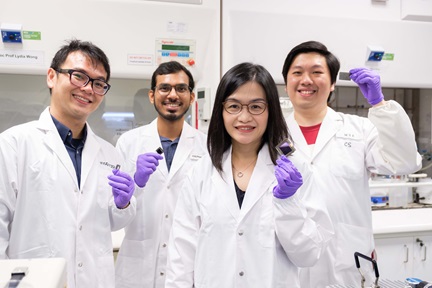
Scientists led by Assoc Prof Wong Liang Jie from NTU’s School of Electrical and Electronic Engineering addressed these difficulties by showing that water-window X-rays of varying energies can be produced using thin flakes of graphite 10-170 nm thick in a table-sized set-up.
The team also showed that the energy of the X-rays can be precisely adjusted by changing the energy of an electron beam fired at the graphite to generate the radiation, as well as by tweaking the angle at which the graphite is tilted.
They achieved this by developing a framework that precisely accounts for the scattering of electrons fired at crystalline materials. The researchers also predicted and experimentally confirmed fundamental scaling laws governing the production of X-rays from shooting electrons at crystals.
---
Details of the study can be found in “Fundamental scaling laws of water-window X-rays from free-electron-driven van der Waals structures”, published in Nature Photonics (2024), DOI: 10.1038/s41566-024-01547-3.
The article appeared first in NTU's research & innovation magazine Pushing Frontiers (issue #25, August 2025).