Moving people forward: Prof Pu Kanyi
Prof Pu is breaking ground in molecular imaging and the use of chemistry to advance health.
.jpg?sfvrsn=7ce27378_1)
Certain biomolecules are produced in greater quantities in diseased tissues than healthy ones. This difference allows scientists to detect damaged areas by injecting imaging dyes that “stick” to these biomolecules and accumulate where the disease is present.
By shining an invisible light like near-infrared radiation on the patient, the dyes glow, allowing doctors to find the diseased tissues.
“You will be able to know when, where and how to treat a disease at the right dosage and at the right time,” explains Prof Pu Kanyi from NTU’s School of Chemistry, Chemical Engineering and Biotechnology, and the Lee Kong Chian School of Medicine. “So, using light, we can guide therapy.”
Unfortunately, the current process causes some biomolecules in nearby healthy tissues to light up at the same time, creating background noise that makes it harder to detect the glowing damaged tissues.
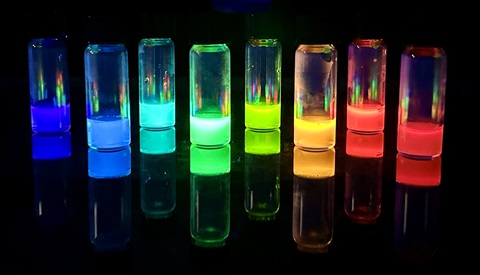
A breakthrough by Prof Pu’s research team could minimise this issue. Tapping his interdisciplinary expertise in molecular imaging and chemical biology – the use of chemistry to advance health – his team developed organic molecules known as afterglow probes. Similar to dyes, these probes illuminate diseased tissues, but only after exposure to invisible light and a time lag.
The delay reduces the overlap between healthy and the damaged tissues lighting up, allowing the latter to be detected more accurately.
Prof Pu, who is also Associate Dean (Research) at NTU’s College of Engineering and President’s Chair in Biomedical Engineering, has expanded on this discovery.
“The afterglow probes my group developed are now 10 times more sensitive than existing clinical imaging methods, and could pave the way for detecting cancer early,” says Prof Pu, adding that the probes might help scientists better understand additional biological processes.
His team has gone a step further and produced afterglow probes that target and kill cancer cells in mice when triggered by X-rays or ultrasound. A Singapore hospital is exploring the feasibility of using one of the team’s probes to detect kidney damage in urine tests.
Prof Pu’s work in molecular imaging and chemical biology has earned wide recognition. He has been in Clarivate’s Highly Cited Researchers list every year since 2019. In 2024, he was appointed Executive Editor of the Journal of the American Chemical Society. He holds around 20 patents, including one licensed to Tokyo Chemical Industry for disease-detecting probes.
The article appeared first in NTU's research & innovation magazine Pushing Frontiers (issue #25, August 2025).