Quantum Optics Meets Correlated Electronic States by Prof Mohammad Hafezi
IAS Frontiers Seminars: Quantum Horizons, Seminar #3
On 3 November 2025, Prof Mohammad Hafezi (University of Maryland) shared his insights on correlated electron physics, an active and exciting field in photonics that delves into quantum many-body physics. The intriguing seminar aimed to unravel and explore the concept of itinerant electronic states and their exotic phases through the selective manipulation of light-matter interactions beyond the usual two-level picture.
The engaging talk was tailored to resonate with audiences at all levels, from undergraduates to postgraduates and faculty members, offering both clarity and insightful depth that appealed to everyone. By highlighting various recent advances in forefront material engineering (e.g., graphene, Transition Metal Dichalcogenides (TMDs)), Prof Mohammad motivated his venture by discussing plausible extensions to such materials, which harbour potential for next-generation optoelectronic technologies.
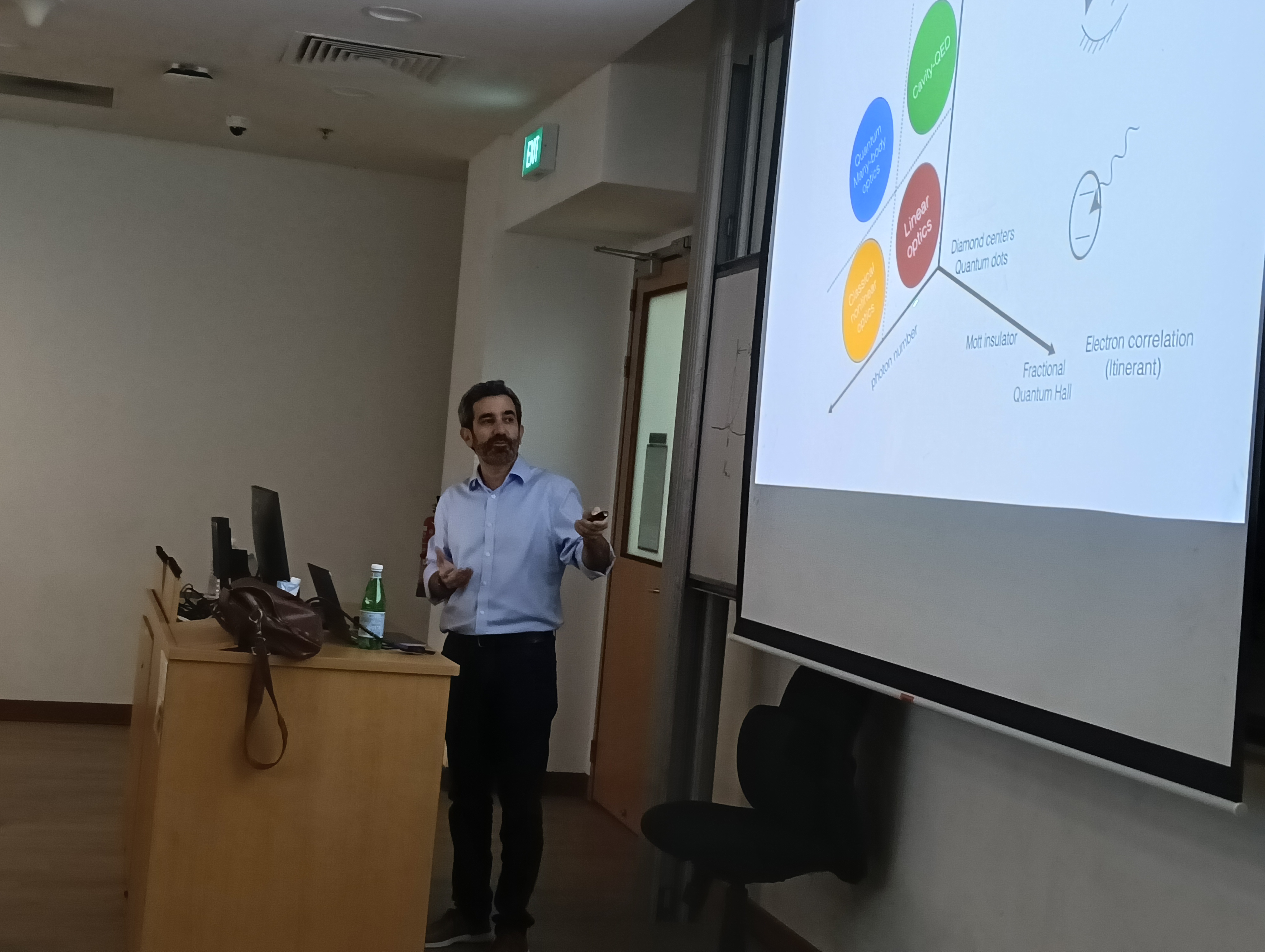 Prof Mohammad challenges the two-level model, exploring complex electron behavior and light-matter interactions.
At the start of the talk, Prof Mohammad posed a powerful yet simple question: Is the basic model in physics, the two-level (dipole) system description, sufficient to capture the complexity of itinerant electrons? He then proceeded to give relevant examples, citing the works of many other renowned researchers, that the usual treatment is too limited and breaks down in cases involving excitons in correlated materials, sub-wavelength optical lattices, and the strong light-matter coupling regime, all of which serve to probe electronic correlations.
By harnessing the tunability of 2D materials, Prof Mohammad discussed his recent group's findings, which showcased a heterostructure consisting of two popular TMDs, namely Tungsten Diselenide and Tungsten Disulfide, known for their unique electronic and optical characteristics. The lattice mismatch between these two monolayers gives rise to a Moiré pattern, and consequently, a superlattice emerges with desirable properties, such as a long excitonic lifetime on the microsecond scale, coupled with a strong magnitude of interaction ranging in the tens of millielectronvolts, making it a reliable tool for probing correlated electrons.
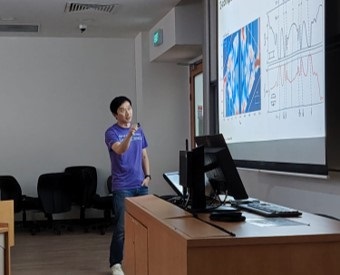
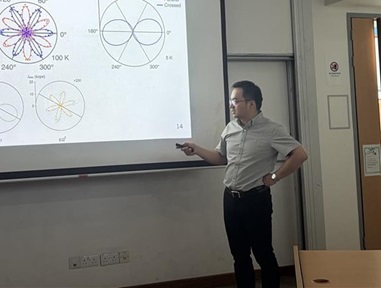
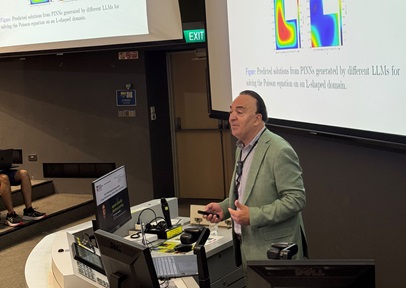
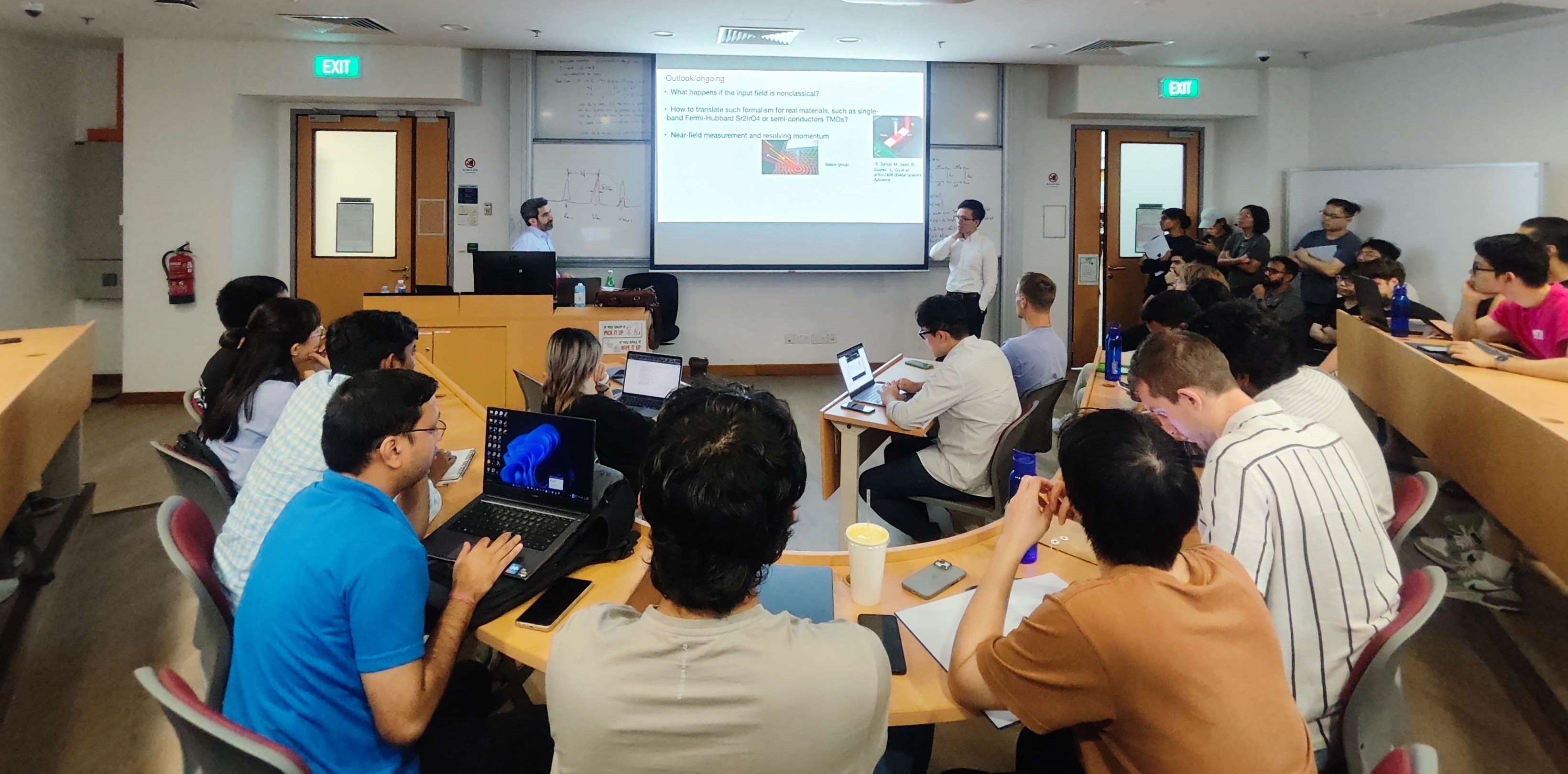 Prof Mohammad Hafezi explores exciton interactions and complex correlated electron physics with the packed seminar room of attendees.
The experiment features a photoluminescence (PL) pump, a common optical technique in which materials are illuminated with light, causing them to emit their own light in return. This emission is then analysed to study the material's properties. Prof Mohammad reported observations of strongly interacting excitons in the heterostructure and noted exciton diffusion near the Mott state filling factor. He then introduced his concept of "non-monogamous" excitons, which is a proposed mechanism where an excited hole in the valence band is not rigidly bound to a specific paired electron in the conduction band, which helped reconcile his experimental data.
This excitonic diffusion signature provides strong support for his claim that the two-level system is insufficient in describing the complexities of correlated electron physics. Prof Mohammad emphasised that the exciton is not merely a passive observer in these interactions but an active participant, influencing the behaviour of the system. This shift in perspective sets the stage for a deeper understanding of how interactions in these materials extend beyond simple models.
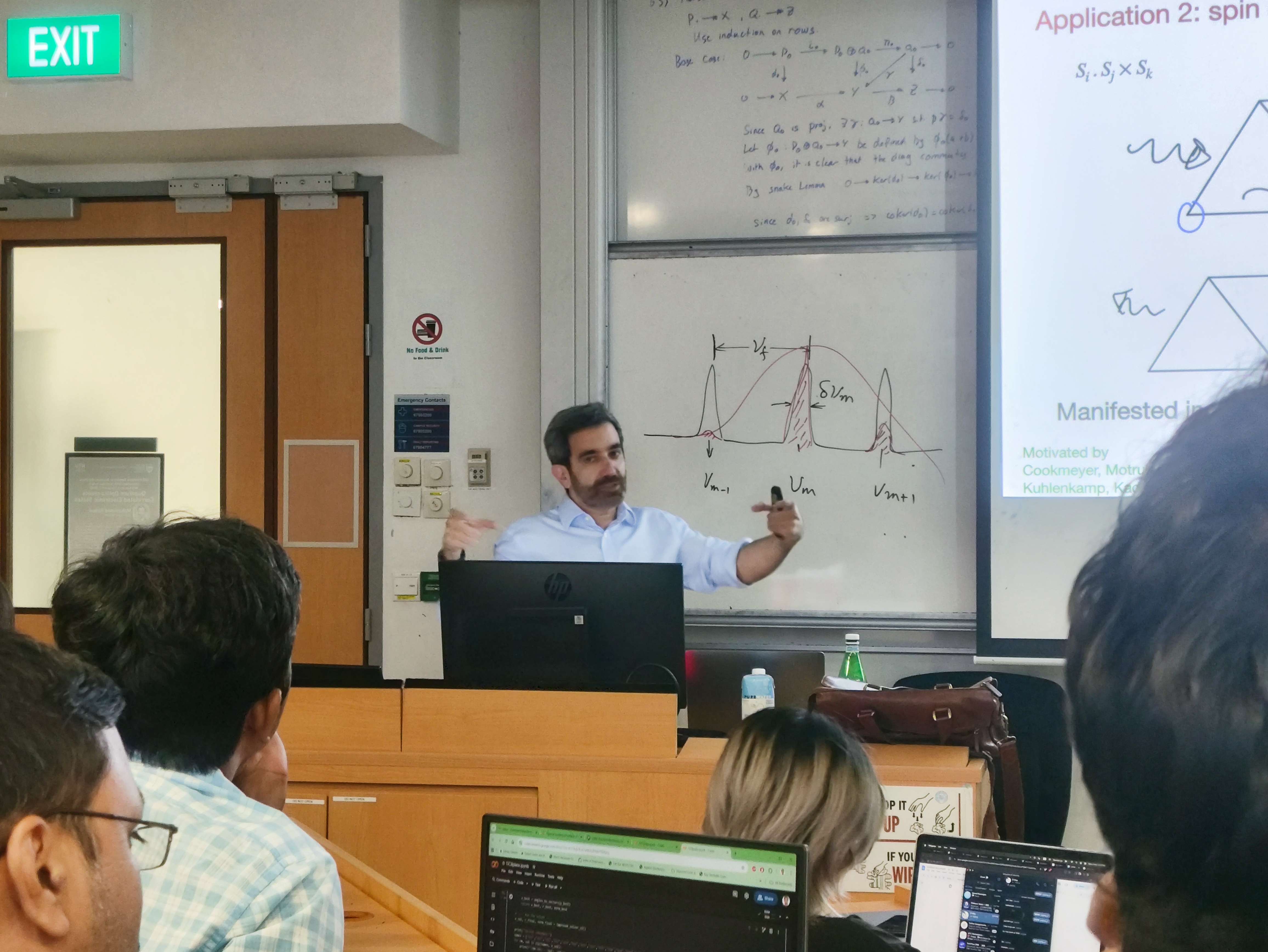 Prof Mohammad engages the audience with insights on fractional statistics, spin dynamics, and photon interactions.
In the next part of the seminar, Prof Mohammad discussed the idea of using a Fermi-Hubbard model at half-filling, which could unambiguously probe fractional statistics realised by optical engineering and detection of magnetisation. Since light does not couple to spin, he hypothesises that a system can absorb and emit photons in a multi-step process, such that the spin of electrons swaps sites. He followed up by giving three applications of these phenomena, which include measuring: 1) non-interacting magnons, 2) spin chirality, and 3) probing anyons, which could detect fractional statistics and provide an alternative to existing methods.
The audience actively engaged with Prof Mohammad during the Q&A, each sharing their unique and educated opinions. He approached each question professionally and light-heartedly, encouraging inputs from across the room and fostering fruitful discussion.
This seminar is part of the ongoing IAS Frontiers Seminars: Quantum Horizons series. Find out more about the upcoming seminars and register here.
Written by John Tan | NTU School of Physical and Mathematical Sciences
“I really enjoyed how the speaker connected optical engineering techniques with strongly correlated electron systems, especially the idea of using light to manipulate excitons and explore fractional quantum Hall–like phenomena in twisted WSe₂. The talk provided a fresh interdisciplinary perspective bridging quantum optics and condensed matter physics.” - Lee Zhe Weng (PhD Student, SPMS)
“While I am not in the quantum optics field, Prof Mohammad's presentation broadened my horizon regarding this topic.” - Chiu Kuan-Fu (PhD Student, SPMS)
"I enjoyed the way he introduced an alternate way of probing spin chirality" - John Tan (PhD Student, SPMS)
In the 4th talk of the series held on 1 December 2025, Prof Alberto Morpurgo (University of Geneva) presents how magnetotransport in 2D magnetic materials uncovers rich magnetic phase behaviour down to the ultimate limit of individual monolayers. Read more about Prof Alberto Morpurgo's talk, “ Probing 2D Magnetic Materials with Magnetotransport.”